
Wondering how to get around Buenos Aires? This guide to public transport in Buenos Aires will help!
If it’s your first time visiting Buenos Aires, you may be wondering what’s the best way to get around: taxis, rideshare, trains, on foot? What are the options?
Well, lucky for you, Buenos Aires is a super easy city to get around. Most neighbourhoods that visitors spend time in are compact and walkable, taxis and ride-shares are everywhere, and the public transport network is extensive and affordable.
In this guide, I’ll walk you through public transport in Buenos Aires and how each operates, as well as the best rideshare options. By the end, you’ll know whether to grab the subte, hop on a colectivo or just call an Uber – and you’ll be travelling around Buenos Aires in no time.
This blog post may contain affiliate links, meaning if you book or buy something through one of these links, I may earn a small commission (at no extra cost to you).
Airport transfers in Buenos Aires
First up, let’s talk about what to do when you first arrive in Buenos Aires. You need to know that Buenos Aires has two airports:
- Ezeiza International Airport (EZE) is the main international airport and it’s well outside the city. Transfer times depend heavily on traffic but it can take anywhere from 45 minutes to 1.5 hours to get to the heart of Buenos Aires.
- Aeroparque Jorge Newbery (AEP) is in Palermo, so it’s much closer to the city centre. This airport is used for domestic flights and some regional/intercontinental international routes. This is by far the easiest airport to fly into if you can make it work.
Important! If you’re flying into Ezeiza and then connecting to a domestic flight out of AEP, make sure you have plenty of time for the connection to account for traffic. If you can, I’d avoid flying into Ezeiza and out of Aeroparque (or vice versa) on the same day, just in case!
From either of the two airports heading into the city, if you want the simplest, least stressful arrival, ride-sharing is hard to beat. Both Uber and Cabify operate at EZE and AEP. Just book your ride as you normally would, then follow the pick-up instructions (either in the app or the airport directional signage).
Taxis are another option – but you’ll probably need cash. While taxis are increasingly accepting credit cards, cash is generally the preferred payment method. There are always plenty of taxis outside both airports – just follow the signs to the taxi stand.
You can also arrange a private, pre-paid transfer. This is a great option if you’re travelling with a group of people or have a lot of luggage.
Airport shuttle bus
If you want a transfer that’s cheaper than a private car, Tienda León runs bus and minibus services connecting both airports with the city. The bus stop is in Recoleta, just off Avenida 9 de Julio. From there, you’ll need to make your own way to your hotel. Services run every hour between 6am and 10pm.
They also operate direct transfers between both EZE and AEP airports.
Taxis and ride-sharing in Buenos Aires
For me, if you’re in Buenos Aires for a short time (say, 3 days in Buenos Aires), taxis and ride-sharing are my default Buenos Aires transport options. They’re plentiful, affordable and much easier than navigating public transport.
Uber and Cabify
I use a mix of Uber and Cabify when travelling around Buenos Aires. Both work well and most travellers can use either with a foreign card. I recommend downloading both apps before you travel to Argentina, just in case – I have heard of people having trouble using their US credit cards when they arrive in the country.
Usually, I’ll check both apps to see which is cheaper and which has more drivers available. I’ve found Cabify in Buenos Aires to be cheaper – they usually have promotions, particularly if you’re a new user to the service. However, Uber in Buenos Aires seems to have more drivers and the pick-up time is quicker. But that’s just my experience!
Buenos Aires is filled with one-way streets, so you may have to walk half a block to a better pick-up point so the driver can stop safely and so that they’re already heading in the direction you want to go in.
As always, double-check the license plate and the driver name before you get in the car. I sometimes get asked for a pin in Uber, but it’s rare (I can’t figure out why I sometimes do and sometimes don’t!).
First time using Cabify? Add my code REBECCAA468 in the app or use this link: https://cabify.com/i/rebeccaa468 for a discount!
Taxis in Buenos Aires
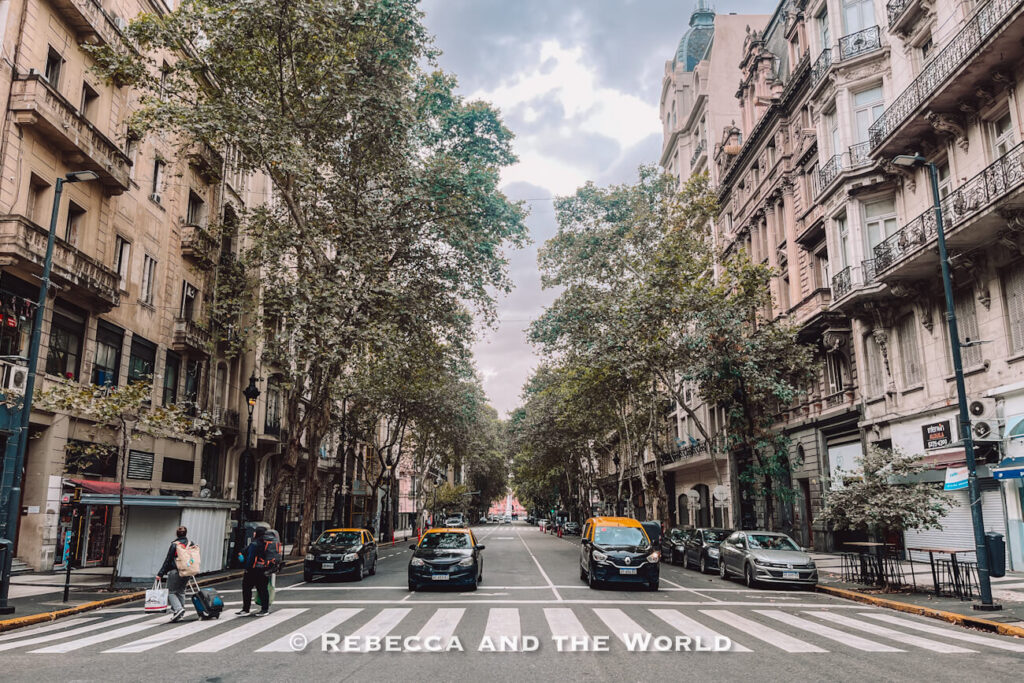
Taxis are everywhere in Buenos Aires, especially in tourist-heavy areas like Palermo, Recoleta, San Telmo and Microcentro. You can usually hail one from the street on a busy road or find ranks near major plazas, shopping streets and transport hubs. Just look for the lit-up “Libre” sign.
But, while more taxis are being equipped with credit card machines, the general payment method for taxis is still cash. Which means you have to have cash on you, of course! As you may already know, money in Argentina can be tricky and you may not be carrying enough cash to cover taxi rides each day.
Taxis also have a reputation for sometimes being dodgy – but I’ve only ever had one or two incidents in years of using taxis (when I lived in Argentina Uber was only just introduced, so I used taxis to get everywhere).
A few tips:
- Make sure the meter is on. If the driver doesn’t turn it on, ask politely or hop out and take another taxi.
- Have a rough idea of the route before you get in. Open your map app and check the direction and estimated time. Most drivers are honest, but every so often someone will take the scenic route.
- Know the cross streets. This is a local navigation quirk. Instead of just saying the specific address you’re heading to, it helps to say “Cerca de Calle X y Calle Y” or show the nearest intersection.
Public transport in Buenos Aires
Public transport is cheap in Buenos Aires and there’s an extensive network. There are colectivos (buses), the subte (underground train) and the train (aboveground, these tend to go to the outer suburbs).
Tip! Google Maps is the app I use to navigate public transport. It’s the easiest way to figure out how to get from A to B – including on buses and the subte.
Do I need a SUBE card?
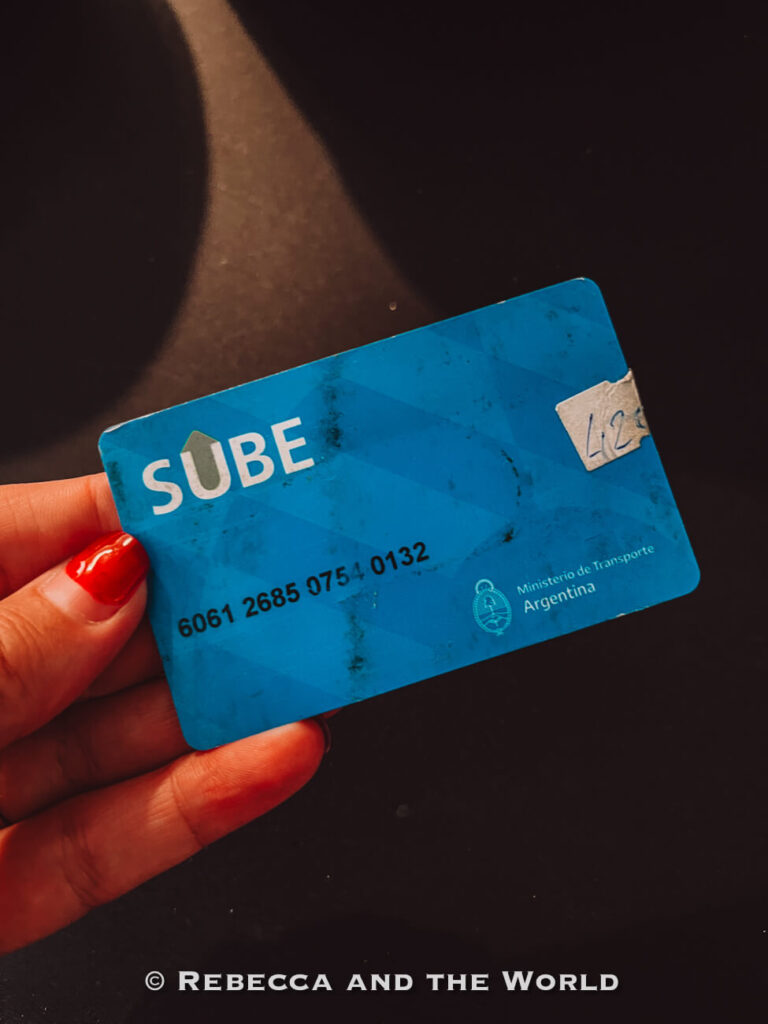
A few years ago, the only way to pay for public transport was with a SUBE card. You can now pay with credit card (including foreign cards) which makes it so much easier for short visits to Buenos Aires.
Simply tap a contactless debit or credit card or use a digital wallet like Apple Pay or Google Pay. This is great if you’re visiting for a few days and don’t want the extra step of buying and topping up a SUBE card (which is easy, but still – there’s so much to see, do and eat, who has time for travel admin?!).
If you’re staying in Buenos Aires for a little longer, a SUBE card might make more sense. Registered cards charge cheaper fares, and it’s a handy backup if you end up on services that don’t accept contactless yet or if your card decides to be temperamental.
You can buy a SUBE card at most subte stations and kioskos/shops displaying the SUBE logo and then top it up with credit as you go.
The subte (Buenos Aires subway)
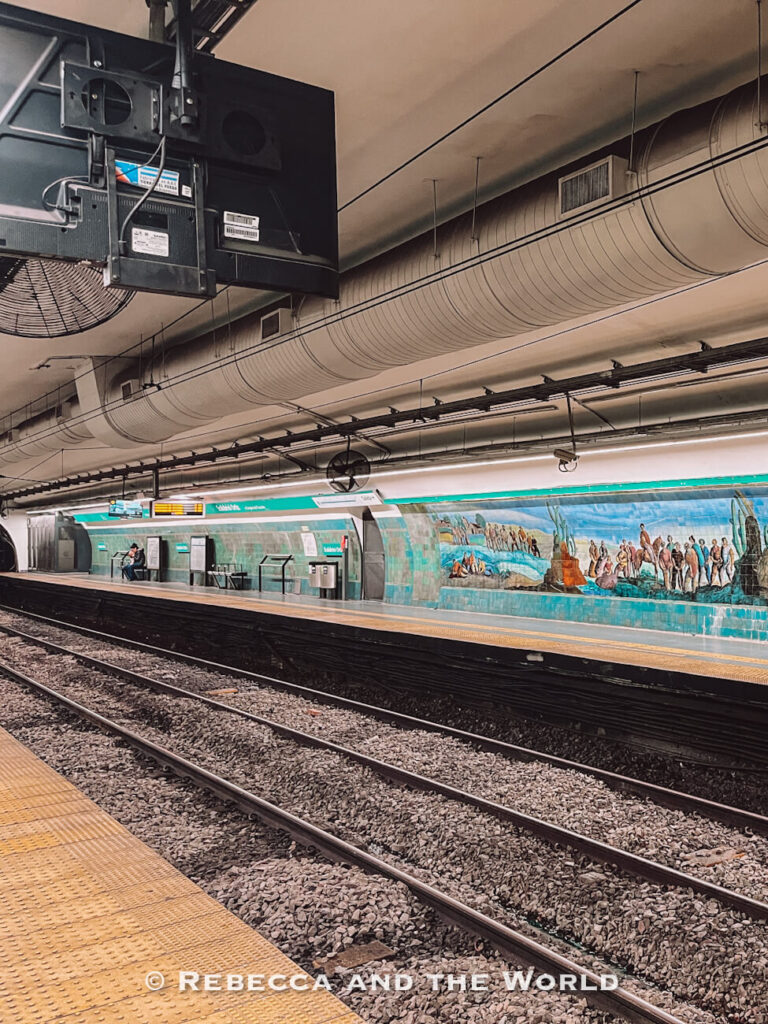
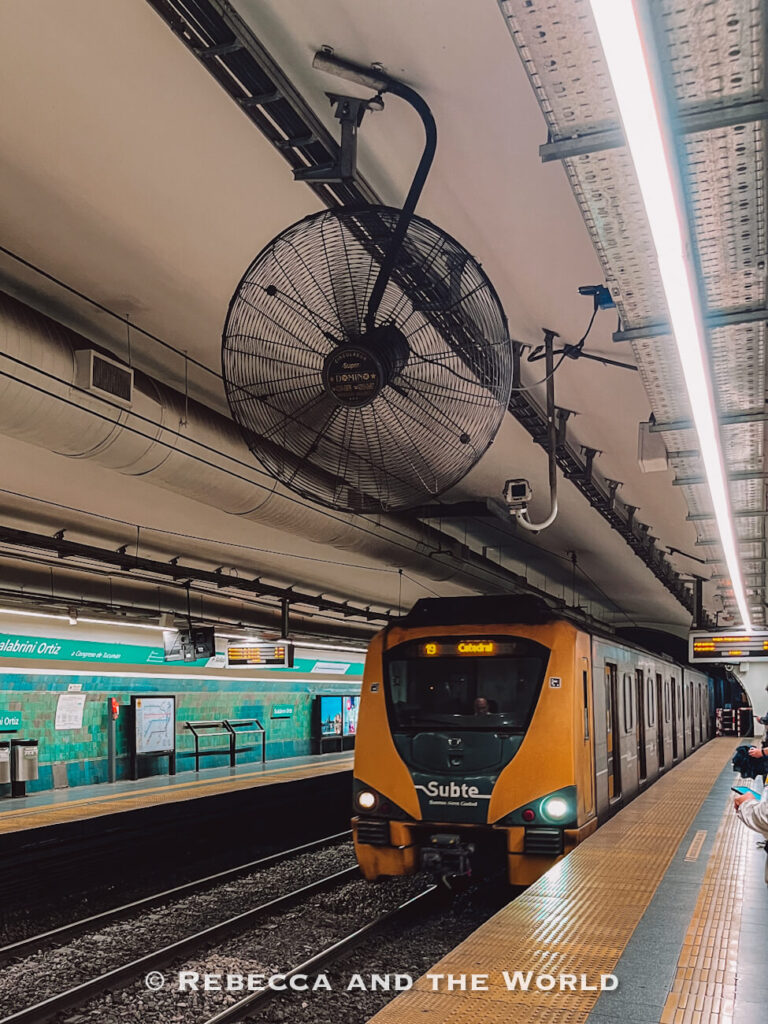
If you want the quickest way to get across Buenos Aires without sitting in traffic, the subte is usually it. It’s fast, cheap and easy.
If you’re heading somewhere that’s not well served by the subway, buses will often fill the gap and I’ll cover those next. Use Google Maps to help you decide.
If you’ve never used the subte before, it’s very straightforward:
- Find your line (each line is labelled with a letter and a colour on maps and signage).
- Check the direction by looking for the end station name on the platform signs. That’s how you know you’re heading the right way.
- Tap in (using either your credit card or SUBE), go down to the correct platform, then wait behind the yellow line.
- Count the stops on your phone or by following the station list on the train wall.
- Exit at your station and follow the salida signs to street level. Voilà, you’ve arrived!
The downside is that the subte doesn’t run everywhere, so it’s not a perfect option.
Peak hour on the subte can be packed, so avoid these times if you can. At any time of day, keep your phone and other valuables in your bag or pocket when the doors open and crowds are shuffling on and off.
Is the subte safe?
In busy areas during the day, the subte is generally fine. The main issue is petty theft, not violent crime. The usual big-city habits apply: keep valuables close, avoid flashing your phone near doors and be alert in crowds. As a general rule, once it’s late, I tend to switch to Uber or Cabify.
One thing to note – people will get on the trains and put things on your lap. Don’t touch the item or there’s an expectation to buy it. You can simply say “no, gracias” or just put it on the seat when you leave.
Did you know? Buenos Aires’ subte was the first subway system in Latin America. The first section opened in December 1913.
Colectivos (buses)
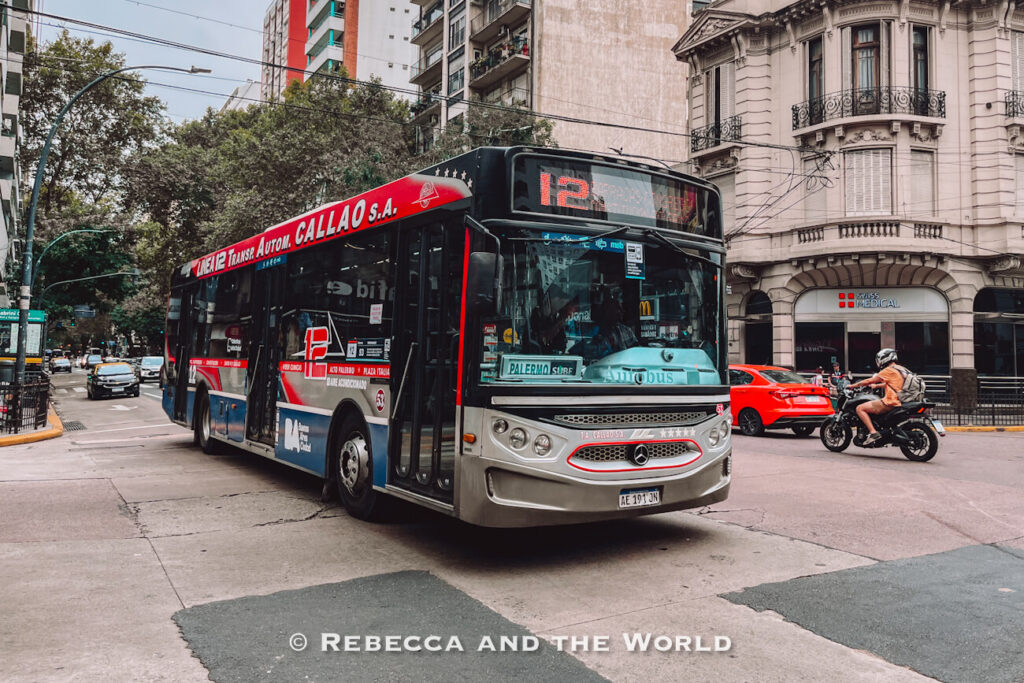
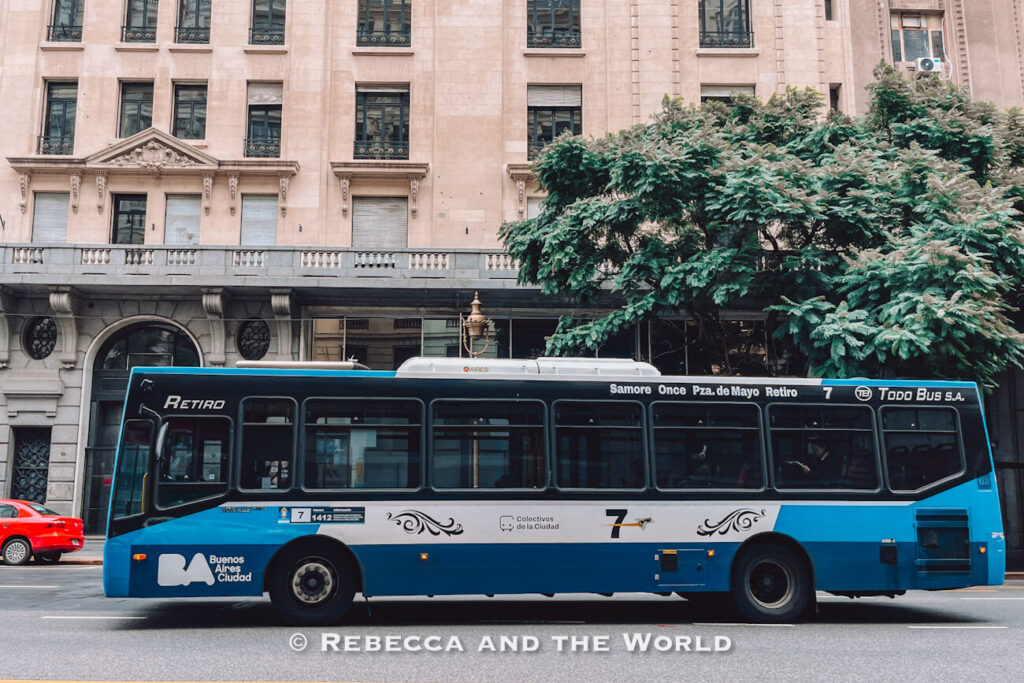
If the Buenos Aires subte is the quickest way to cross the centre, colectivos (buses) are what fill in all the gaps. The city’s buses are also slowly being replaced by electric ones, which is also great for the environment.
Buenos Aires has a huge bus network that reaches neighbourhoods the subway doesn’t, and it’s very inexpensive. The catch is that it can feel slightly chaotic the first time you use it, mainly because stops are not always obvious and the drivers always seem to be racing to stick to their timetable. Once you’ve taken one bus successfully, it gets much easier!
So, how do you catch a colectivo?
Once again, use Google Maps to figure out the route and where to get on the bus. Stops can be marked by a small sign, a pole or sometimes just a cluster of people waiting.
Unlike some cities where buses always stop automatically, buses often need to be flagged down.
- Stand near the stop and watch for your bus number. They’re lit up so you’ll see it coming
- Raise your arm clearly as it approaches so the driver knows you want to board.
- Have your SUBE or credit card ready before you step on.
On board, keep an eye on your phone to track stops, but do it discreetly, especially when you’re near doors or in a crowded bus. Buses are known for being snatch-and-run targets, where thieves will grab the phone or bag of someone close to the bus door and then run off – while the unfortunate owner is stuck on the bus.
At night, I never take buses – always rideshare.
If you’re on a tight schedule, the Subte or a taxi may be a better call, especially in peak hour.
Trains
Trains are aboveground (as opposed to the subte’s underground network). For most first-time visitors, you probably won’t use Buenos Aires’ train network much. Trains are geared more towards commuters travelling to and from the outer suburbs, rather than getting around the central neighbourhoods where you’ll likely spend most of your time.
That said, trains become useful in a few specific situations, especially if you’re planning a Buenos Aires day trip to somewhere like Tigre.
You can purchase train tickets from the station or use a SUBE card.
I won’t go into all the different trains here, but they’re easy to use.
Walking and bikes in Buenos Aires

Buenos Aires is one of those cities where you’ll do a lot on foot without really meaning to. I used to walk everywhere when we lived here – we’d walk from our home in Recoleta all the way to eat lunch in Palermo and then back, especially on a sunny day. (Read next: My guide to where to eat in Buenos Aires.)
Many of the neighbourhoods visitors spend time in are made for wandering. I always recommend first-time visitors stay somewhere like Palermo or Recoleta, and both of those areas are very walkable. (Check out my Where to stay in Buenos Aires guide for recommendations.)
Keep an eye on the footpath, both for caca (dog poop!) and for loose baldosas (the footpath tiles). The latter can move and splash water on you after a rainy day, it’s very annoying!
When stepping out on the street, cars should stop for you when you’re crossing at zebra crossings – but not always. Hold up your hand to remind them to stop. Also keep an eye on the bike lane as you cross – there have been many times I’ve almost been taken out by a bike because I wasn’t paying attention!
Also, be phone aware when on the street. If you need to check directions, step into a doorway or closer to a wall rather than standing on the edge of the footpath with your phone out. Motochorros are thieves on motorbikes that drive past and snatch phones and bags.
At night, I’m more selective about walking. In busy areas with people around, it can be fine. If streets are quiet or you’re unsure, a short Uber or Cabify ride is often worth it.
Bikes
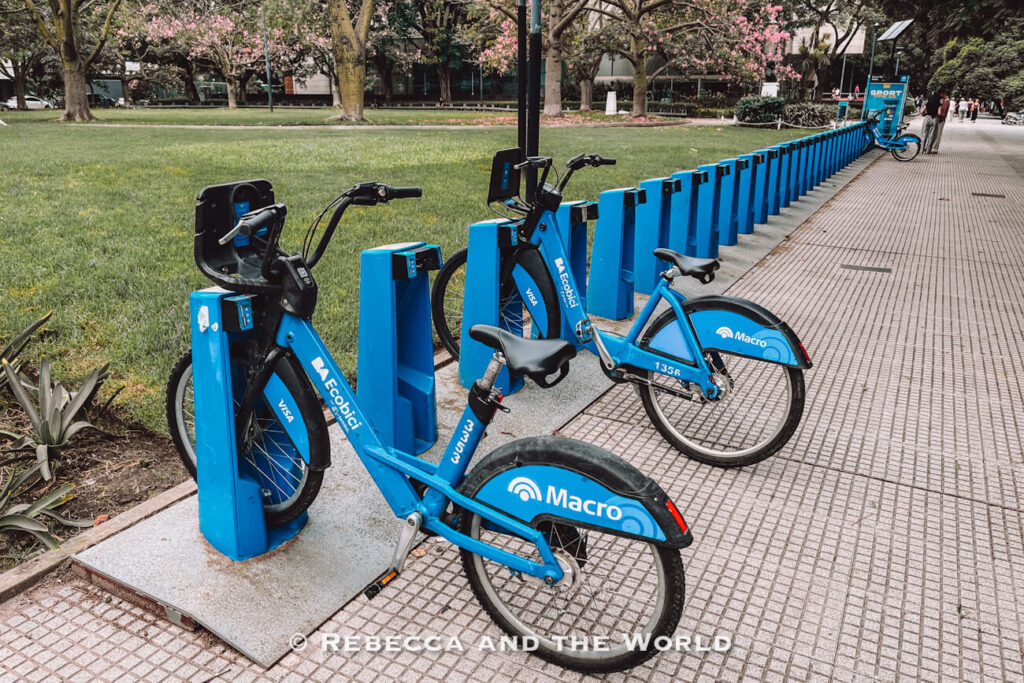
Cycling can be a great way to cover more ground, particularly around parks and along wider streets, but it’s not the transport option I’d recommend for everyone. Buenos Aires traffic can be intense, and the experience varies a lot depending on where you are and how confident you feel riding in a big city.
There are some great bike tours of Buenos Aires, where you’ll be led (safely) by a guide.
There’s also a bike-sharing scheme called Ecobici. While I’ve never used it, if you enjoy riding a bike, it can be a great way to see the city.
There are dedicated bike lanes in many streets, but do be careful and aware of cars.
Hop-on hop-off bus
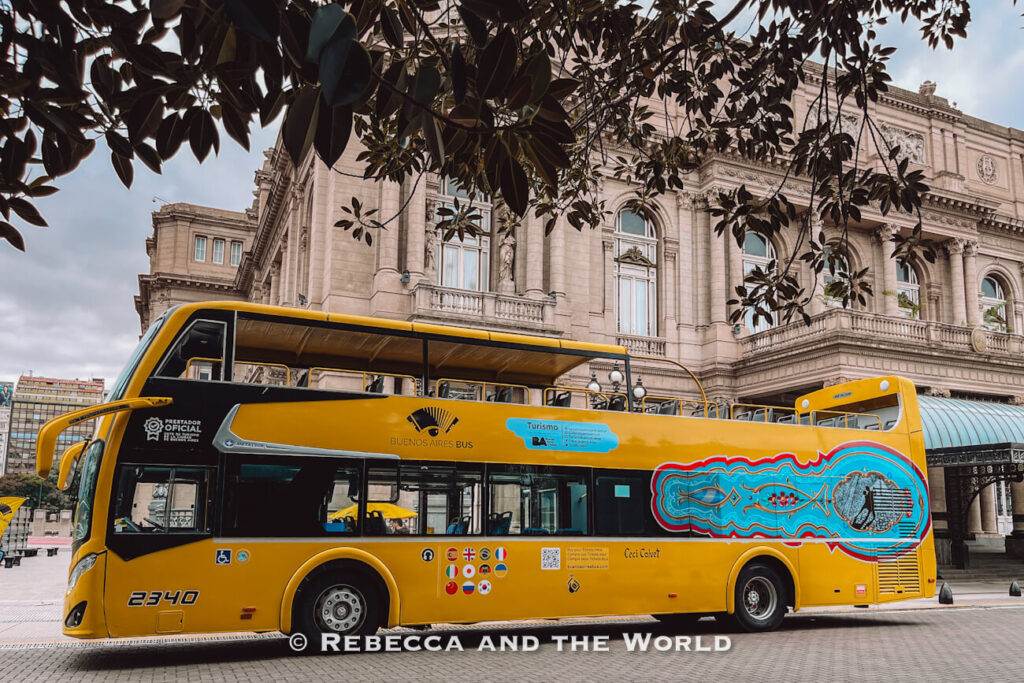
Another great option for getting around Buenos Aires is the hop-on hop-off bus. There are actually two sightseeing bus operators, what I call the Yellow Bus and the Red Bus, and they run slightly different routes around the city’s main highlights. This can be a great way to spend a day exploring the sights without having to figure out how to get between each one.
It’s super easy to use: you buy a ticket for a set time period, then you can hop on and off as many times as you like at designated stops. Most tickets are sold as 24, 48 or 72 hours, and both operators include a multilingual audio guide.
I have a full guide to using the hop-on hop-off buses in Buenos Aires, including the key stops.
Renting a car in Buenos Aires

If you’re sticking to the key touristy areas, you won’t need a car in Buenos Aires. In fact, I’d recommend against it. Traffic can be chaotic at times, parking can be a headache and it’s very easy to spend more time dealing with logistics than actually enjoying the city.
The only time a car becomes worthwhile is if you’re using Buenos Aires as a base for a day trip or short road trip. A classic example is San Antonio de Areco, a lovely gaucho town in the Pampas, or heading out to an estancia near Buenos Aires.
If you do want to rent a car, check out DiscoverCars, where you can compare different rental companies based on car availability, price and rating.
Final thoughts: Getting around Buenos Aires
Buenos Aires is a fantastic city – but it’s big. Which means you might need to take several different transport options to get from A to B. Walk when you can, take the subte when you want to move quickly across town, use colectivos if you’re on a budget, and switch to Uber, Cabify or a taxi when it’s late, you’re tired or you just want the easiest option.
Rideshares like Uber and Cabify will probably end up being your default method, but it can also be fun figuring out how to use the subte or buses and successfully ending up in your planned destination.
Whatever you do, keep the few safety tips I’ve recommended in mind and enjoy exploring this city!
FAQ: getting around Buenos Aires
Do I need a SUBE card?
Not always. In Buenos Aires city, contactless payments are now widely available for public transport, but a SUBE card is still useful as a backup and can be handy if you plan to travel outside the main city network or you just prefer the simplicity of using one system everywhere.
What’s the best app for getting around?
I use Google Maps. It’s generally up to date and has never let me down in telling me how to get from A to B, whether that’s by car, on foot or public transport.
Is Uber easy to use as a visitor?
Yes, and it’s often the easiest option late at night or when you want door-to-door transport without any negotiation. Cabify is also worth downloading – you can compare costs of both rideshare options.
Did you find this article helpful? Consider buying me a coffee as a way to say thanks!
I hope you’re now more confident in knowing how to get around Buenos Aires! Drop any questions in the comments section below.
Need help planning your Argentina trip? 🇦🇷
Feeling overwhelmed about planning your trip to Argentina? I get it. And I can help! I offer one-to-one travel consultation calls to help you plan your trip to Argentina. In an hour, we can map out a realistic itinerary or work through your specific questions so you can book an incredible trip. Save hours of your time with my local knowledge and expertise.
Read next
Before you go… you might like these Buenos Aires travel guides:
- 3 Days in Buenos Aires Itinerary: What to See, Do and Eat
- What to Do in Buenos Aires: Top 25 Ideas for Your Itinerary
- Where to Stay in Buenos Aires, Argentina: A (Former) Local’s Top Choices
- Where to Eat in Buenos Aires: 35+ Great Restaurants to Try
- Navigating Money in Argentina: A Traveller’s Guide to Money Matters
- Is Buenos Aires Expensive? How to Plan Your Travel Budget
- Buenos Aires Hop On Hop Off Bus: The East Way to See the City
ARGENTINA TRIP ESSENTIALS
- Book your flight to Argentina online with Skyscanner. I like how this site allows you to find the cheapest days.
- One thing I always purchase is travel insurance! Travel Insurance Master allows you to compare across multiple policy providers, while SafetyWing is great for long-term travellers and digital nomads.
- Wise is my choice for sending and receiving money and spending money overseas (you can get a digital and physical card).
- Find a great hotel in Argentina. Check prices on Booking.com and Expedia online.
- Check out the huge range of day tours throughout Argentina on GetYourGuide or Viator. I love a good food tour in particular!
- Saving money? Check out the range of free walking tours across Argentina with GuruWalk (don’t forget to tip!).
- How to get around? I use DiscoverCars for car hire, or Motorhome Republic and Jucy for campervan/RV rental. For buses, trains and ferries, I use 12GO, Busbud and Omio.
- Grab an e-sim to stay connected while on the road.
- A copy of the Lonely Planet guide to Argentina will be handy. Also pick up a Spanish language phrasebook to help you navigate your visit.
- Keep those bottles of wine you’ll be buying safe in these wine bags.
- Check out my Amazon shop for my fave travel items – everything from backpacks and suitcases to travel adapters and beauty products.
PIN IT FOR LATER: HOW TO GET AROUND BUENOS AIRES
Save this guide to getting around Buenos Aires to Pinterest so you can plan your trip later!