
Wondering what to eat in Bogotá? This Bogotá food tour is a great introduction to the food of Colombia and the capital city’s regional specialties.
The food of a country is a huge reason why I travel. I love discovering new dishes, regional specialties and what makes the food so special.
But before our trip to Colombia, my understanding of Colombian food was basically arepas – and not much else. I’d eaten them plenty of times, but beyond that I couldn’t have told you what a typical Bogotá dish was, what to look for on a menu or what was specific to this part of the country.
That’s why I booked a food tour almost as soon as we arrived in Bogotá. A Chef’s Tour is my go-to in a new city – I’ve done their tours in Bangkok, Kuala Lumpur, Singapore and Santiago, and they’re consistently strong on the two things that matter: you learn a lot and you eat extremely well.
On A Chef’s Tour’s Viejo Bogotá tour, over four hours we walked through four neighbourhoods, starting in a part of the city most tourists never see and finishing in one of Bogotá’s busiest places. Along the way we tried everything from the city’s most iconic soup to sweet snacks to coffee, and even squeezed in a game of tejo – Colombia’s wonderfully loud, 500-year-old pastime involving gunpowder and flying metal discs.
So, should you take a Bogotá food tour? In this article I’m sharing about my experience, why food tours are one of my favourite ways to get my bearings in a new city and some of the best things to eat in Colombia. If you want to feel more confident ordering food in Bogotá for the rest of your trip, this tour is a very good place to start.
This blog post may contain affiliate links, meaning if you book or buy something through one of these links, I may earn a small commission (at no extra cost to you).
At a glance: A Chef’s Tour Bogotá food tour
- Duration: 4 hours (12pm-4pm)
- Group size: 8 people max
- What’s included: 10+ tastings plus a coffee workshop and bottled water
- Dietary requirements: This tour isn’t suitable for vegetarians/vegans, lactose-free, gluten-free or pork-free diets
- Price: US$55 (book here)
- My verdict: A great way to find out exactly what to eat in Bogotá – the traditional dishes and local favourites
What to expect on A Chef’s Tour Bogotá food tour
I’ve done food tours with A Chef’s Tour in a few cities now (Bangkok, Kuala Lumpur and Santiago) and the thing they consistently get right is the balance between food and context. You’re not just being marched from snack to snack, you’re getting the backstory: why certain dishes exist, where ingredients come from, and how Bogotá’s food culture is shaped by history and geography.
And you won’t be hungry afterwards. These tours are excellent value for the amount of food you eat and the level of detail you walk away with.
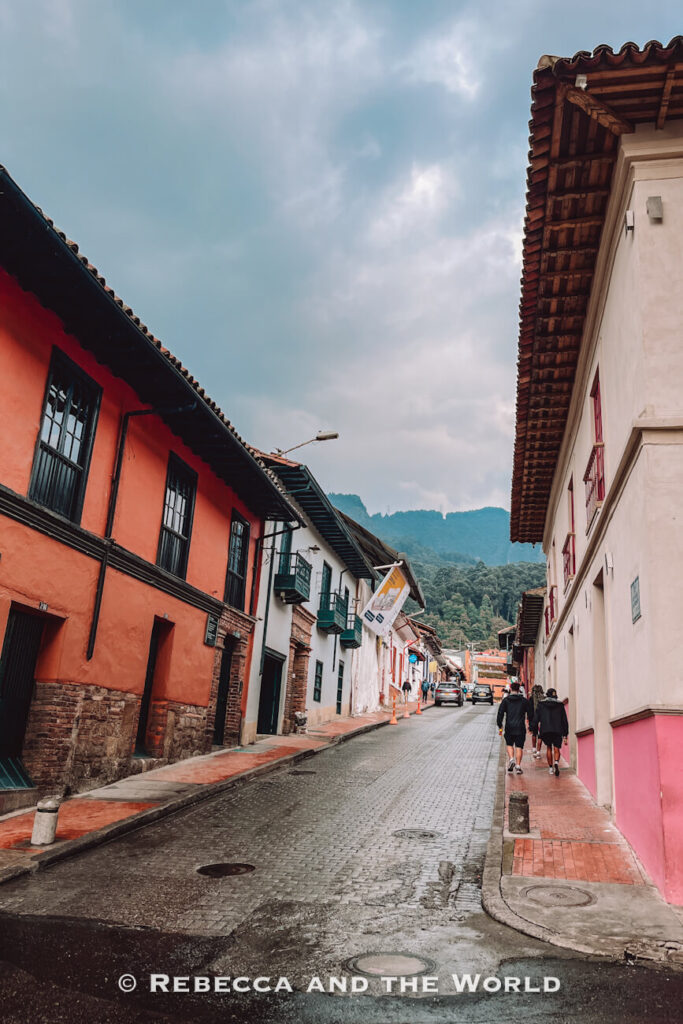
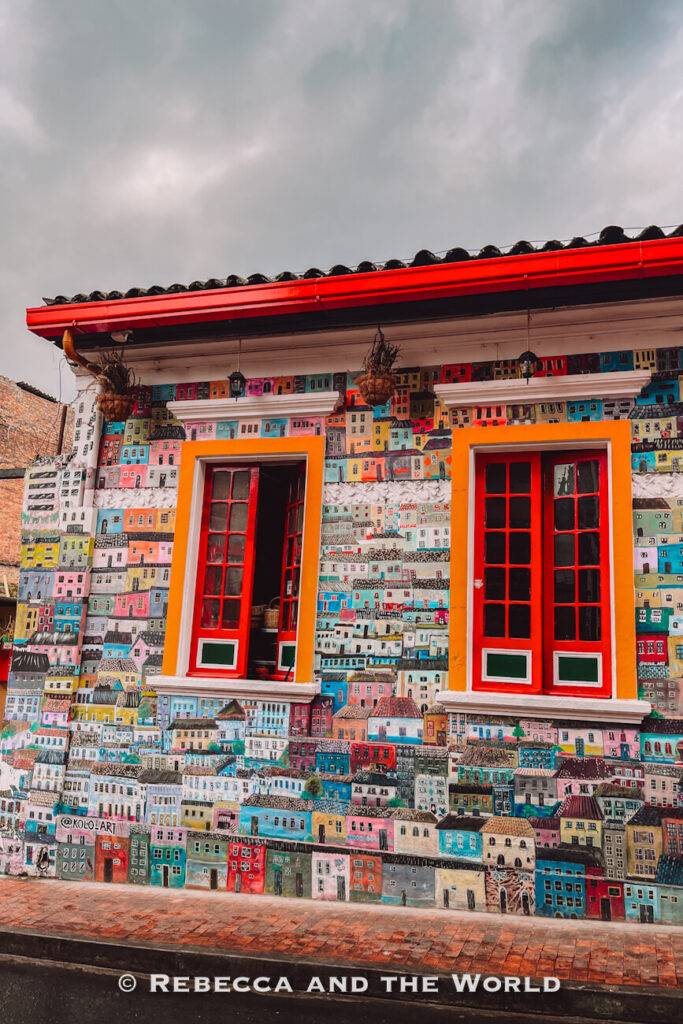
The Bogotá food tour is a walking tour and you’ll cover around 4 kilometres. It sounds like a lot, but the pacing is comfortable – you’re stopping constantly to eat and some tastings are sit-down while others are quick bites perched on a stool in a small shop. The route also covers four very different neighbourhoods, which is a great way to see the city beyond the usual tourist bubble.
Our guide was Juliana, who has a degree in gastronomy. As you can imagine, with that background she was incredibly knowledgeable and full of stories that made the food feel connected to the city. She was also just genuinely enjoyable to spend four hours with – it felt like hanging out with a friend of a friend.
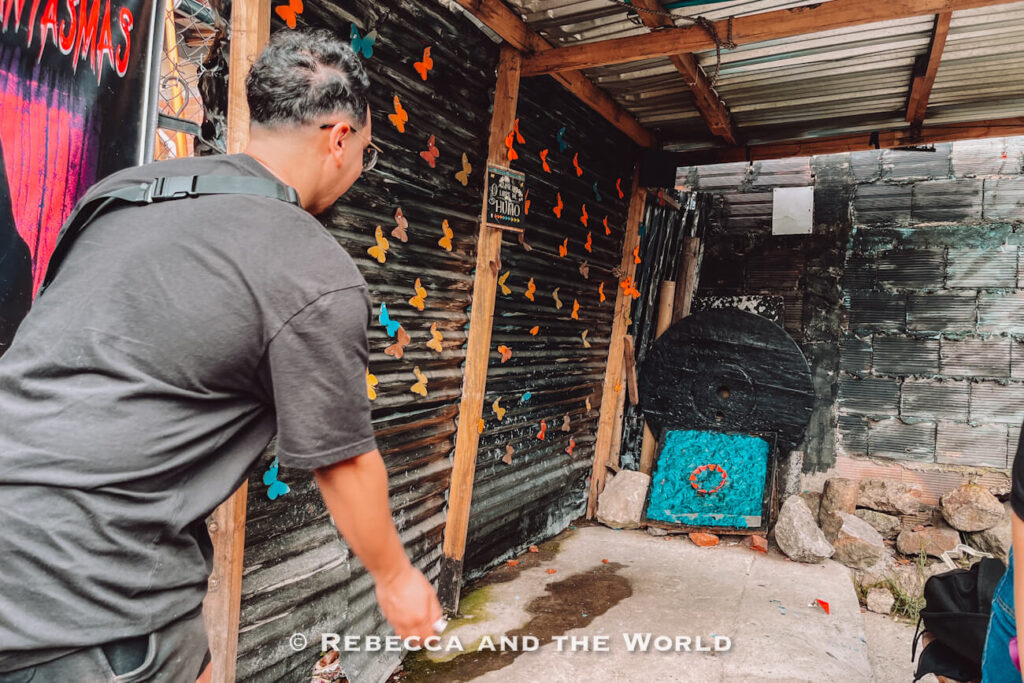
While food is obviously the highlight of this tour, there are some fun surprises thrown in. One of my favourite parts of the tour was playing tejo. It’s a 500-year-old game and it’s insane: you throw heavy metal discs (also called tejo) at a clay board dotted with little triangles of gunpowder and the goal is to make them explode. Yes, really!!
If you’re deciding when to book this Bogotá food tour, I’d do it early in your Bogotá stay. It makes the rest of your meals easier because you’ll recognise dishes on menus, know what’s worth ordering and you can go back to a couple of the stops later on.
Tip: Pack a raincoat or umbrella. Bogotá weather has a mind of its own, and there’s quite a bit of walking on this tour.
🫔 BOOK THE BOGOTA FOOD TOUR HERE 🫔
What to eat in Bogotá: 10 things to try
One of the best parts of doing a food tour in Bogotá is that it takes the guesswork out of ordering later on. Instead of staring at menus and defaulting to whatever feels most familiar, you get a guided introduction to what people actually eat in Bogotá.
Now, obviously this isn’t an exhaustive list of everything you can eat in Bogotá. It’s a rundown of the dishes and drinks we tried on this A Chef’s Tour, plus a few details on how to eat them and what stood out to me.
Ajiaco santafereño
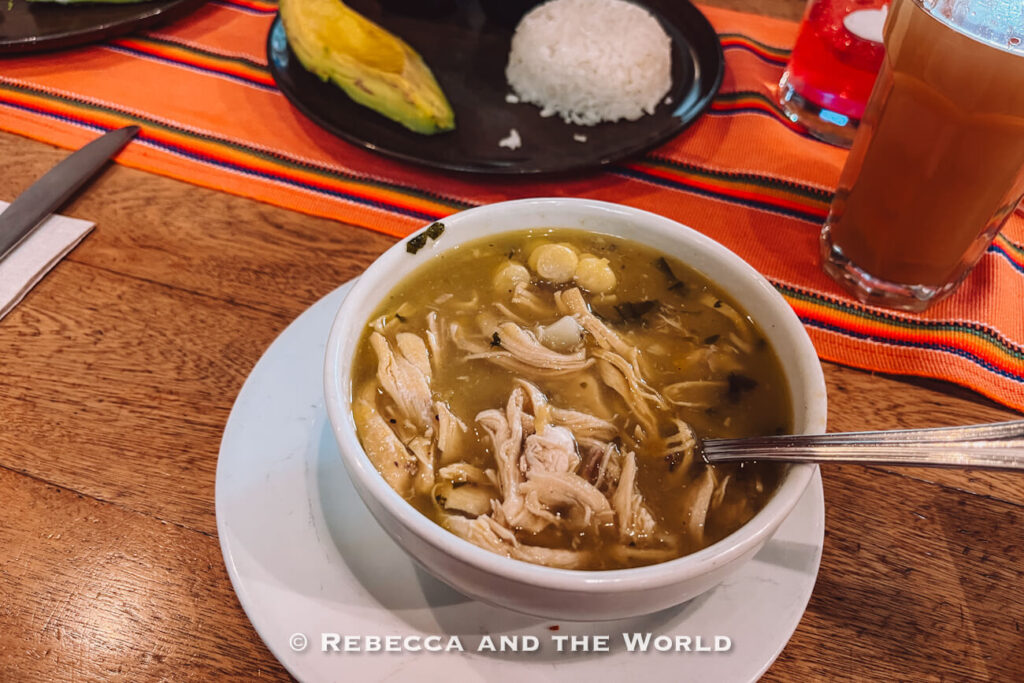
If there’s one dish that feels unmistakably Bogotá, it’s ajiaco santafereño. This is the city’s signature soup: chicken and three different types of potato, simmered until it’s thick and comforting, then finished with guasca (a herb that gives it its distinctive flavour). It’s typically served with rice and avocado on the side, and topped with capers and cream, a Spanish colonial influence that adds a pop of flavour.
The soup is eaten by Bogotans when they’re sick, hungover or when it’s cold.
For us, this soup was absolute heaven. We’d just come off the back of a stomach bug and it was exactly what I wanted: warm and nourishing. I could happily eat it every day, especially if Bogotá is doing its usual cool, drizzly thing.
Pace yourself, though. This was just the first tasting and it was the size of a full meal – there’s still a lot more food coming.
Tropical fruits
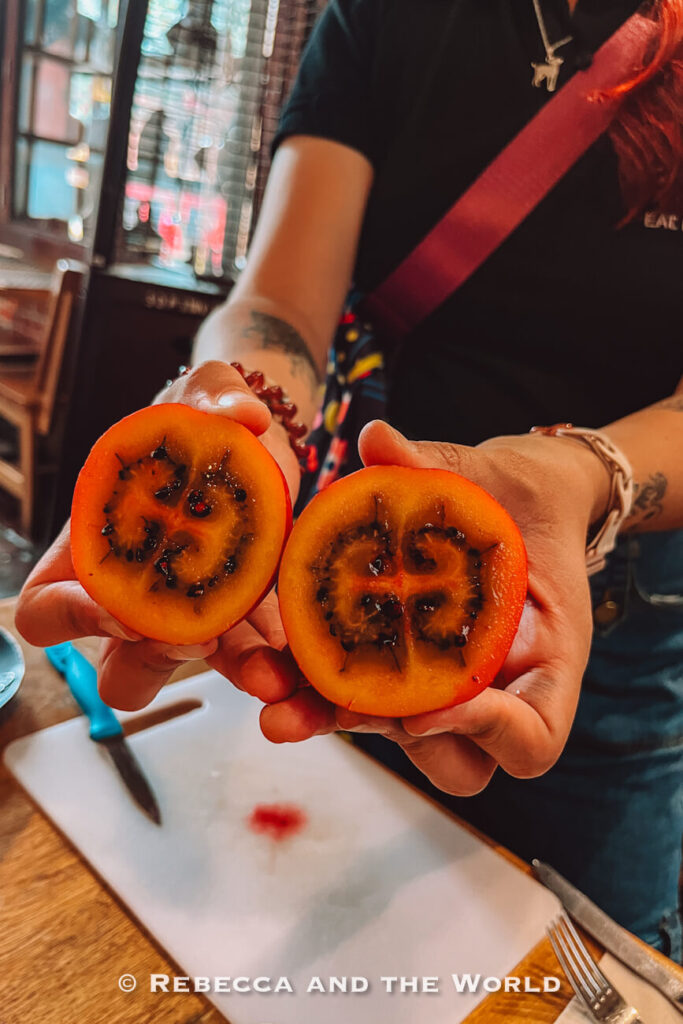
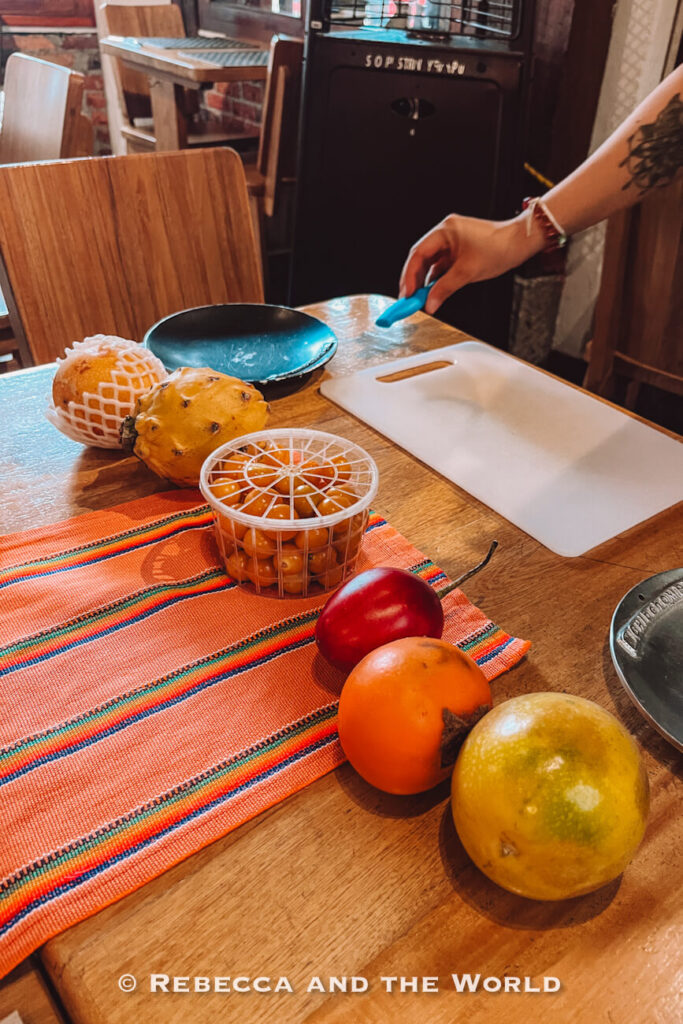
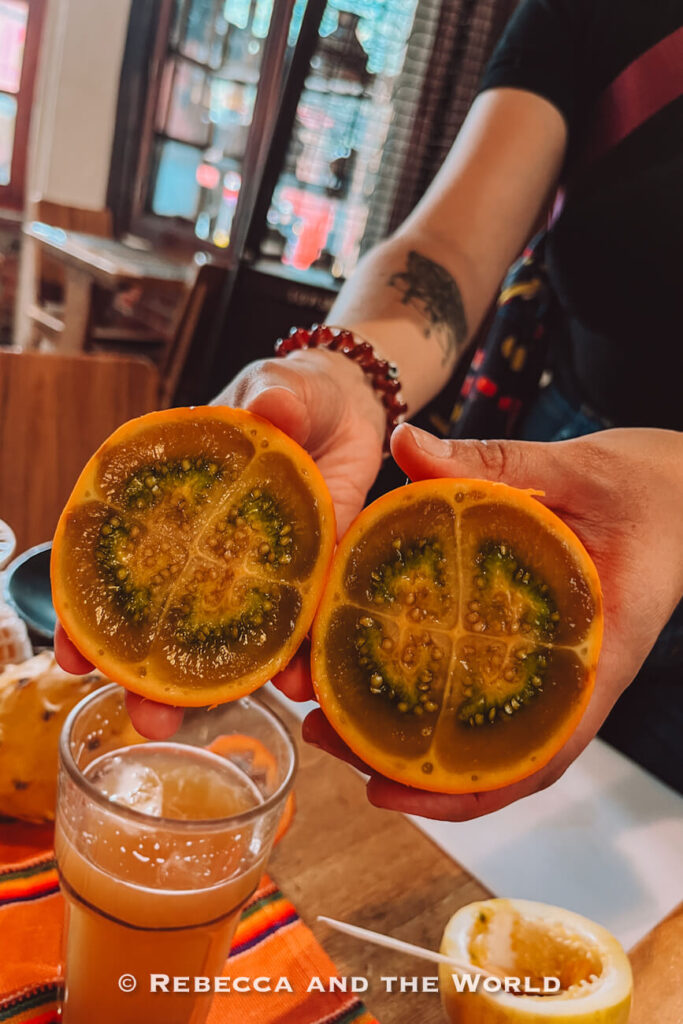
While we were waiting for the ajiaco to arrive, we started with a fruit tasting. Even if you’re used to seeing tropical fruits at home, there are so many varieties in Colombia that you just don’t come across elsewhere. Having someone explain what you’re eating makes it much more interesting than simply buying a random juice and hoping for the best.
We tried maracuyá (passionfruit), tomate de árbol, lulo, golden berries (uchuva), cumquat (their version starts off tasting like orange but finishes with a surprisingly tomato-like note), and pitaya (dragonfruit). On our Bogotá food tour we even learned the local way to split open passionfruit – by smacking it on your head!
If you see pitaya around Bogotá later, one small warning: don’t go too hard on it. It’s known for having a laxative effect, and it’s not the kind of souvenir you want to take back to your hotel!
Lechona
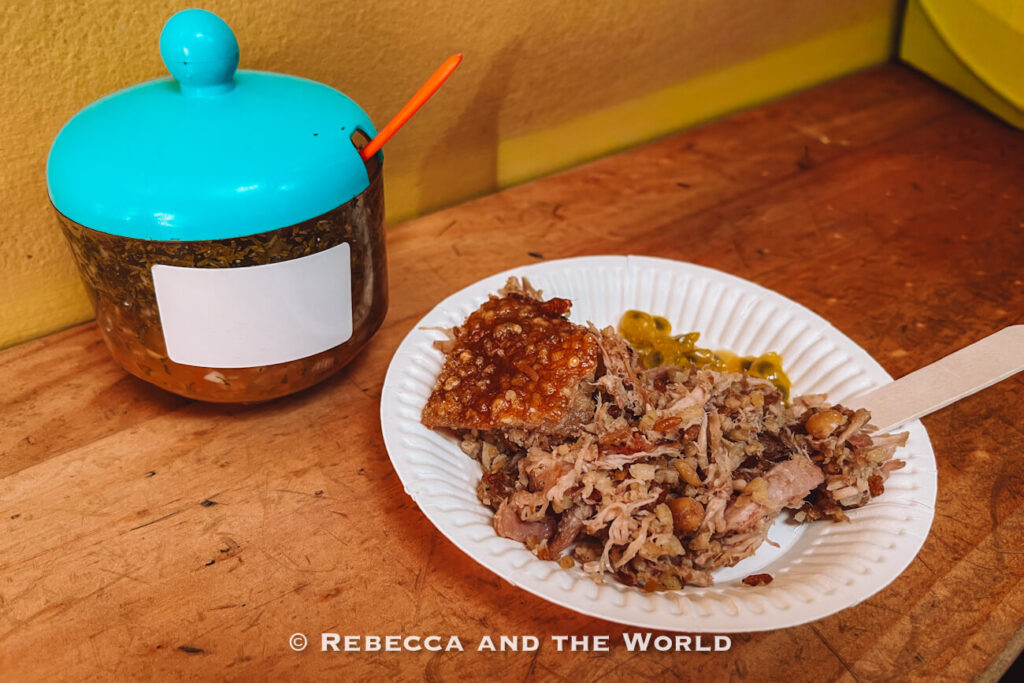
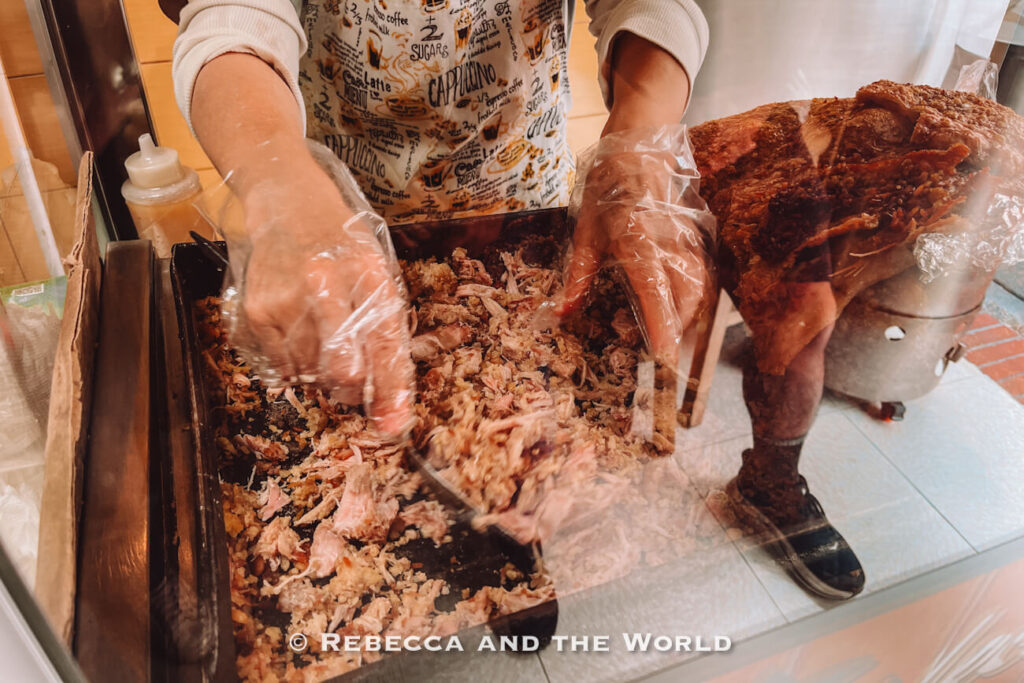
Next up was lechona, and it’s one of those dishes that’s very hard to stop eating once you’ve started. It’s suckling pig cooked low and slow for around 15 hours, then shredded and served with yellow peas, rice and spices, with crunchy crackling on the side.
We stopped at a tiny, no-frills place I’d never have noticed or gone into by myself. But Bogotans clearly know about it – there was a steady stream of customers the entire time we were perched on our stools eating.
The crackling was the standout – properly crunchy, not the sad chewy kind – and the whole dish was rich and deeply savoury. Juliana showed us a trick I never would have thought of: add fresh passionfruit to cut through the fat. It sounds unusual, but it works, giving the dish a bright, tangy lift.
Pandebono
Pandebono was one of the most delicious breads I’ve eaten in a long time – warm, slightly chewy and deeply moreish.
It’s originally from the Cali region, but Juliana explained that it has Italian roots. It was created by an Italian, and the name comes from a mistaken pronunciation of “pan de bueno” (meaning good bread in Italian). We had tried this on our street food tour in Cartagena so I already knew that this was a winner.
It’s made with costeño cheese, which is salty, so you get that savoury hit that makes you keep reaching for just one more piece. If you spot pandebono in bakeries later in your trip, it’s absolutely worth repeating, ideally fresh from the oven.
Avena (oat cream)
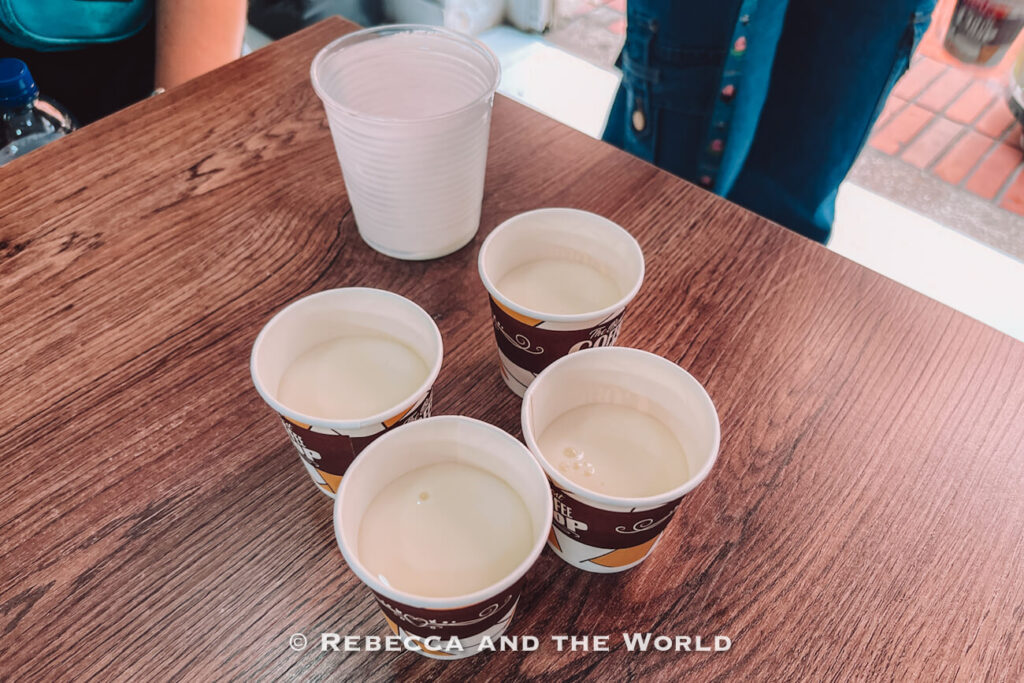
Avena was something I’d never even come across in my Bogotá research – which is exactly why food tours are useful. It’s basically a drinkable dessert – the consistency is like thin custard, super creamy and lightly spiced with cinnamon.
Despite the name, it’s not actually made with oats. It’s made from cassava and then mixed with milk, sugar and cinnamon. We dipped the pandebono into it, and the combination made perfect sense – warm, salty bread with sweet, creamy avena.
Tamales
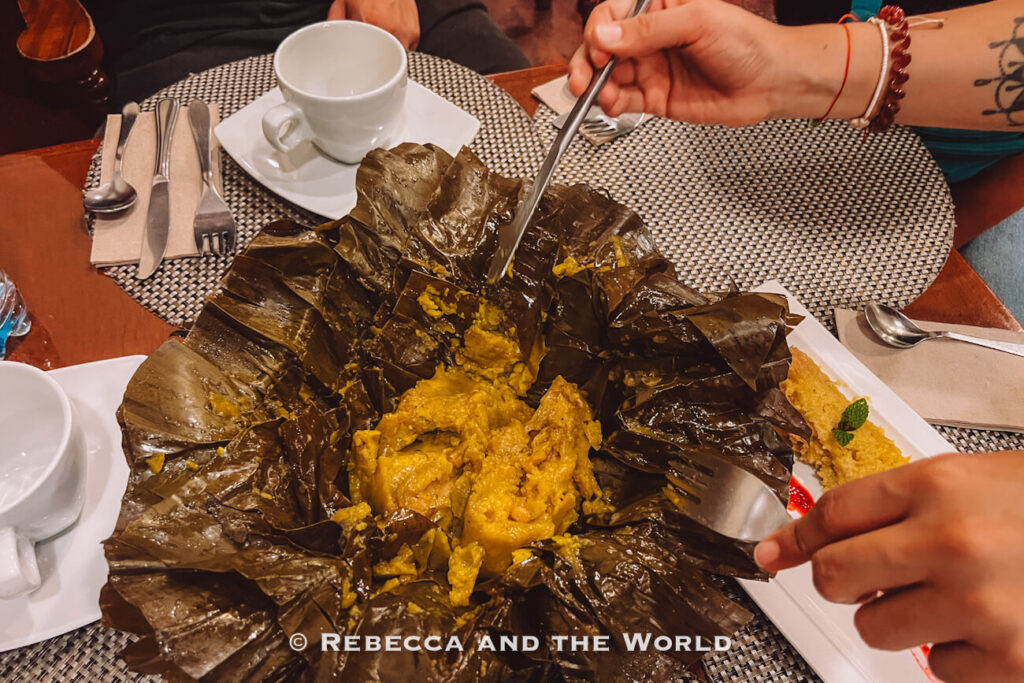
At one of Bogotá’s oldest bakeries, we tried a few different things, including two types of tamales. The first was a classic tamal – rice-based and seriously hearty, filled with chicken, pork and a boiled egg, then steamed in plantain leaves. It’s quite different to Mexican tamales, which tend to be masa-based. In Colombia, tamales are often a breakfast food, and you can see why. One of these would keep you going for hours.
The second version was an envuelto, a corn tamal. This one was sweeter and lighter, and we ate it with blackberry jam. It tasted more like cornbread than the savoury tamal, and it was a nice contrast after all the rich dishes earlier on.
Juliana also mentioned that both ajiaco and tamales are Christmas specialties – dishes families will gather to cook and eat together on special occasions. These are one of the most traditional foods in Bogotá – and Colombia more broadly.
Chocolate santafereño
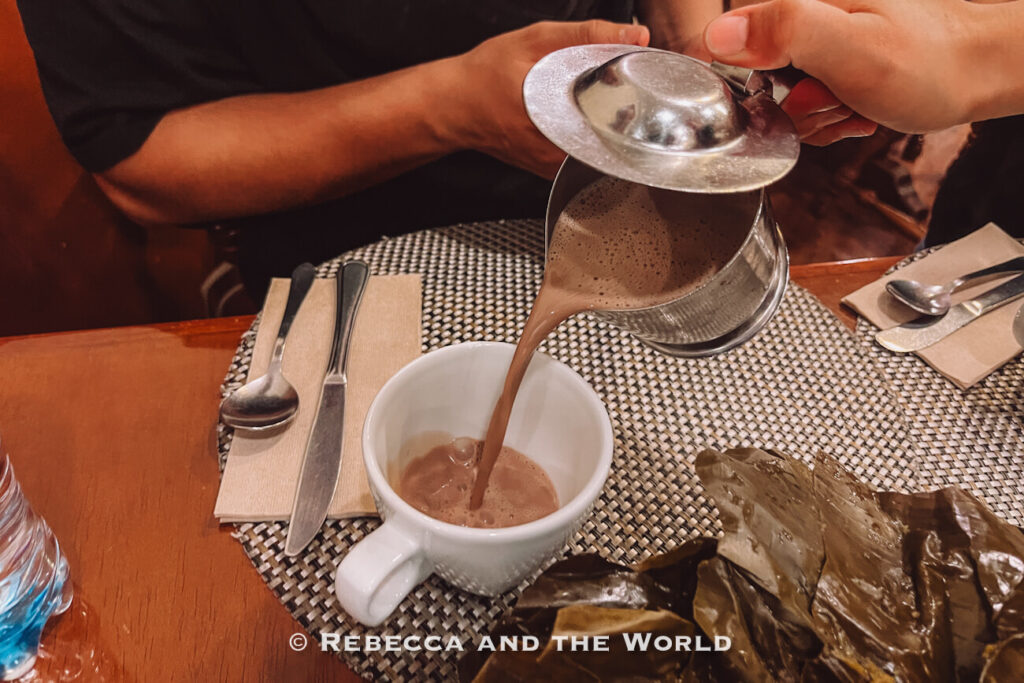
Chocolate santafereño is the classic Bogotá pairing that sounds strange until you try it – hot chocolate served with cheese. You drop the cheese into your cup, let it soften (it won’t fully melt), then scoop it out with a spoon once it’s warm and a little gooey.
We tried it with two types of cheese. The first was a double cream cheese made from cow’s milk, with a mild flavour and a soft texture once it warmed through. Someone in our group described it as “savoury marshmallows”, which is oddly accurate. The second was campesino (farmer) cheese – saltier and firmer, and it doesn’t soften as much. I much preferred the double cream cheese.
Juliana told us the tradition supposedly came about by accident – someone dropped cheese into their hot chocolate, realised it worked, and it stuck. It’s a Bogotá staple, but you’ll see versions of it in other parts of Colombia too.
Coffee
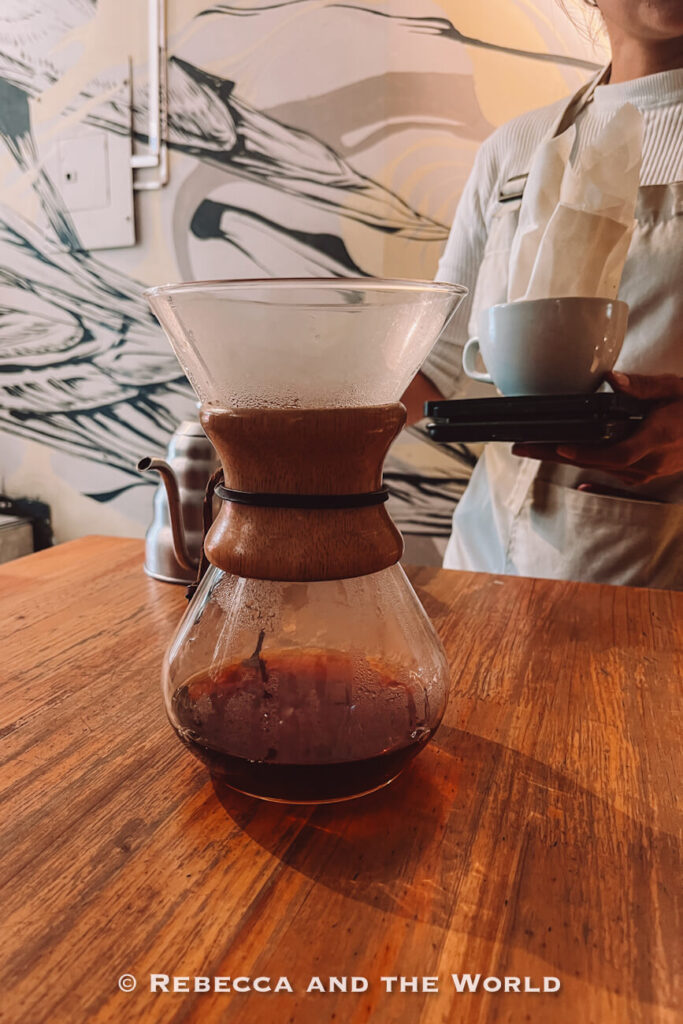
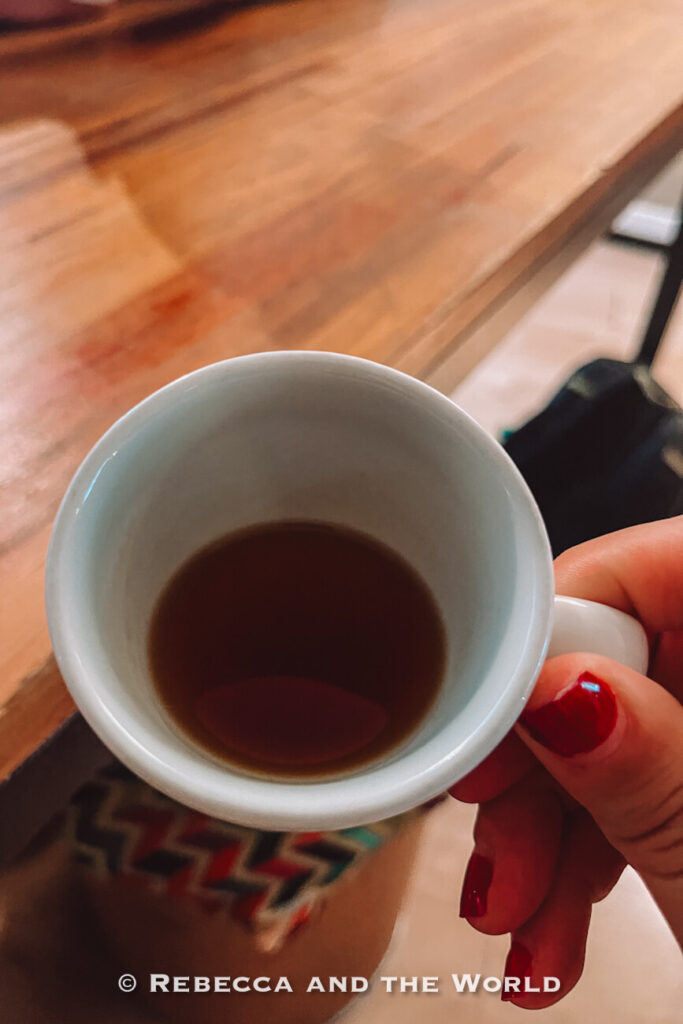
Colombia is known for coffee – it’s the third largest producer in the world – so it makes sense that this tour finishes with a proper coffee tasting.
Towards the end of the tour, we stopped in at a coffee shop where we tried two different varieties, both prepared using the Chemex method. While I’m not a coffee drinker, I appreciate the effort that goes into growing, roasting and brewing coffee – and my fellow tour guests said that this was really good Colombian coffee (definitely not drowned in milk and sugar).
Coca tea
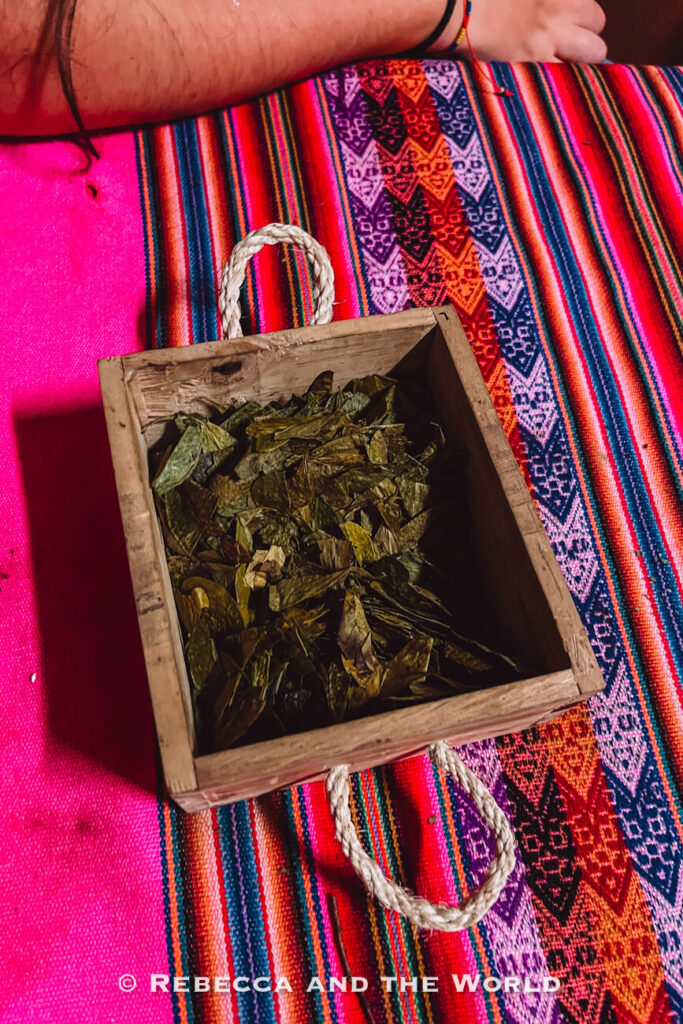
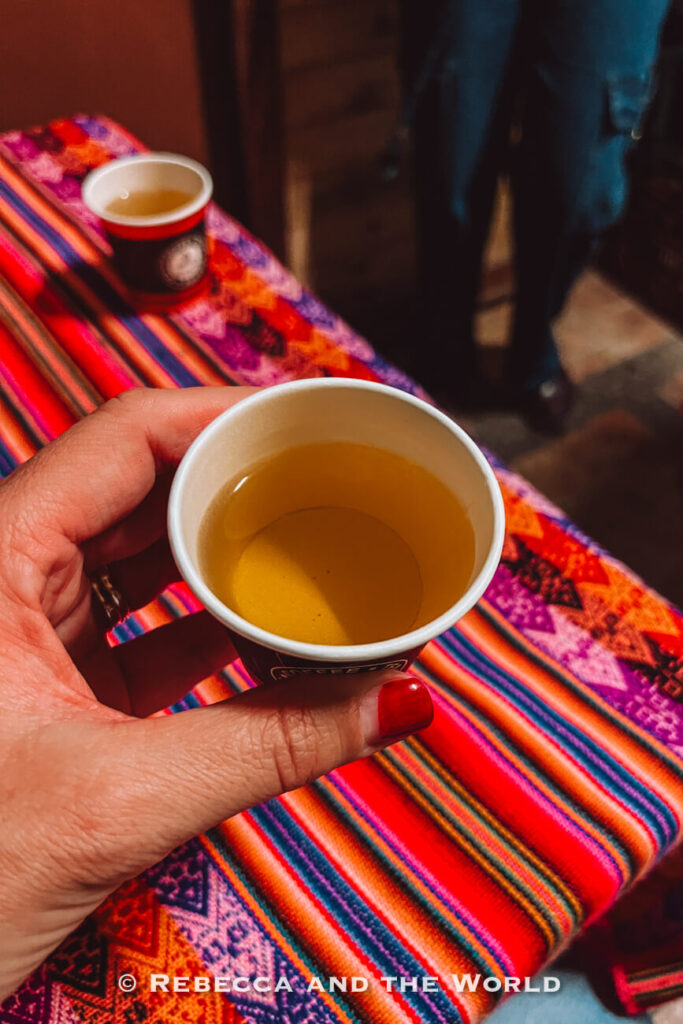
We tried coca tea in a small Native American store, and it felt like a very Bogotá-appropriate tasting given the city’s altitude. It’s commonly used to help with altitude symptoms and as a gentle energy boost. I’ve had it before in Peru (to help us with the altitude while hiking the Salkantay Trek) and found it genuinely helpful on high-altitude days, especially when you’re walking a lot.
One practical thing to know: if you have a drug test coming up in the next few days, it’s better to skip tasting this!
Chicha
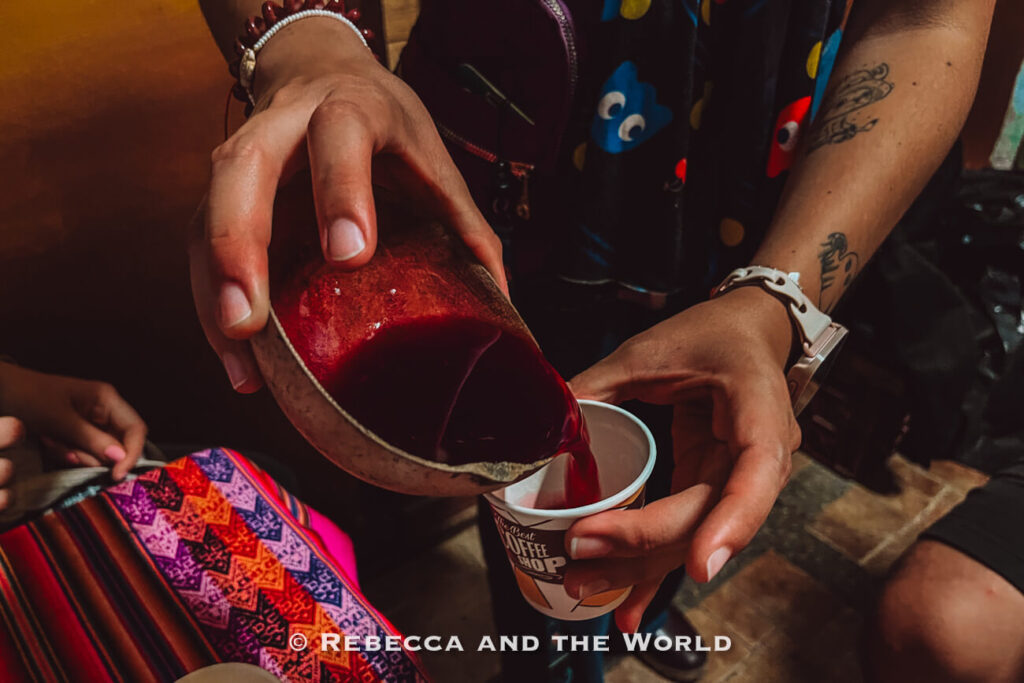
Our final tasting was chicha, a traditional fermented drink with a tangy, slightly sweet flavour. On this tour it was a Peruvian-style version – lighter and more spiced – made with flavours like pineapple, cloves and orange peel. Juliana mentioned that Colombian chicha is usually thicker.
Chicha used to be hugely popular in Bogotá, but it was banned in the 1940s. A brewery wanted people drinking more beer than chicha, and there were even posters warning people they could go to prison for drinking it – you can see some of them on display at the Museo Nacional (which is a great stop if you’ve got 2 days in Bogotá).
Is A Chef’s Tour Bogotá food tour worth it?
For us, yes. I’ve done A Chef’s Tour in a few cities now, and the reason I keep booking them is simple – they’re consistently strong on the two things that matter: you learn a lot and you eat extremely well.
It was no different in Bogotá. The neighbourhoods we covered were a diverse range, exposing us to parts of the city we probably wouldn’t have visited in our short time there. Our guide Juliana was also excellent – her gastronomy background showed in the detail she shared, but she kept it engaging and easy to follow the whole way through.
It’s also excellent value for what you get. The number and size of tastings add up to far more than light snacks – this is more than a full meal so you won’t be hungry in the end.
A couple of honest caveats. First, you need to be up for walking and changing locations – this isn’t a sit-down progressive lunch. Second, it’s not a flexible tour for dietary requirements, so if you’re vegetarian, vegan, gluten-free or lactose intolerant, you’ll be better off planning a DIY food day instead.
If you can, I’d book it early in your trip. It’s the kind of tour that makes the rest of Bogotá easier – you’ll recognise dishes on menus, know what’s worth ordering and feel more confident choosing where to eat.
🫔 BOOK THE BOGOTA FOOD TOUR HERE 🫔
Final thoughts: Bogota food tour
If you’re even slightly curious about Colombian food beyond arepas, this tour is an easy yes. It gives you a clear sense of what’s actually eaten in Bogotá, not just what happens to be popular with visitors, and it sets you up to eat better for the rest of your trip.
I’d recommend it most to first-timers who want a fast, low-effort introduction to the city’s food culture, and to anyone who likes their travel experiences with a side of history.
Book it early, take notes on what you love, then use the rest of your time in Bogotá to repeat your favourites.
FAQs: What to eat in Bogotá
Is a Bogotá food tour worth it?
If it’s your first time in Bogotá, yes. It will help you understand what’s actually local, what’s worth ordering and where to find it again.
How hungry should I arrive?
Come hungry. A light breakfast (or just coffee) is usually perfect because all the food on this tour adds up to a solid meal by the end.
How much walking is involved?
Most Bogotá food tours are walking-heavy with short stops, rather than long sit-down tastings. Wear comfortable shoes and assume you’ll be on your feet for most of the experience. A Chef’s Tour’s Bogota food tour covers about 4 kilometres, so it is quite a bit of walking – but it’s broken up over four hours.
What should I wear?
Layers. Bogotá weather can swing quickly, so you’ll be glad you’ve got a light rain jacket or umbrella and something warm. Closed-toe shoes are a good idea.
Is it safe to eat street food in Bogotá?
A big advantage of a tour is that someone else is choosing vendors who do this all day, every day and have strong turnover. Everything we ate was freshly cooked for us. Bring hand sanitiser or hand wipes (even though your tour guide will usually have this).
Should I do the Bogotá food tour at the start or end of my trip?
At the start, if you can. You’ll get more value because you’ll recognise dishes on menus and can repeat your favourite foods.
Did you find this article helpful? Consider buying me a coffee as a way to say thanks!
Would you do a Bogotá food tour? What are your favourite Colombian foods?
Related posts
Before you go, you might like these Colombia travel articles…
- 48 Hours in Bogotá: The Perfect 2-Day Itinerary for First-Timers
- 3 Days in Cartagena Itinerary: Plan Your First Trip to This Colourful Colombian City
- Cartagena Street Food Tour: 10 Colombian Foods to Try
- What to Expect on Colombia’s Lost City Trek + An Honest Expotur Review
- Is Santa Marta Worth Visiting? A Guide to Colombia’s Caribbean Gateway
- Is Palomino Worth Visiting? A First-Timer’s Guide + Tips for Planning Your Stay
COLOMBIA TRIP ESSENTIALS
- Book your flight to and around Colombia online with Skyscanner. I like how Skyscanner allows you to find the cheapest days to travel and compares multiple airlines at once.
- One thing I always purchase is travel insurance! Travel Insurance Master allows you to compare across multiple policy providers, while SafetyWing is great for long-term travellers and digital nomads.
- Wise is my choice for sending and receiving money and spending money overseas (you can get a digital and physical card).
- Find great hotels across Colombia. Check prices on Booking.com and Expedia online.
- Check out the huge range of day tours throughout Colombia on GetYourGuide or Viator. I love a good food tour in particular!
- Saving money? Check out the range of free walking tours in Colombia with GuruWalk (don’t forget to tip!).
- How to get around? I use DiscoverCars for car hire, or Motorhome Republic and Jucy for campervan/RV rental. For buses, trains and ferries, I use 12GO, Busbud and Omio.
- Grab an e-sim to stay connected while on the road.
- A copy of the Lonely Planet guide to Colombia will be handy. Also pick up a Spanish language phrasebook to help you navigate your visit.
- Check out my Amazon shop for my fave travel items – everything from backpacks and suitcases to travel adapters and beauty products.
PIN IT FOR LATER: BOGOTA FOOD TOUR
Save this guide to what to eat in Bogotá on a food tour to Pinterest so you can plan your Colombia trip later!