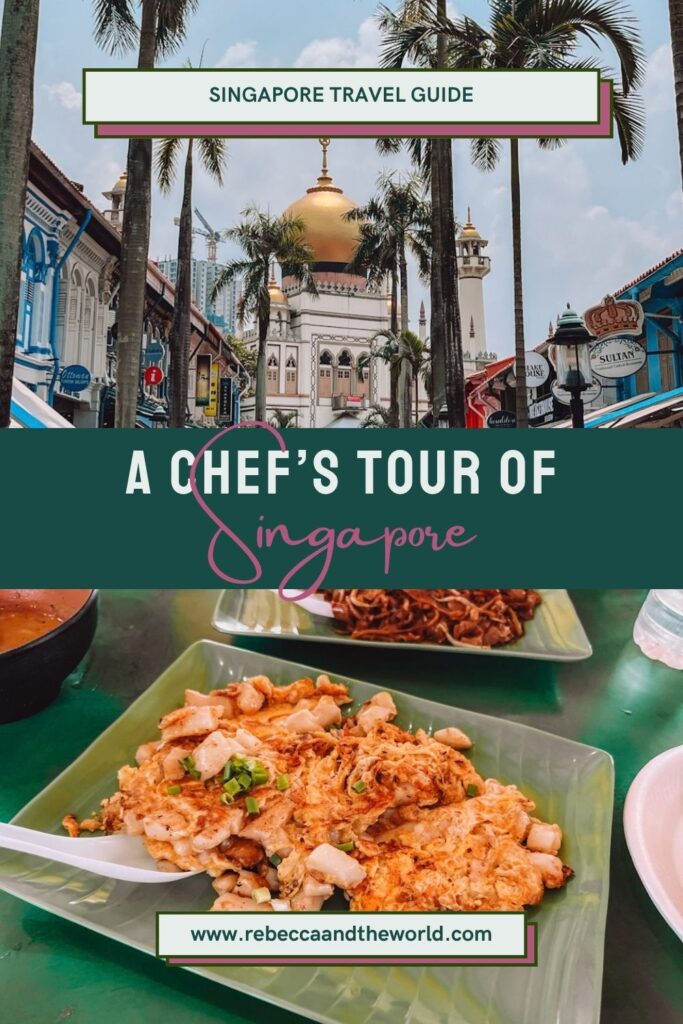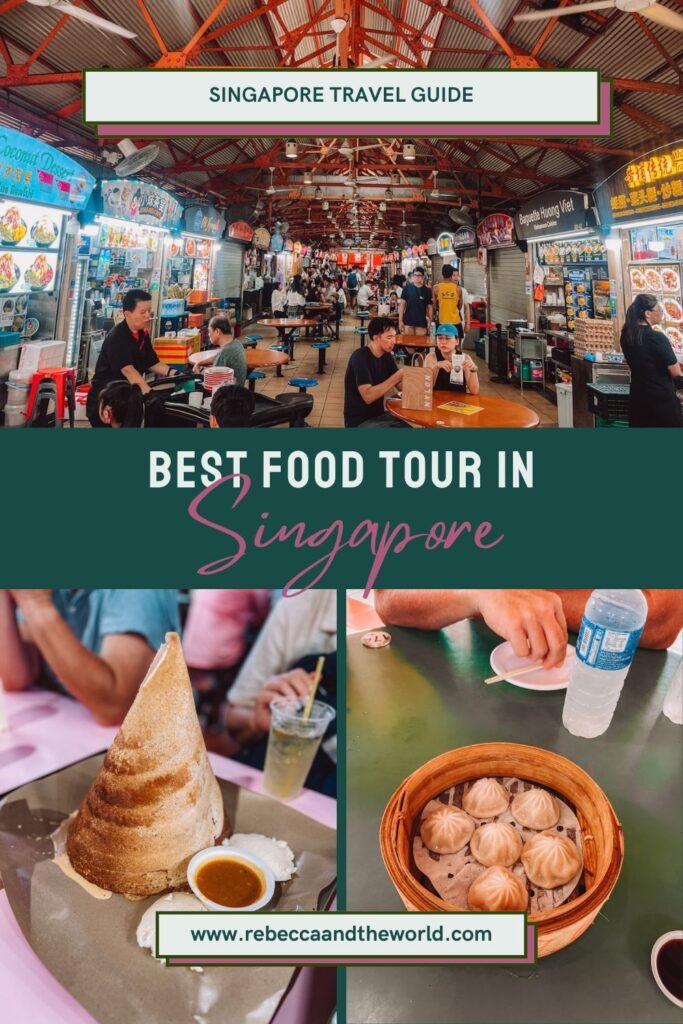

Looking for the best Singapore food tour? Here’s my review of A Chef’s Tour’s “Singapore Stories” experience!
Singapore’s food scene is one big story about the people who built the city – Chinese, Malay, Indian and Eurasian communities all cooking side by side, sometimes borrowing from each other, sometimes fiercely protecting a recipe that’s been in the family for generations.
I love a good food tour, and while it’s easy to eat your way through Singapore solo, I wanted a guide to help me make sense of this city-state’s food story, so I booked the Singapore Stories tour with A Chef’s Tour.
This wasn’t my first rodeo with the company. Singapore was my fifth time with A Chef’s Tour, after Kuala Lumpur, Bangkok, Bogota and Santiago, and it’s become one of my go-to bookings whenever I land somewhere new. What keeps me coming back is that they don’t just walk you through the most Instagrammed places in town. The itinerary for the Singapore food tour, for example, is a mix of hawker legends, family-run holes-in-the-wall and the odd Michelin-recognised stop, and the guides are always full of the history and culture behind what you’re eating.
The Singapore edition did not disappoint. Four hours, three neighbourhoods and more dishes than I could count on two hands later, I walked away with a much deeper understanding of how Chinese, Malay and Indian cuisines have shaped this city – and a very full stomach. If you’re planning your Singapore itinerary, this is one tour I definitely recommend you add!
This blog post may contain affiliate links, meaning if you book or buy something through one of these links, I may earn a small commission (at no extra cost to you).
A Chef’s Tour Singapore food tour at a glance
- Duration: 3.5-4 hours
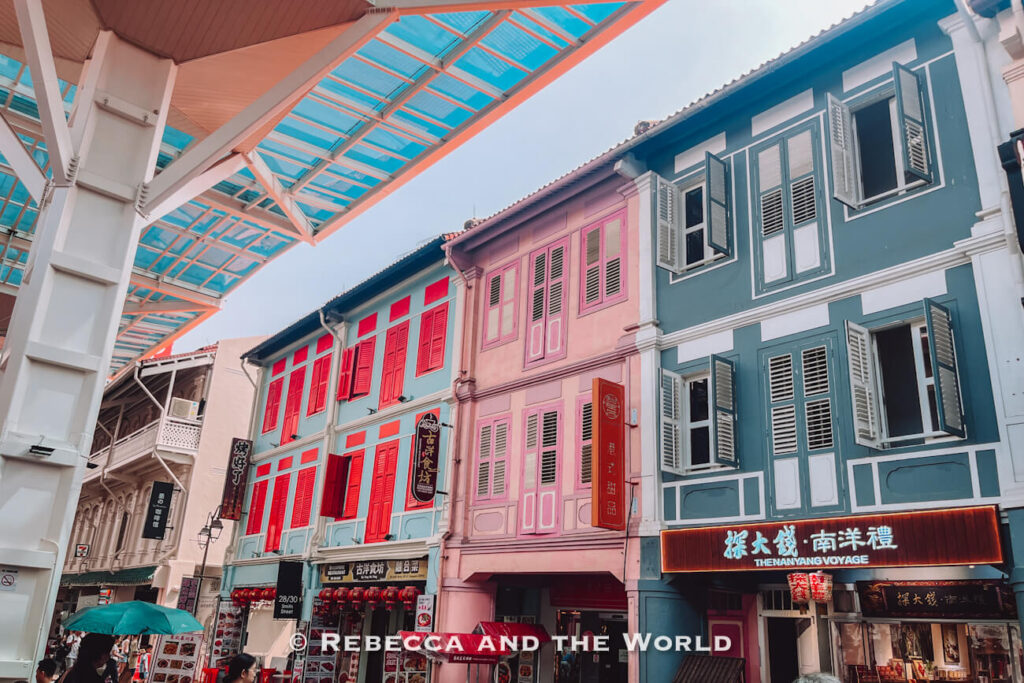
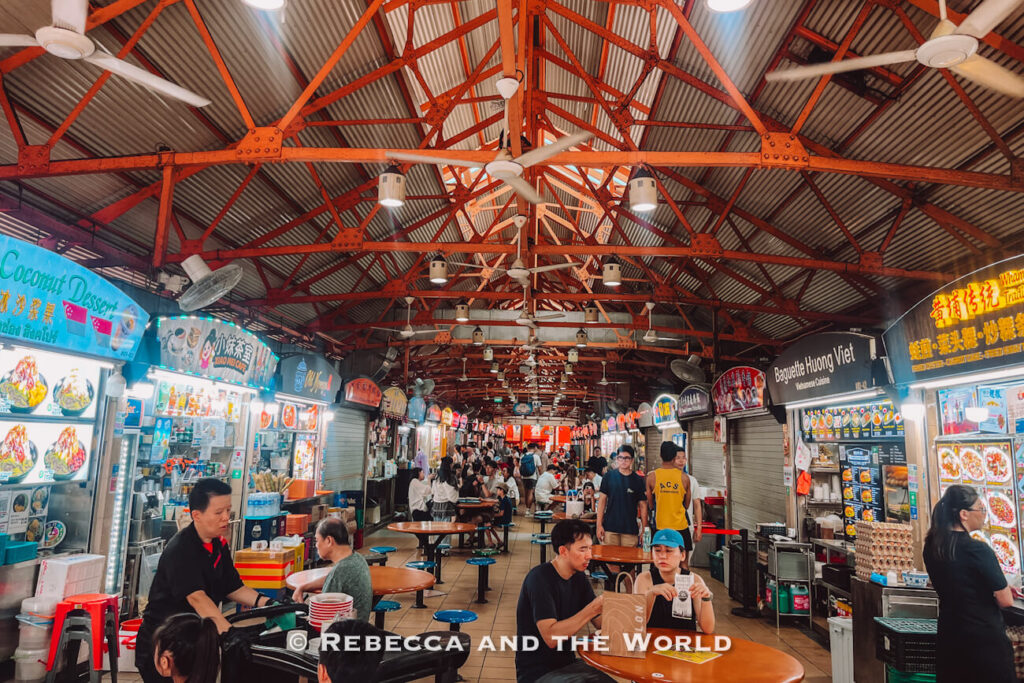
- Stops: Maxwell Food Centre and Chinatown, Little India, Kampong Glam
- Tastings: 12+ dishes
- Price: From US$99 per person
- Group size: Small group, maximum 8 guests; private tours available on request
- How to book: Book the Singapore Stories tour here
🍜 BOOK A CHEF’S TOUR SINGAPORE STORIES ONLINE HERE 🍜
Best food in Singapore
Before we dive in, this isn’t meant to be a comprehensive list of Singapore’s must-eat dishes. It’s what I tried on this particular Singapore food tour, and it’s not even everything I ate! Between Maxwell Food Centre, Chinatown, Little India and Kampong Glam we tasted well over a dozen things across four hours. These are the standouts.
Xiao long bao
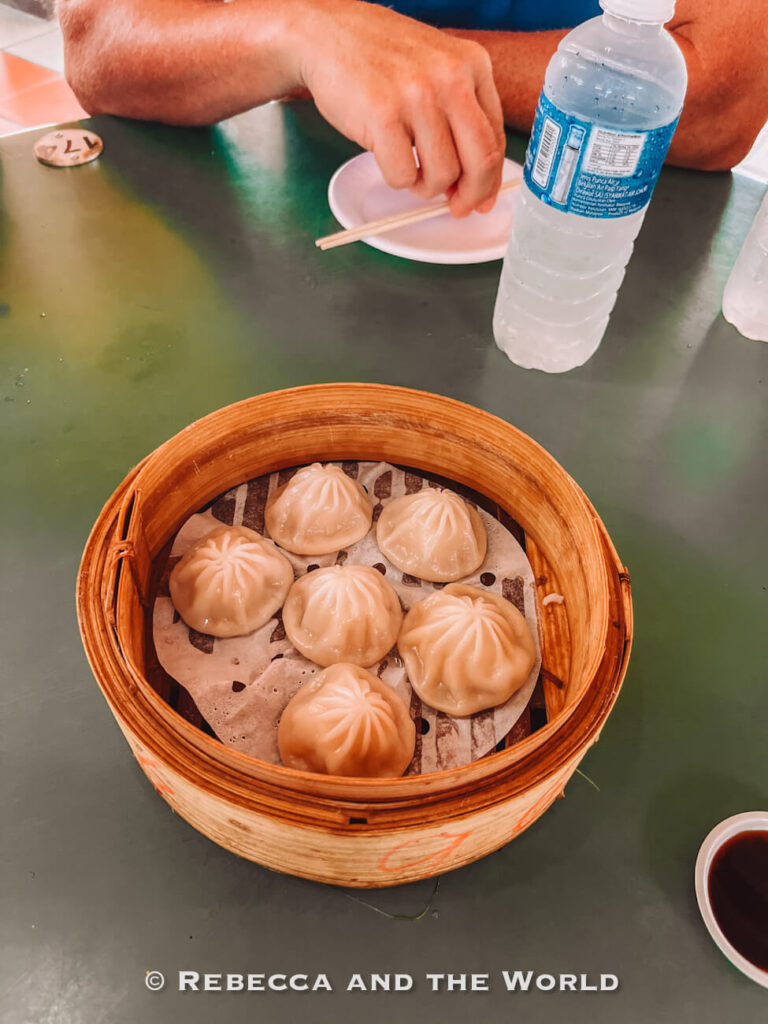
Our first stop, inside Maxwell Food Centre, was xiao long bao – the soup-filled dumplings that most people associate with Shanghai rather than Singapore. They’re thought to have been invented in the late 19th century in Nanxiang, a town on Shanghai’s outskirts, when a restaurant owner started filling steamed buns with a jellified meat stock that melts into broth as the dumpling cooks.
It’s not the dish that first comes to mind for Singaporean hawker food, and that was rather the point. Much of Singapore’s Chinese food heritage comes from Hokkien, Teochew, Cantonese and Hainanese immigrants, so kicking off with a Shanghainese dish was a reminder that “Chinese food” in Singapore is really shorthand for several distinct regional cuisines that all happened to land on the same small island.
Ours arrived piping hot. Our guide Dayne had to show some of our group how to eat them so you don’t end up with a mouth full of burning soup.
Singapore laksa
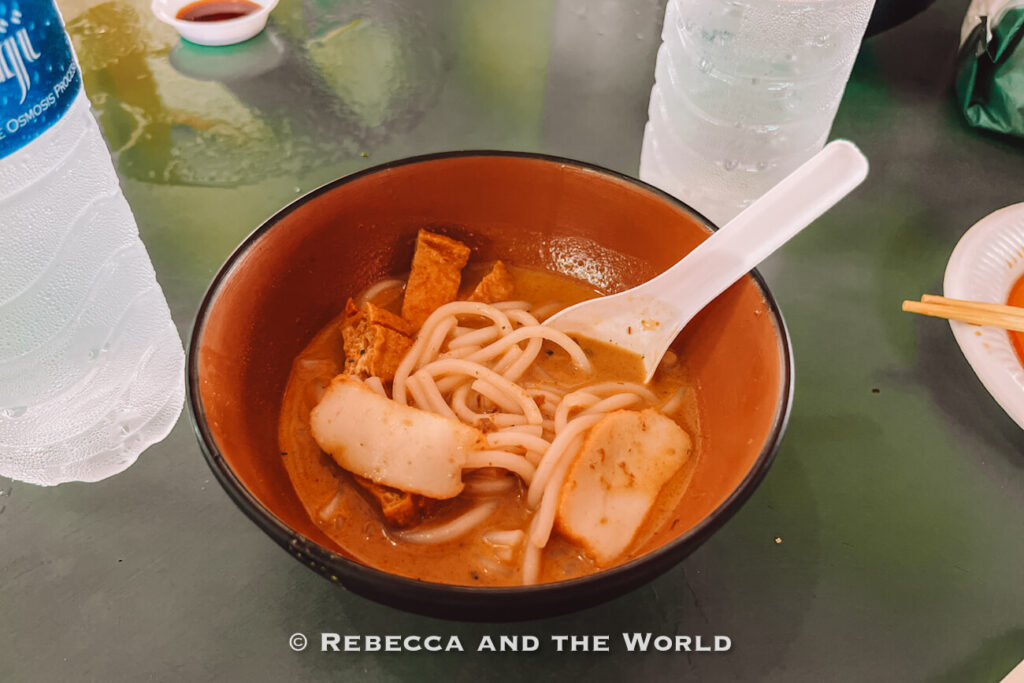
Next up on the Singapore food tour was laksa – a bowl of thick rice noodles in a rich, spicy coconut broth, topped with coriander, tofu puffs and fish cake.
Laksa is one of the clearest expressions of Peranakan (Straits Chinese) cuisine, born when Chinese immigrants who settled in Malacca and the Straits Settlements from the 15th century onwards married local Malay women and their kitchens blended. The result: Chinese noodle traditions meeting Malay spices and coconut milk.
Singapore has its own take, often associated with Katong in the city’s east, where the noodles are traditionally cut short so the whole bowl can be eaten with just a spoon. Ours wasn’t the assam (sour, tamarind-based) version but the richer, coconut-based style – warming and just a little bit spicy.
Popiah
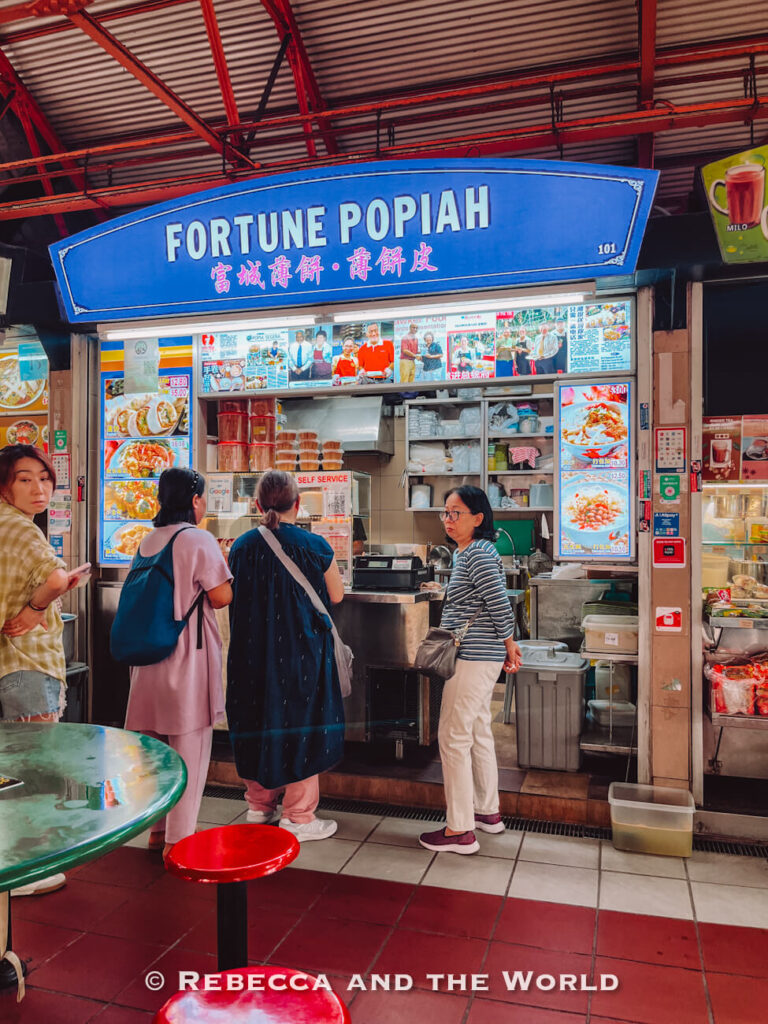
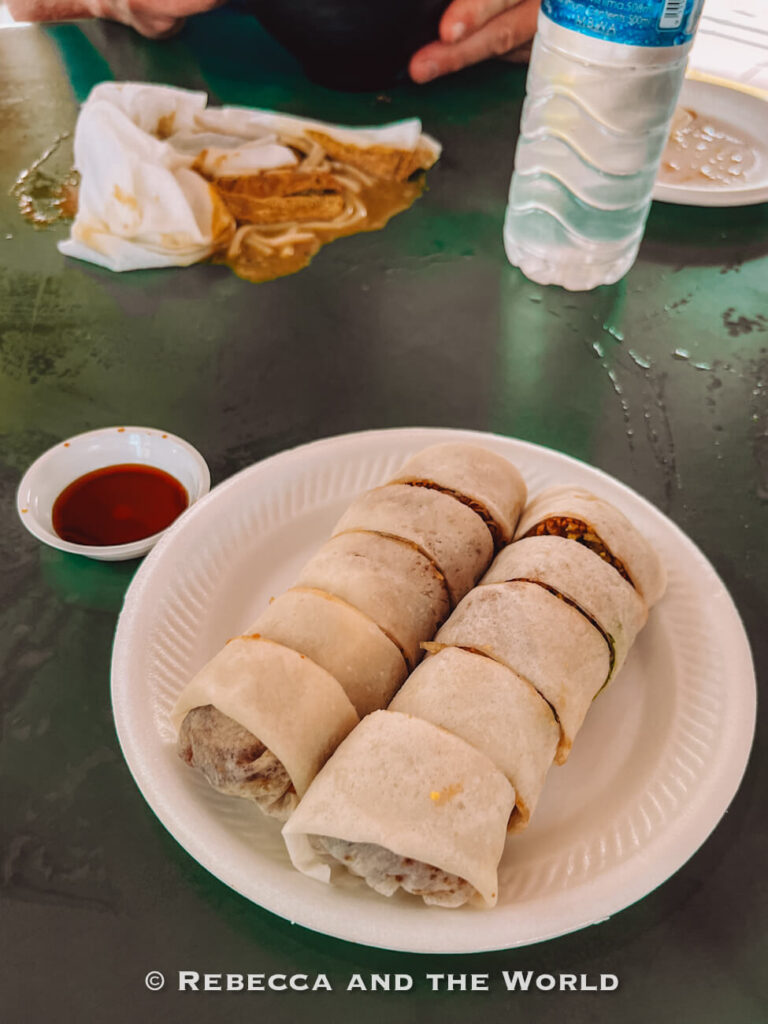
Popiah translates to “thin cake” or “thin pancake” (po meaning thin, piah meaning cake), and it’s essentially a fresh, unfried spring roll. It’s a Hokkien and Teochew dish, traditionally eaten during the Qingming Festival, when families visit ancestral graves and eat “cold food” as part of the observance.
We learned from Dayne that classic versions use cabbage, but the Chinese immigrants who brought the dish to Singapore couldn’t easily find it, so they substituted turnip instead – and that substitution stuck, becoming the local standard.
Ours was filled with turnip, cucumber, egg yolk and peanuts, wrapped in a soft, thin skin. It’s vegetarian and traditionally a daytime dish, and it was easily one of the freshest-tasting things we ate all day.
Carrot cake
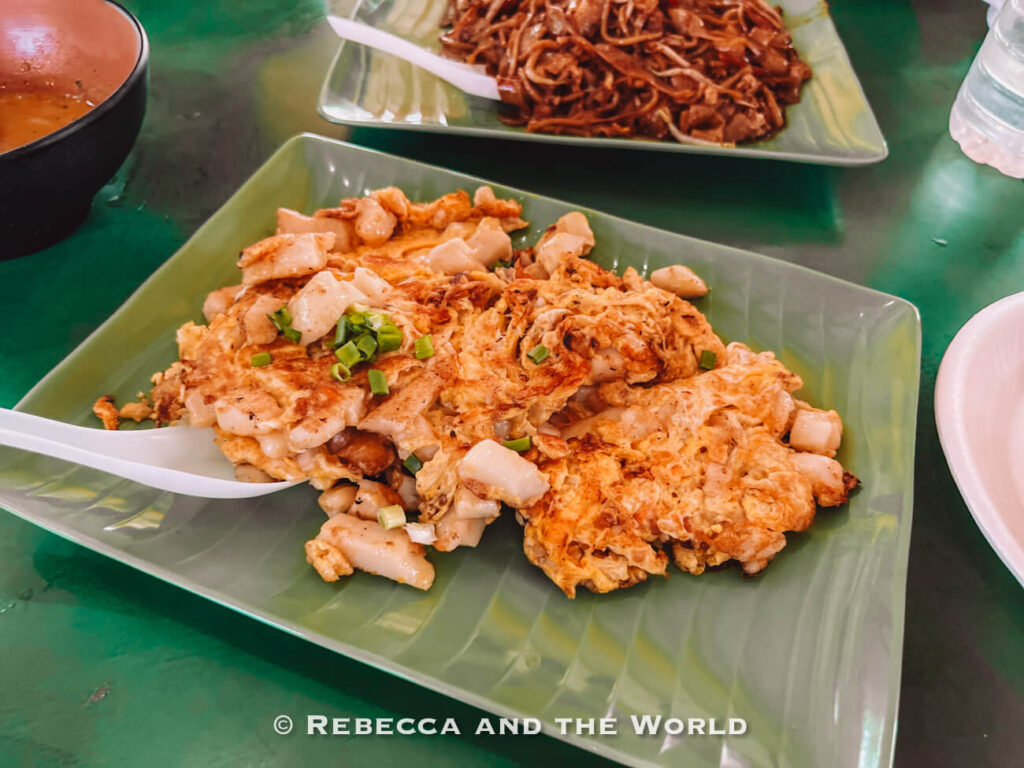
Despite the name, there isn’t a carrot anywhere near this dish – it’s made from daikon radish, which resembles a pale carrot, hence the mistranslation that stuck. In Teochew, chai tow means radish and kway means rice cake, and the dish (chai tow kway) was brought to Singapore by Teochew immigrants in the late 19th and early 20th centuries.
To make it, the daikon is steamed, mixed with rice flour, steamed again, then fried with egg, garlic and vegetables until it’s crisp on the outside and soft within. One of our group described it quite well: it’s like a savoury omelette rather than a stir-fry dish.
Surprisingly, this was my first time eating carrot cake and I loved it – I could have eaten the entire portion myself.
Char kway teow
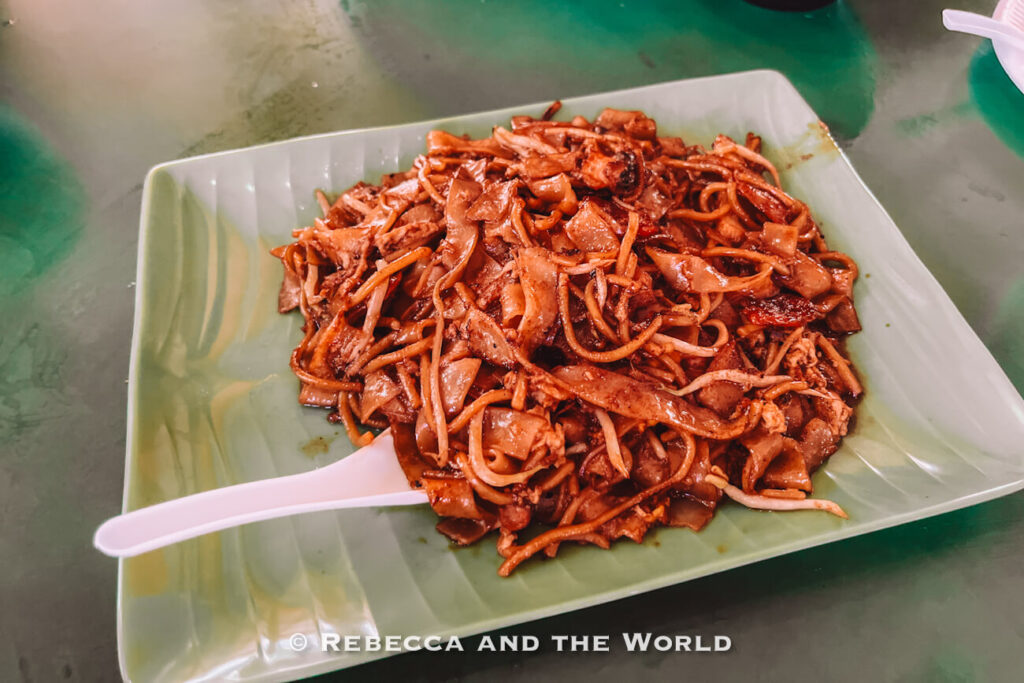
Char kway teow is one of my favourite dishes – flat rice noodles fried hard and fast over intense heat with egg, Chinese sausage and bean sprouts, finished with a smoky char known as wok hei (“breath of the wok”). It’s a Teochew dish, its origins tracing back to Chaoshan in Guangdong province, and like carrot cake, it began life as cheap, calorie-dense fuel for dock workers and labourers – lard, dark soy sauce and rice noodles were simply what was affordable and available.
The Singapore version leans into dark soy sauce for a deeper colour and sweeter finish than you’ll find in, say, Penang, and traditionally includes blood cockles, a holdover from when they were cheap and plentiful for the working class. Ours skipped the cockles but had plenty of smoky char and a hit of umami from the sausage.
As Dayne pointed out, it’s meant to be eaten right alongside the carrot cake, not after it – two humble, working-class dishes that have both become hawker icons in their own right.
Curry puff
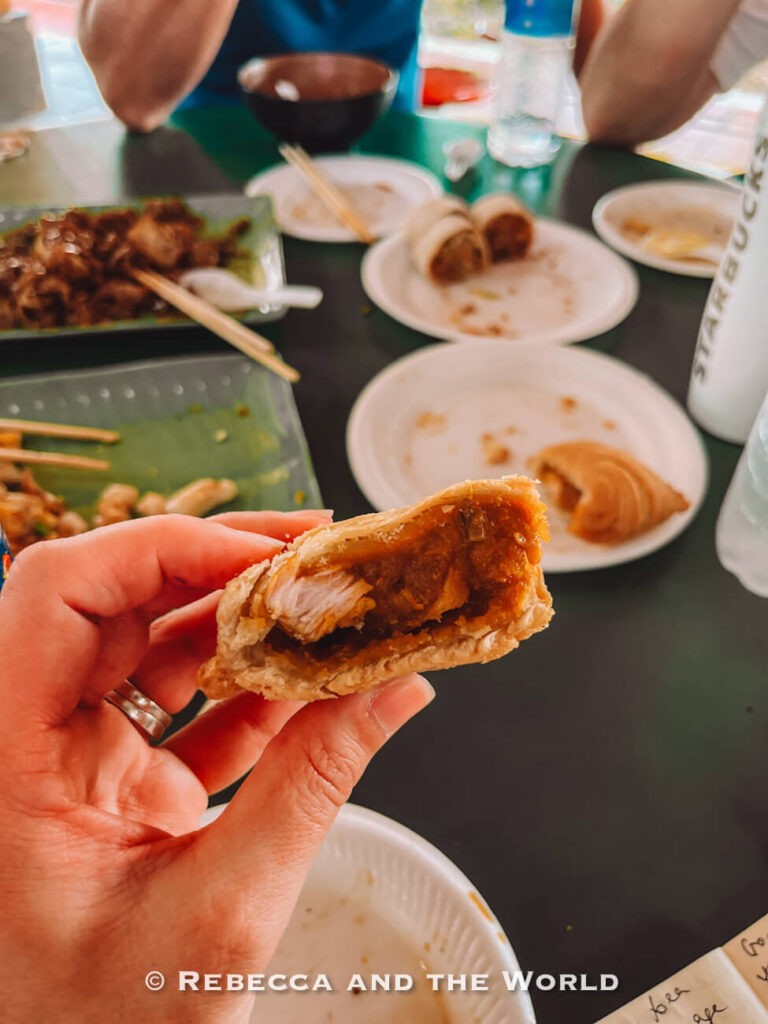
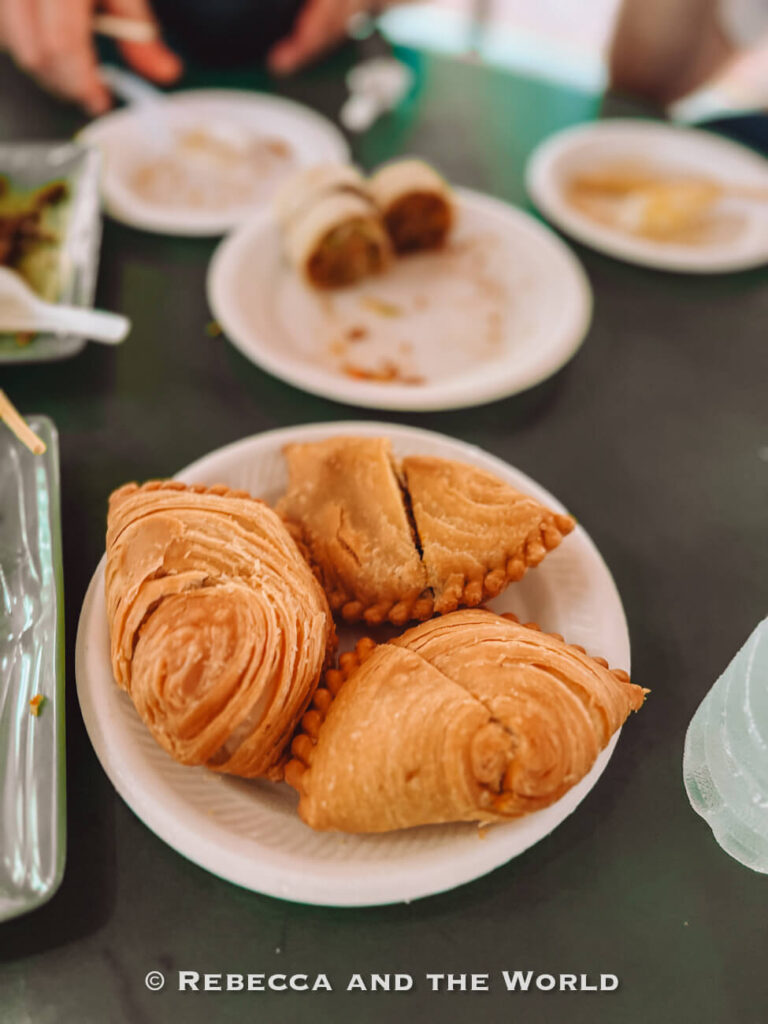
A small, easy-to-eat pastry you could carry around and snack on – ours was filled with potato, egg and chicken curry.
The curry puff’s history is a tangled one: it’s variously credited to the British Cornish pasty, the Portuguese empanada and the Indian samosa, all filtered through Singapore and Malaysia’s colonial-era food culture. The filling has a clearly Indian influence, while the pastry technique and shape borrow from European hand pies.
It’s a neat little snapshot of Singapore’s food story in miniature: a British name, a pastry shaped by Portuguese and Cornish traditions, and an Indian-spiced filling, all sold from a hawker stall.
Ours was warm, flaky and gone in about four bites.
→ READ NEXT: How to spend 2 days in Singapore
Egg tart
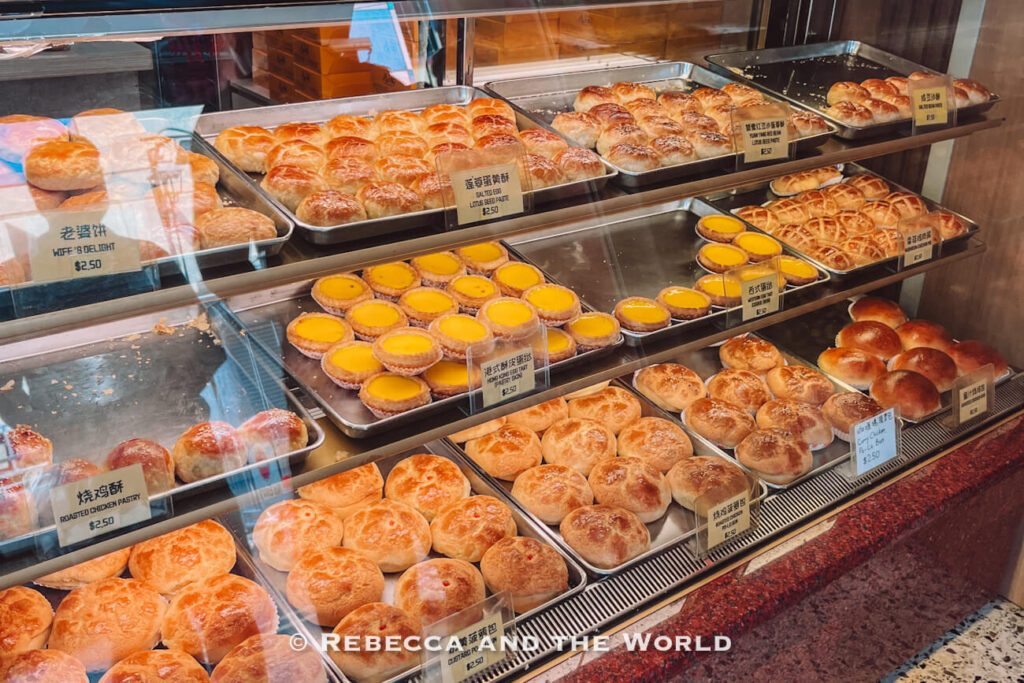
A Cantonese bakery stop in Chinatown gave us our first sweet dish of the day: a small, warm egg custard tart, straight out of the oven. Despite looking similar to Portugal’s famous pastel de nata, the Cantonese egg tart (daan tat) actually descends from the British custard tart, not the Portuguese one. The story goes that it was invented in Guangzhou in the 1920s, when British colonial trade brought custard tarts to the only Chinese port then open to Europeans. Local bakers copied the idea but swapped butter for lard, since it was cheaper and more available, giving the pastry its distinctive flaky, layered crust. After the Second World War, the daan tat travelled south with Cantonese immigrants into Hong Kong, where it became the version most people now know.
Compared to a Portuguese egg tart, the daan tat has a smoother, glossier custard and a much less sweet, less caramelised top. Ours had a thick, short pastry shell and a custard that was warm and only lightly sweet – closer to a savoury custard than a dessert, and completely different to the Portuguese-style tarts I’ve had elsewhere. (I still much prefer the Portuguese pasteis de nata!)
Soya marinated chicken
With so many Michelin stars in Singapore, you can’t have a food tour without trying a Michelin dish.
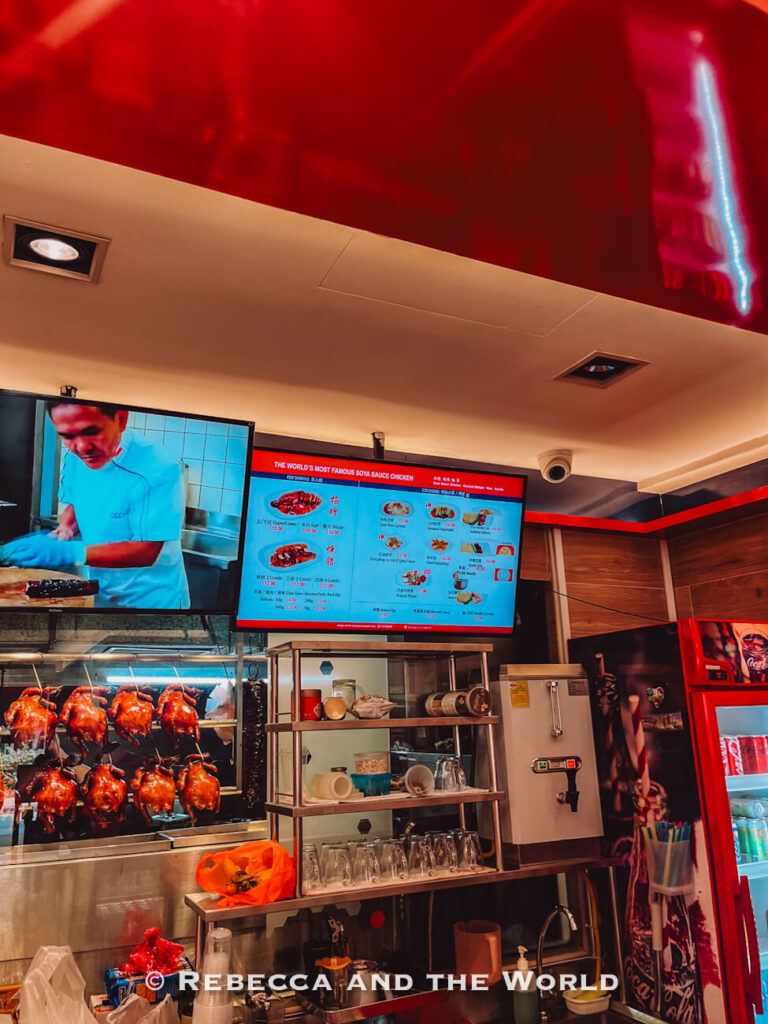
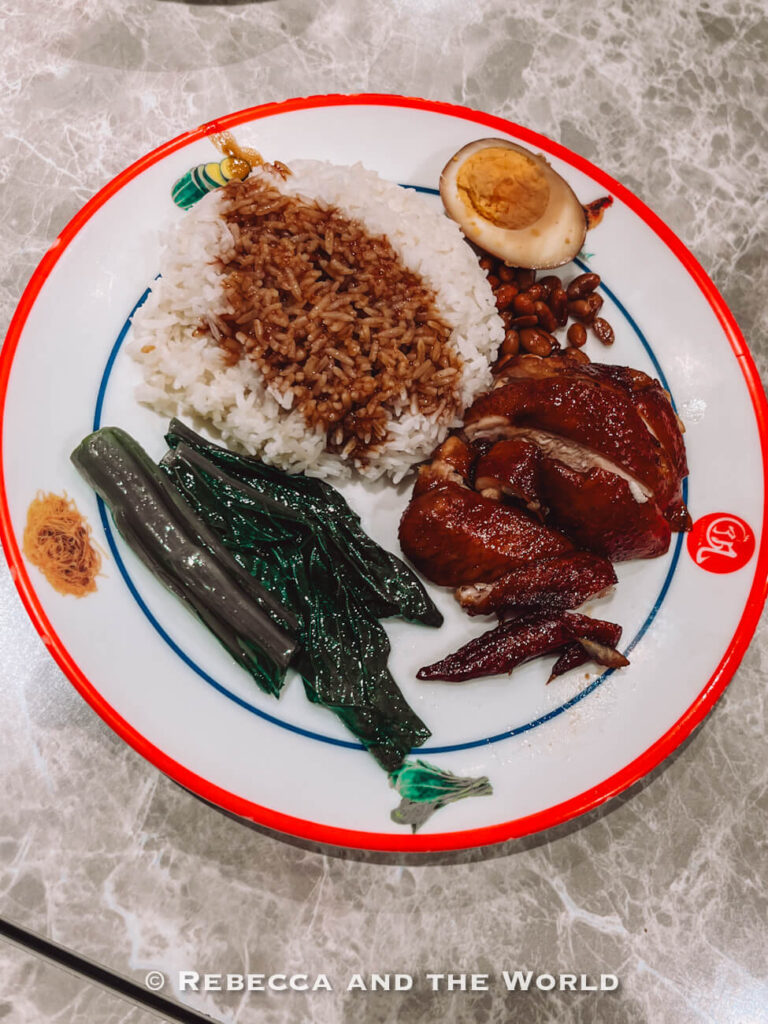
We sat down at a branch of Liao Fan Hawker Chan, self-styled as the world’s most famous soya sauce chicken. In 2016, founder Chan Hon Meng’s original stall in the Chinatown Complex Food Centre – then a humble corner counter selling a Hong Kong-style soya sauce chicken recipe he’d learned from a Hong Kong-trained chef – became one of the first two hawker stalls in the world to be awarded a Michelin star. Dayne told us Chan reportedly didn’t even know what the Michelin Guide was when the inspectors turned up, and that the recognition put Singapore’s hawker culture on the world stage in a way nothing else quite had.
The chicken itself is slow-braised in a soya marinade using small birds – around 1.8kg – for maximum tenderness, and served with vegetables, soya beans, egg and rice. It’s a specific style: soya sauce chicken rice is quite different from the more common Hainanese poached chicken rice you’ll find elsewhere in Singapore. At the time it won its star, a plate cost around S$2, making it the cheapest Michelin-starred meal in the world; when we visited it was still under S$7, which is remarkable value by any Michelin-adjacent standard.
We also had a fried tofu dish with a Thai dressing on the side – a lighter, tangier contrast to the rich, dark chicken.
(I found out after the tour, while I was researching this article, that Hawker Chan was later dropped from subsequent editions of the Michelin Guide Singapore, though its Smith Street branch still holds a Michelin Bib Gourmand recognition – the guide’s nod to exceptional value rather than a full star.)
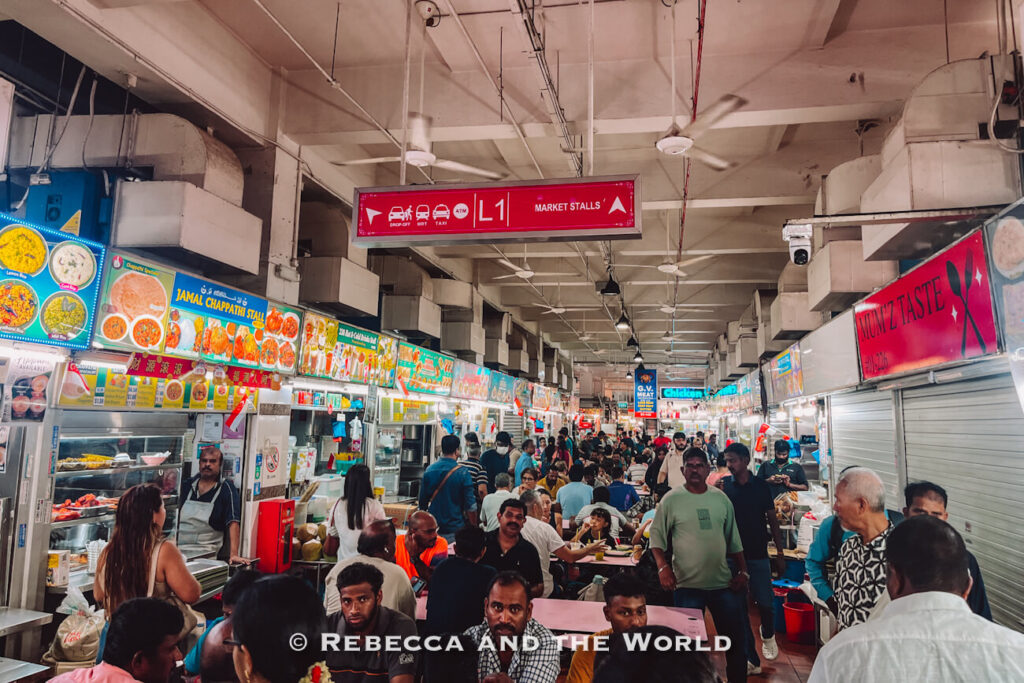
From Chinatown we hopped on the MRT to Little India, and the change in atmosphere was immediate – busier, louder, with incense and spices for sale instead of souvenirs. Before we sat down to eat, we had iced limau, a sweetened lime drink that tastes more like orange, and very welcome on a hot day.
Appam
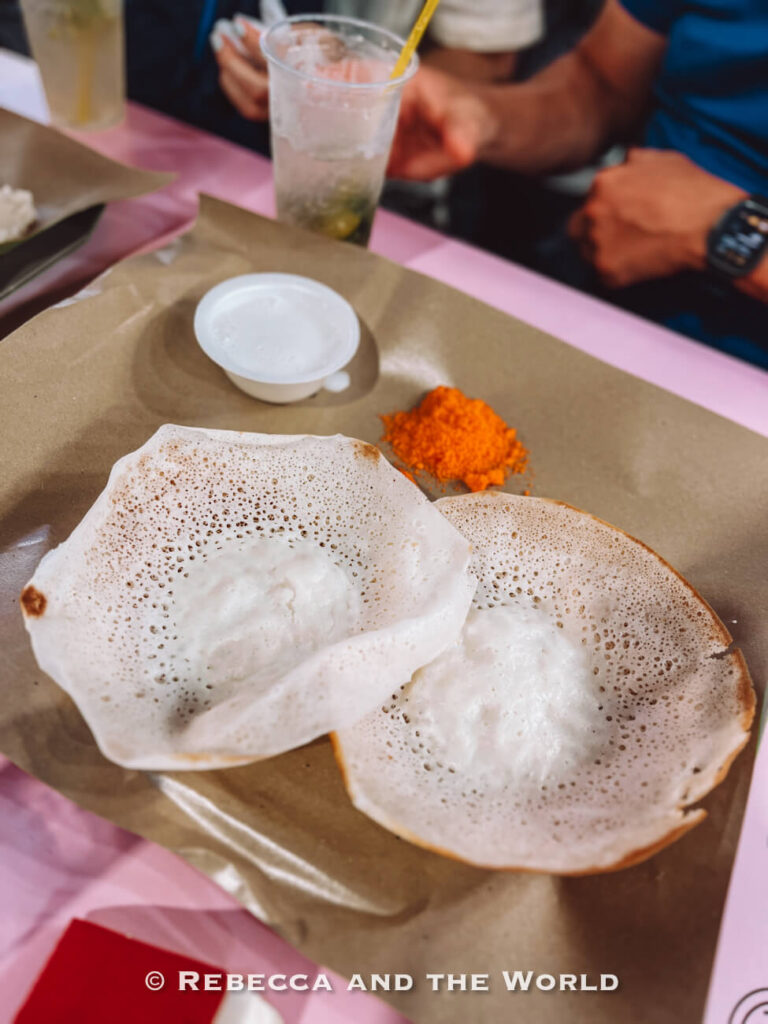
Appam is a bowl-shaped, lacy-edged pancake made from a fermented rice batter, cooked in a small, rounded pan called an appachatti so the batter pools thick and soft in the centre while the edges crisp up thin and crackly. It’s a South Indian dish and its history stretches back a long way – it’s mentioned in ancient Tamil poetry from around the Sangam period, roughly 2,000 years ago.
Ours came with coconut milk and a jaggery-like orange sugar syrup for dipping, a classic pairing that balances the appam’s mild, slightly sour tang (from the fermentation) against something sweet and rich.
We ate this at the same time as a few other Indian dishes, but I would have preferred to eat this after because it’s such a great dessert.
Dosai
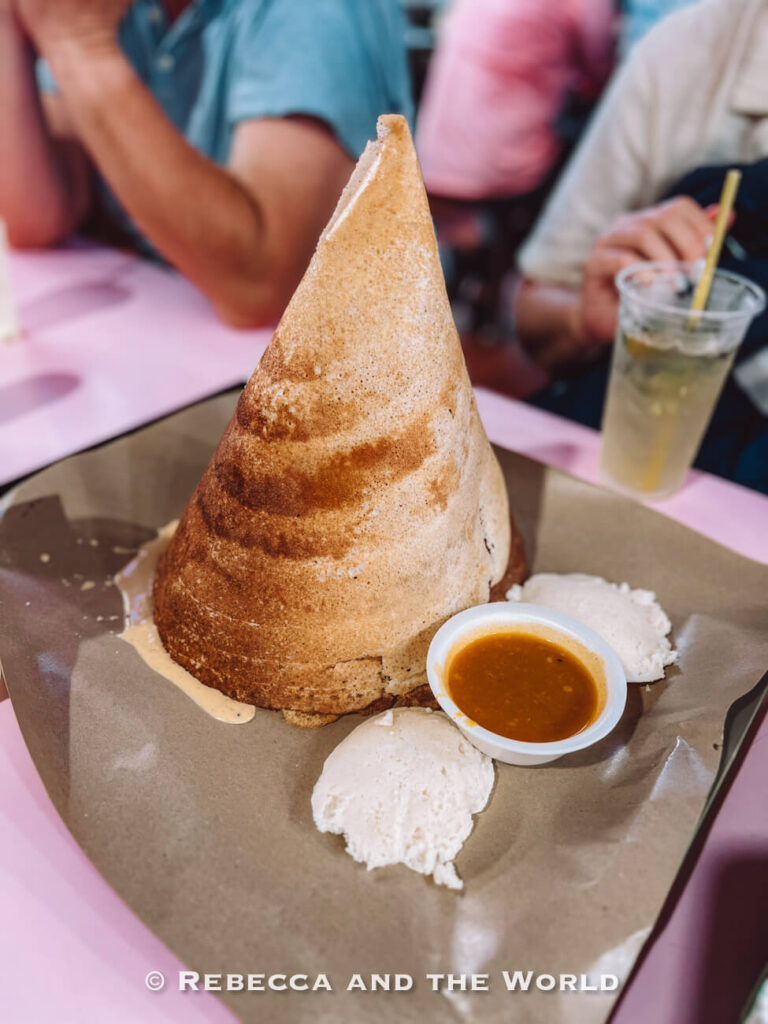
Dosai (or dosa) is one of South India’s most iconic foods – a thin, savoury crepe made from a fermented batter of rice and black gram (urad dal), cooked until crisp on a hot griddle. Like appam, its roots go back centuries in Tamil culinary tradition.
Ours was rolled into the classic cone shape and served with a potato curry, and we ate it by hand rather than with cutlery. Crisp on the outside, soft where it meets the potato filling, and one of my favourite bites of the whole tour.
Murtabak
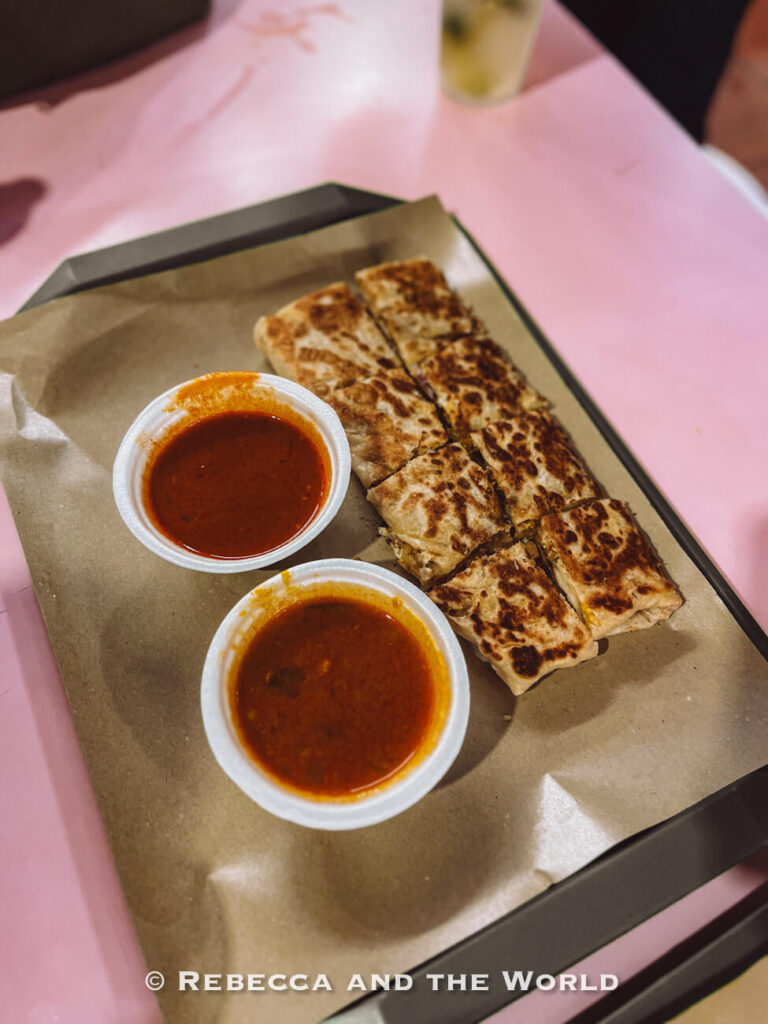
Our final dish in Little India was murtabak, known here as “Indian pizza” for its stuffed, folded shape – though its actual origins trace back further and further afield than that nickname suggests. The name comes from the Arabic mutabbaq, meaning “folded,” and the dish is thought to have originated in Yemen or the Arabian Peninsula before Tamil Muslim traders carried it across the Indian Ocean into Southeast Asia, adapting it along the way with South Indian influences from Kerala. In Singapore it’s strongly associated with the Indian Muslim community around Little India and Kampong Glam.
Ours was filled with mutton, folded and pan-fried until crisp, and served alongside both a fish curry and a mutton curry for dipping. It’s rich and filling.
🍜 BOOK A CHEF’S TOUR SINGAPORE STORIES ONLINE HERE 🍜
Do I recommend this tour?
Dayne was clearly passionate about food and about sharing it with visitors, which came through in every stop – he wasn’t just reciting facts, he really wanted us to understand why each dish mattered to the people who make it.
Pacing-wise, four hours was exactly enough to keep tasting without ever feeling rushed or overstuffed. We had time to actually digest as we went. Our group of five felt like a comfortable size too – especially when we moved through the busier areas of Little India.
On value: at US$99 per person, this isn’t the cheapest food tour in Singapore, but it’s good value for four hours, three neighbourhoods and 12+ tastings led by someone who clearly knows the city’s food history inside out. You’ll leave full, and you won’t need to plan another meal for the rest of the day.
I’d recommend this to first-time visitors wanting an introduction to Singapore’s food scene – but don’t assume it’s only for beginners. I’ve been to Singapore more than ten times and still tried dishes on this tour I’d never had before.
What to know before booking
Dietary restrictions: The tour can accommodate lactose intolerance without issue, but it’s not a great fit for vegetarians or vegans, since meat and seafood (including shrimp paste) feature across more than half the dishes with no alternatives offered. Those avoiding beef are well catered for, and pork, seafood and gluten are each present in only a couple of dishes if you need to work around them. If you have specific dietary needs, contact A Chef’s Tour before booking.
Arrive hungry: You’ll be eating more or less continuously for four hours, so skip breakfast (or keep it light) and come prepared to graze your way around the city.
What to bring: Comfortable walking shoes are a must – you’ll be on your feet the whole time, with a subway ride between neighbourhoods. Wear weather-appropriate clothing (Singapore is hot and humid year-round), and pack an umbrella, which doubles as protection from sudden tropical downpours and the midday sun. A small USB or battery-powered personal fan is also worth packing to stay cool between stops! You’ll be given a bottle of water when the tour starts, and your guide carries wet wipes and napkins.
🍜 BOOK A CHEF’S TOUR SINGAPORE STORIES ONLINE HERE 🍜
Wrap-up: Singapore food tour
Four hours, three neighbourhoods and more dishes than I can count later, this is one of the best ways I’ve found to understand Singapore’s food story. If you want to understand how Chinese, Malay and Indian cuisines have shaped this city, one dish and one story at a time, I can’t recommend A Chef’s Tour Singapore Stories tour highly enough.
🍜 BOOK A CHEF’S TOUR SINGAPORE STORIES ONLINE HERE 🍜
FAQs: A Chef’s Tour Singapore
Is the tour suitable for vegetarians or vegans?
Not really. Meat and seafood, including shrimp paste, feature in more than half the tastings with no substitutes offered, and the tour isn’t set up for vegans at all. If you’re vegetarian or vegan, this probably isn’t the right tour for you – reach out to A Chef’s Tour directly if you want to double-check before booking.
How much walking is involved?
A moderate amount, but it’s a gentle pace on flat terrain, and you’re rewarded with a food stop every 15-20 minutes or so. You’ll also hop on the MRT a couple of times, so it’s not a continuous four-hour walk.
Can I book a private tour instead of a group tour?
Yes. This runs as a small-group tour (up to eight guests) by default, but A Chef’s Tour offers a private version of the same route on request.
What happens if it rains?
Singapore gets sudden, heavy downpours, but since most of the tour takes place inside covered hawker centres and along sheltered walkways, tours generally go ahead as planned. Pack an umbrella and you’ll be fine either way.
Is tipping expected?
Tipping isn’t a strong local custom in Singapore, and it’s not built into the tour price. That said, if your guide goes above and beyond, a small tip is always appreciated, though never required.
Do I need to bring cash, or is everything included?
All 12+ tastings and drinks are included in the price you pay when booking, so you don’t need cash for food. It’s still worth carrying a bit for anything extra you might want to buy along the way, or in case you’d like to tip your guide.
Is the tour suitable for kids?
Yes, families are welcome, and children under 13 go at half price. Given the amount of walking and the four-hour duration, it’s best suited to kids who are happy being out and about for a full morning or afternoon, and who aren’t fussy eaters.
How far in advance should I book?
This is a popular tour with a small group size, so I’d recommend booking at least a few weeks ahead, and earlier if you’re travelling during a peak season (school holidays, major festivals).
Did you find this article helpful? Consider buying me a coffee as a way to say thanks!
If you’re looking for the best Singapore food tour, I hope this review of A Chef’s Tour experience has helped you decide. Let me know in the comments below what you think of the tour.
Read next
Before you go, you might like these travel articles:
- 2 Days in Singapore: The Perfect First-Time Visitor’s Itinerary
- Where to Stay in Singapore (COMING SOON)
- Travelling from Singapore to Bangkok by Train: The Ultimate Overland Adventure
- How to Spend 2 Days in Kuala Lumpur
BOOKING A TRIP SOON? HERE ARE SOME HELPFUL LINKS
- Book your flight online with Skyscanner – it’s where I always start my flight research. (I then book directly with the airline.)
- One thing I always purchase is travel insurance. Travel Insurance Master allows you to compare across multiple policy providers, while SafetyWing is great for long-term travellers and digital nomads.
- Wise is my choice for sending and receiving money and spending money overseas (you can get a digital and physical card).
- Find a great hotel on Booking.com.
- How to get around? I use DiscoverCars for car hire, or Motorhome Republic and Jucy for campervan/RV rental. For buses, trains and ferries, I use 12GO, Busbud and Omio.
- Grab an e-sim to stay connected while on the road.
- Check out the huge range of day tours throughout major cities and countries on GetYourGuide, Klook or Viator. I’m always a fan of a good food tour!
- Saving money? Check out the huge range of free walking tours on GuruWalk (don’t forget to tip!).
- Stuff I always pack? A reusable water bottle, packing cubes and a handy electronics organiser. Check out my Amazon shop for all my fave travel items – everything from backpacks and suitcases to travel adapters and beauty products.
PIN IT FOR LATER: A CHEF’S TOUR SINGAPORE FOOD TOUR REVIEW
Save this Singapore food tour review to Pinterest so you can plan your trip later.