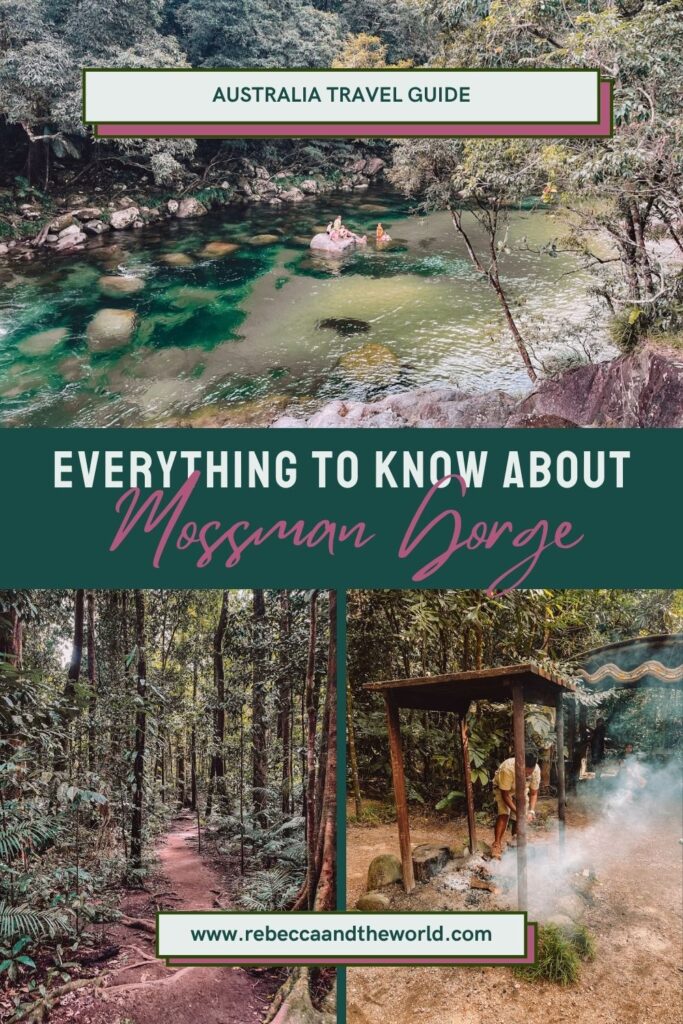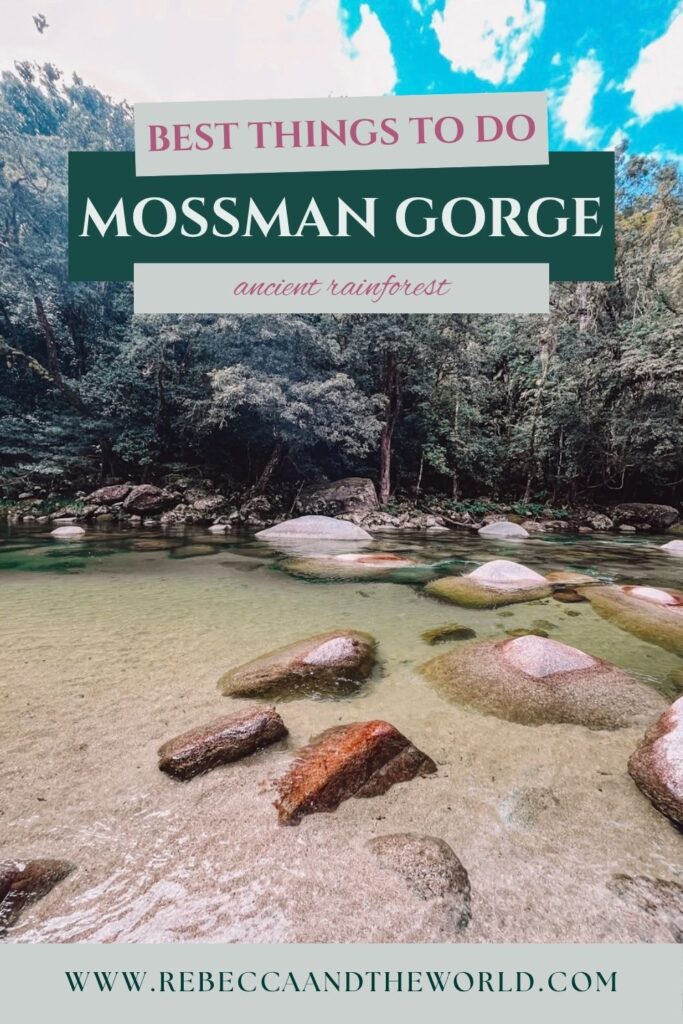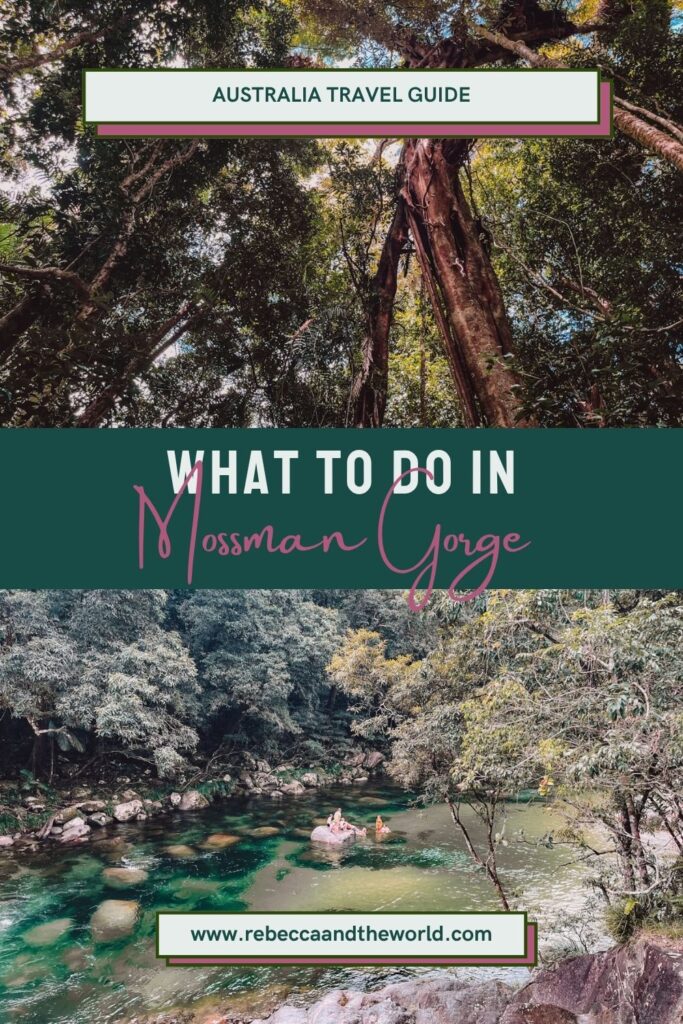

Planning a trip to Mossman Gorge? Here’s everything you need to know about the best walks and swimming spots, and practical information for visiting.
Mossman Gorge is one of those places where you truly feel small and you get a sense of just how old this earth really is. This landscape has been forming for millions of years, and you feel that the moment you step onto the boardwalk.
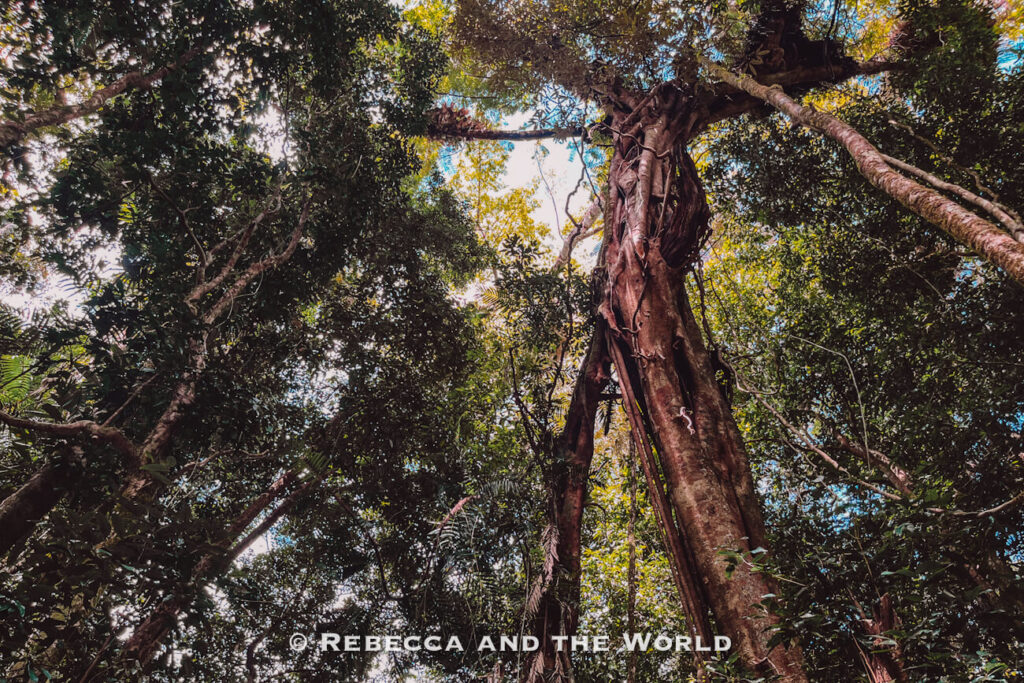
The trees are enormous, the boulders sitting in the river look like they’ve been there for centuries (because they have), and the whole gorge has a stillness to it that’s hard to describe until you’re standing in it.
Visiting Mossman Gorge was one of the highlights of our recent Tropical North Queensland road trip. Making up the southern portion of the enormous Daintree National Park, this is the easiest section to access – just a 25-minute drive from Port Douglas or an hour from Palm Cove. It’s well worth planning a half-day trip to explore this beautiful pocket of rainforest.
Here’s everything you need to know about visiting Mossman Gorge and my tips for making the most of your trip.
This blog post may contain affiliate links, meaning if you book or buy something through one of these links, I may earn a small commission (at no extra cost to you).
Visiting Mossman Gorge: Quick facts
- Opening hours: The Mossman Gorge Centre and shuttle operate from 8am to 5pm, seven days a week (closed Christmas Day)
- Entry cost: Free to enter the national park, but you’ll need to pay for the shuttle bus. There are also paid guided walking tours available
- Shuttle cost: $15.50 for adults, $7.75 for children aged 5-15, and free for kids under 5 (family passes are also available)
- Shuttle frequency: Every 15 minutes throughout the day, with the last shuttle departing the gorge at 4.30pm
- Is food available? There’s a good café on site or you can bring your own food for a picnic
→ READ NEXT: Best things to do in Port Douglas
How to get to Mossman Gorge
Mossman Gorge sits about 2km outside the small sugar cane town of Mossman, and the only way to get there is by road. There’s no public transport, so you’re either driving yourself or joining a tour.
Self-driving is the easiest option, and it’s what we did (in the Jucy campervan we hired). From Port Douglas, head back out along Port Douglas Road to the Captain Cook Highway and turn north towards Mossman. Once you’re in Mossman, follow the signs to Mossman Gorge Road – it’s well signposted and you can’t really go wrong. All up it’s about 20km and takes around 20 minutes.
From Cairns, it’s 77km along the Captain Cook Highway, which takes about 1 hour 15 minutes without stops. I say “without stops” because this is one of the most beautiful coastal drives in Australia, with the rainforest on one side and the Coral Sea on the other, and you’ll want to pull over at least a couple of times along the way!
→ READ NEXT: Cairns to Port Douglas drive: The best stops along the way (COMING SOON)
Tours are the other option – we saw several different tour groups on the day we visited. Day tours run from both Cairns and Port Douglas, and some bundle Mossman Gorge in with the Daintree River ferry crossing, a crocodile cruise and Cape Tribulation, which makes for a big (but brilliant) day. This highly-rated tour departs from Cairns or Port Douglas while this tour includes pick up from Port Douglas.
→ READ NEXT: Daintree Rainforest guide: What to see and do (COMING SOON)
Need to know: The Mossman Gorge shuttle
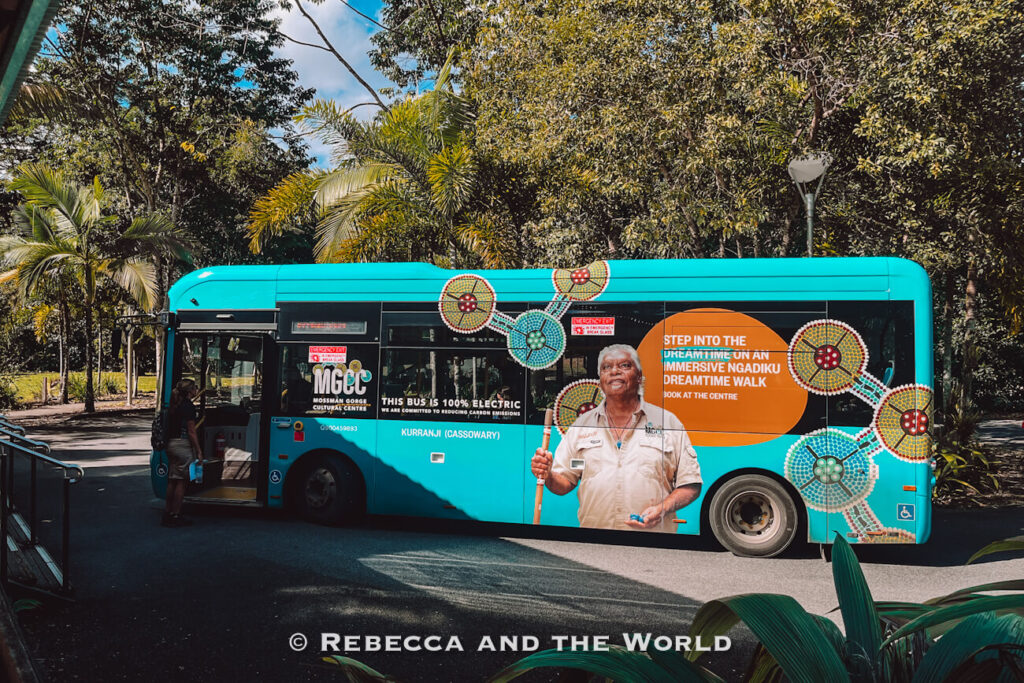
While entry to Mossman Gorge is free, you will have to pay for the shuttle bus (100% electric, very cool!), because you can’t drive your own car up to the trail head. Park your car in the large car park and jump on the bus instead.
You buy your shuttle tickets at the desk inside the Centre (you can also buy them online ahead of time), and your ticket covers unlimited trips for the day, so you can head back to the Centre for lunch and go out again if you want to. The shuttle runs every 15 minutes between 8am and 5pm. The last shuttle leaves the gorge at 4.30pm, so keep an eye on the time if you’re doing all the walks – you don’t want to be the one running down the path with the driver waiting!
I did see a few people walking the road instead of taking the shuttle, but there are signs explaining why that’s not a good idea. The road is narrow, there’s no dedicated pedestrian path and it also runs through a Kuku Yalanji community – walking isn’t just a safety issue, it’s a matter of respecting the community who live along that road.
It’s a 4km return walk, so honestly, just take the shuttle!
Important! If you’re doing the Ngadiku Dreamtime Walk, the shuttle is included in your ticket, so you don’t need to buy a separate shuttle pass.
→ READ NEXT: How to plan a Cairns to Cape Tribulation road trip
Things to do in Mossman Gorge
Here are the best things to do in Mossman Gorge. Plan to spend at least half a day here – although you could easily fill a whole day with walks, an Indigenous-led tour, swimming and a leisurely picnic.
Best walks in Mossman Gorge
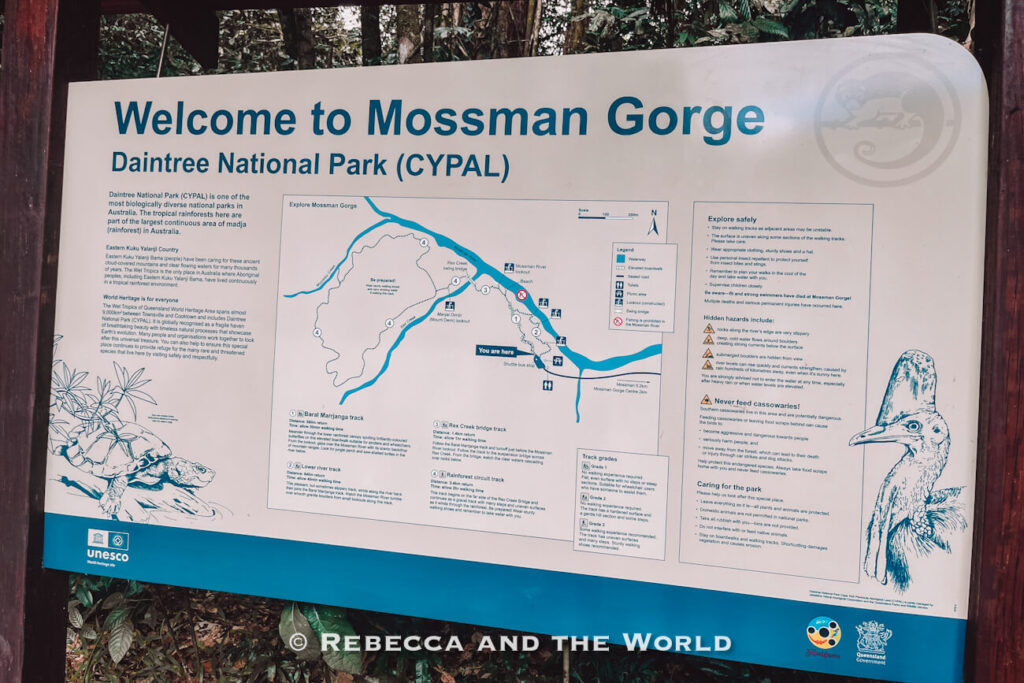
The Mossman Gorge walks are all fairly short and all connected to each other, which makes it easy to string together as much or as little walking as you want. If you do all four trails and lookouts, you’re looking at around 3.4km of walking in total, which took us a leisurely two hours with plenty of stops for photos and gawking at trees.
Only one section is wheelchair accessible, so if that’s a consideration for your group, stick to the Baral Marrjanga Walk. Everything else involves stairs, roots and uneven ground.
If you want to do the lot, start on the Baral Marrjanga Walk from the shuttle stop, continue over the Rex Creek suspension bridge and around the Rainforest Circuit Track (with the short detour to Wurrmbu Creek), then come back over the bridge and finish with the Lower River Track on your way to the shuttle stop.
I recommend arriving early if you like crowd-free trails – it gets busier around lunchtime.
Take plenty of water, and pack reef-safe sunscreen, insect repellent, your swimmers under your clothes and a towel.
Baral Marrjanga Walk (660m return)
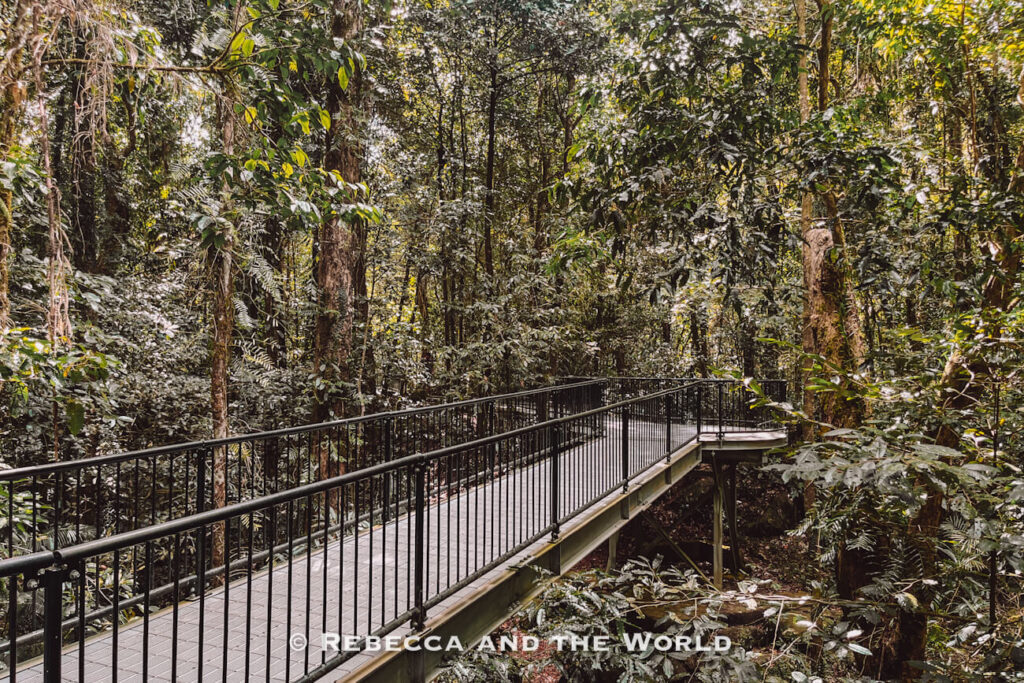
This is the short, wheelchair-accessible boardwalk that leads to the river lookout, and it’s where everyone starts. It’s a mix of concrete paths and raised boardwalks, and it’s really well done – the raised sections lift you up into the mid-canopy so at times you feel like you’re right up in the treetops.
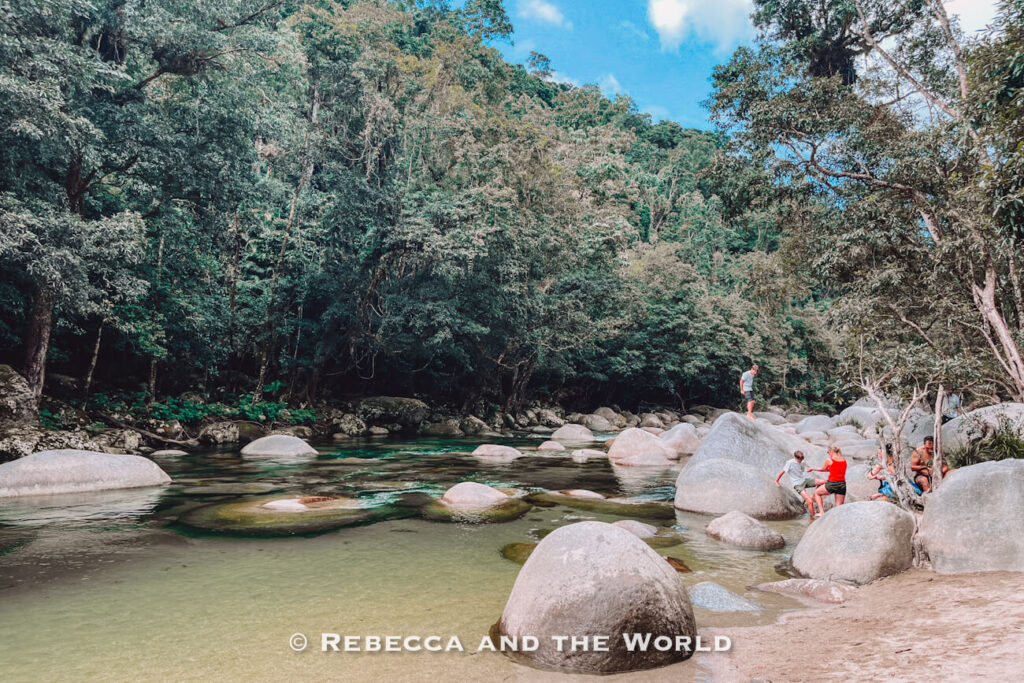
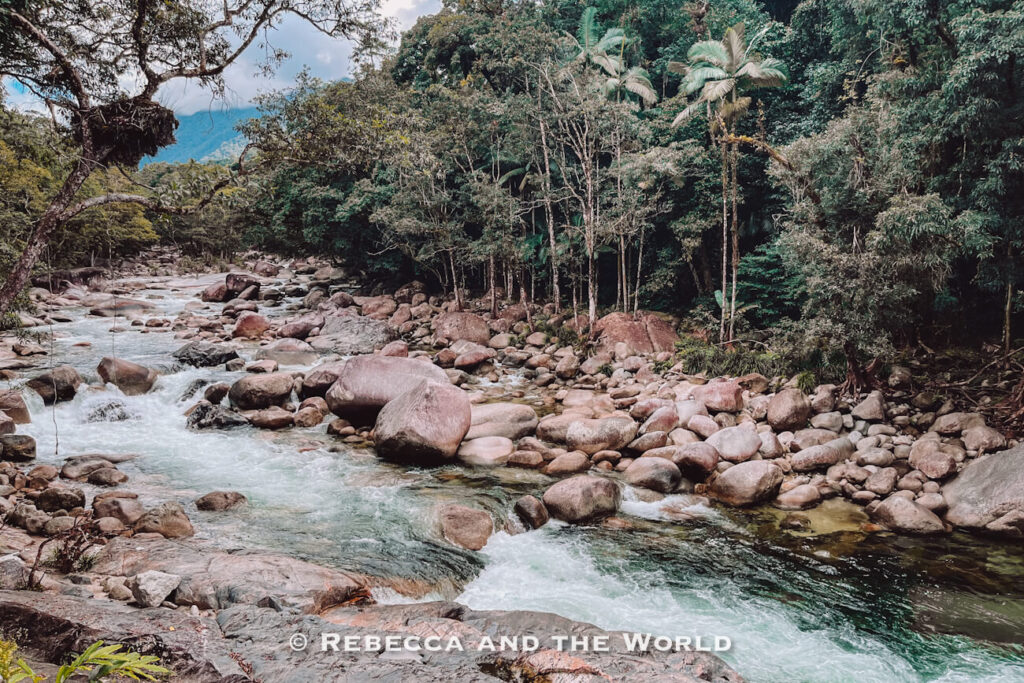
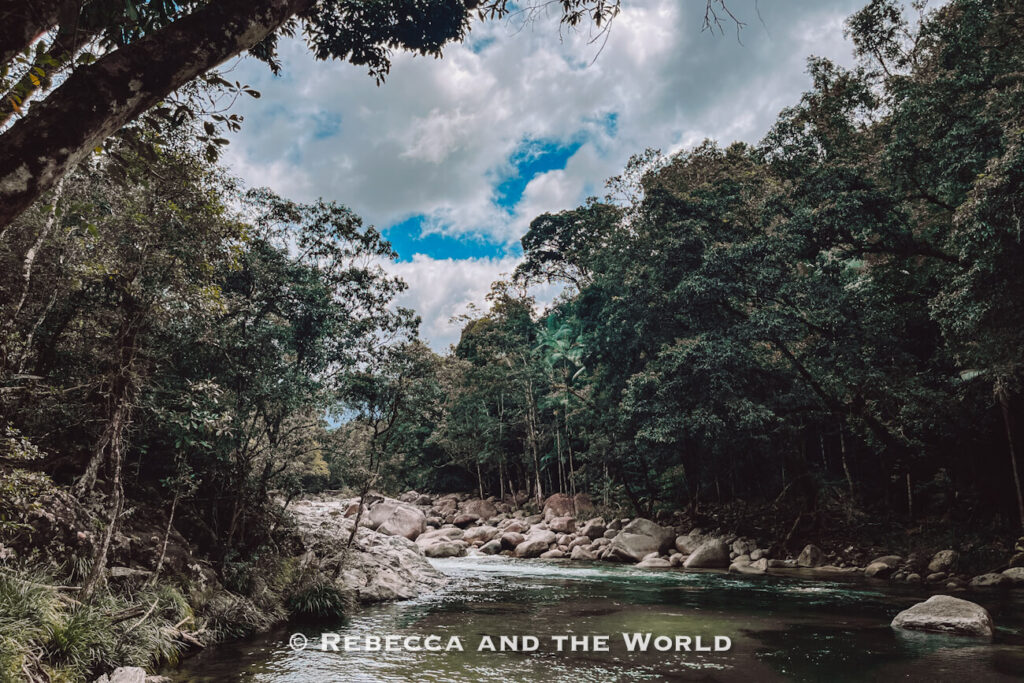
It leads to a lookout over the Mossman River, where you get your first look at those huge boulders and the greenish tinge to the water, which comes from the reflection of the surrounding trees.
There are informational signs along the way covering rainforest ecology and how the root systems work, which are worth a read even if you’re keen to keep moving. If you only have 20 minutes, this is the walk to do.
Rex Creek suspension bridge track (1.4km return)
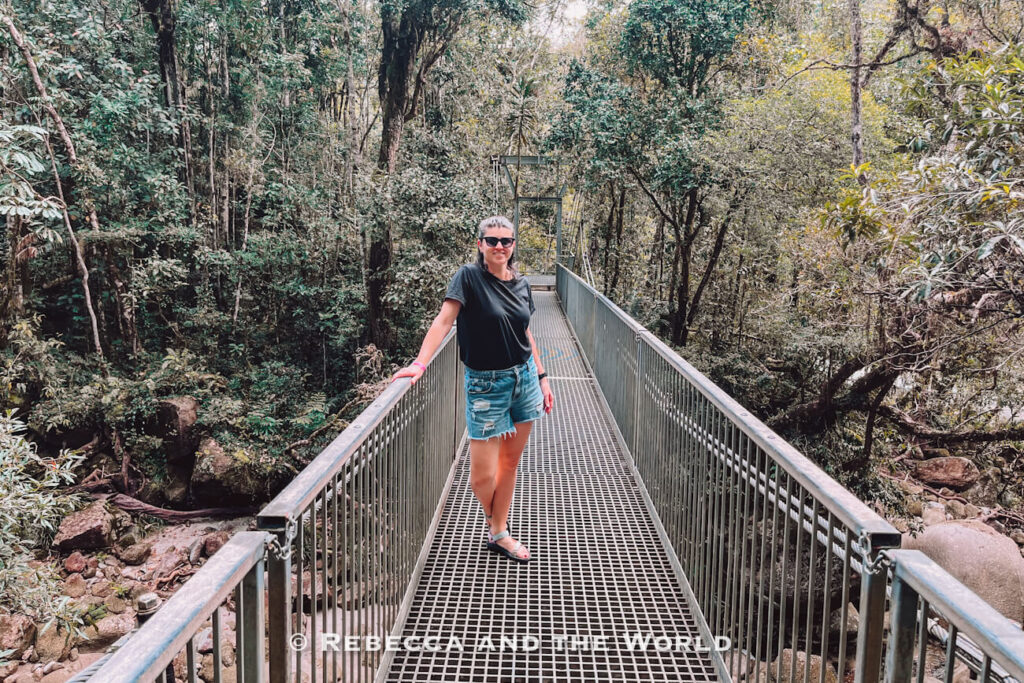
This is a highlight on the way to the Rainforest Circuit Track, and worth doing even if you don’t plan on tackling the full loop. The suspension bridge sways gently as you walk across it (my husband made sure it swayed a little more than gently!), with Rex Creek tumbling over the rocks below.
The current bridge dates back to 2010, after the original structure (built in the 1980s) was deemed unsafe and rebuilt. There are stairs on the way to the bridge, so it’s unfortunately not wheelchair accessible.
Rainforest Circuit Track (2.4km loop)
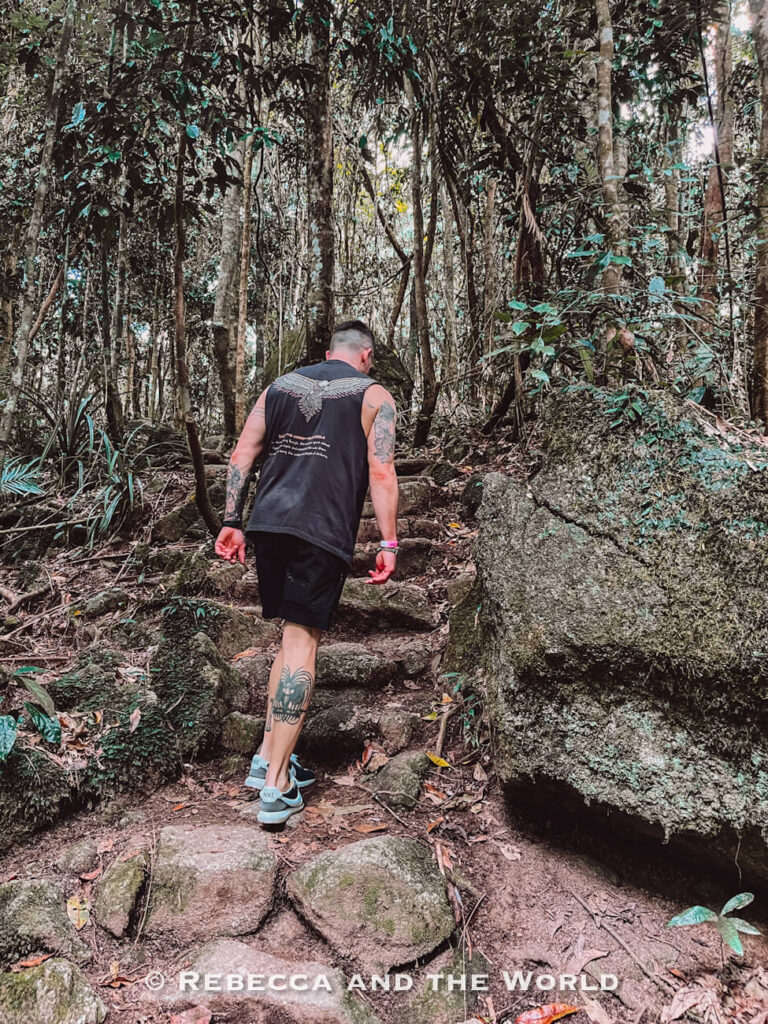
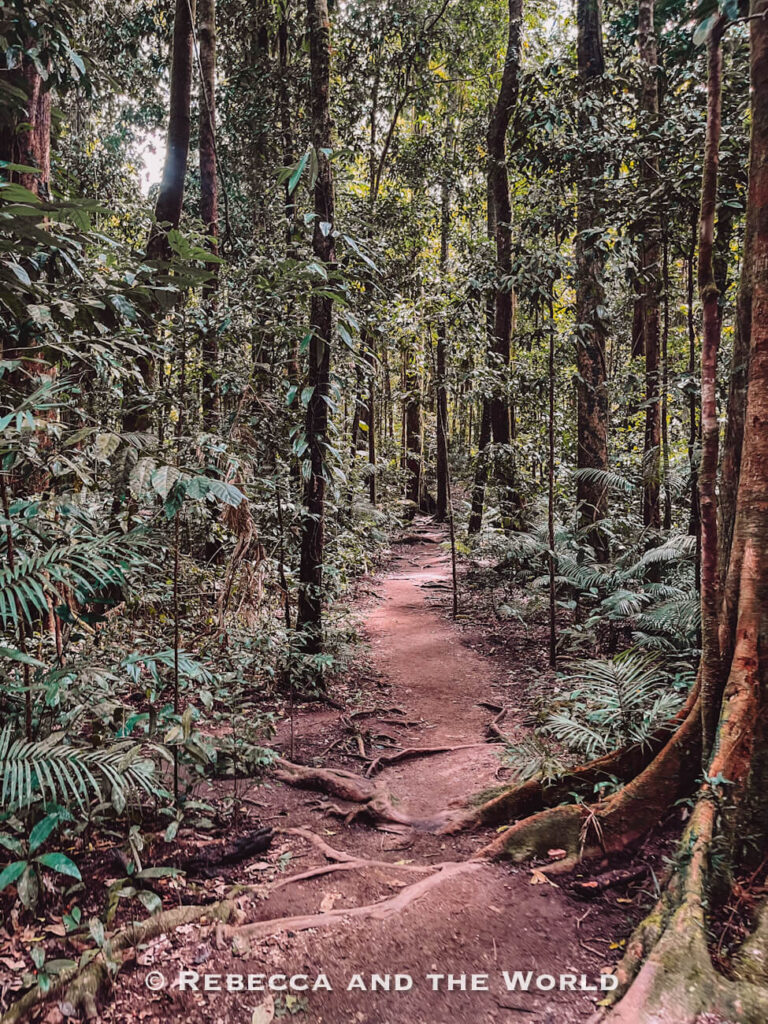
This is the longest track in the Gorge, a loop through the rainforest, which you reach via the Rex Creek suspension bridge and Baral Marrjanga tracks. The track has steps and uneven surfaces, with plenty of roots and rocks to trip over – there are no boardwalks – so wear decent shoes. Allow about an hour for the loop itself.
The further you get from the bridge, the quieter it gets. Most people turn around at the bridge or the lookout, so you’ll often have long stretches of rainforest all to yourself, with nothing but birdsong and the occasional rustle in the undergrowth.
What makes this walk special are the informational signs about the Kuku Yalanji people and the different trees you’ll pass, including Mirrbangku (pencil cedar), Jinjajalka (damson, often called the “dead horse tree” because of its distinctly smelly flowers) and Baway (black bean), which is popular with rainbow lorikeets and whose seeds contain a chemical that’s been investigated for potential use in treating HIV/AIDS.
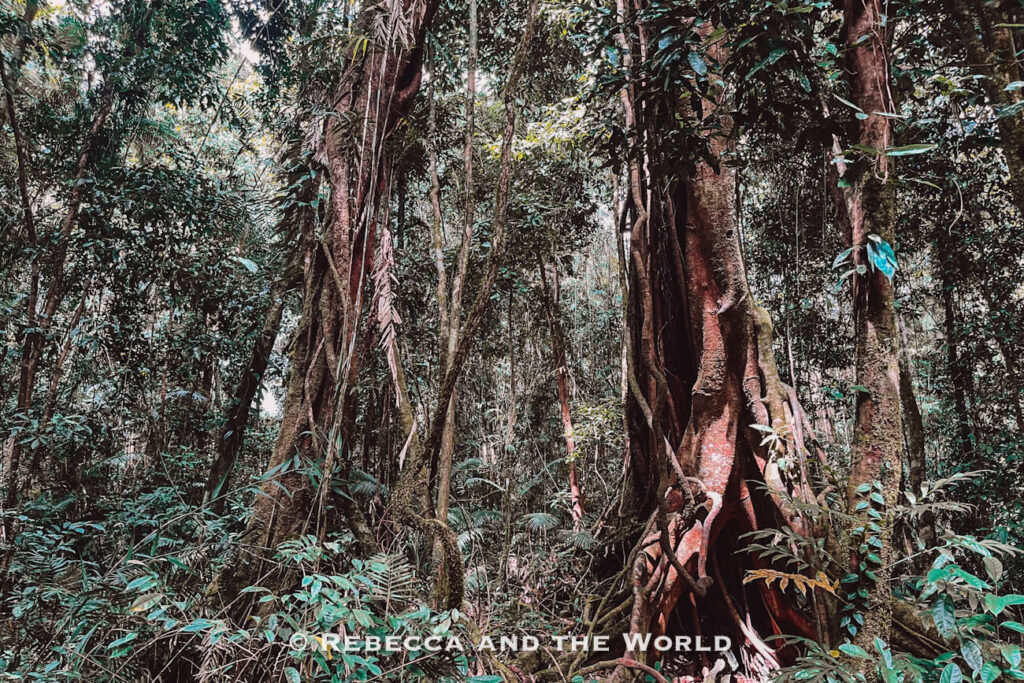
Honestly, the scale of the trees here is what struck me the most. Some of them are enormous, and standing underneath them really puts into perspective how small we are and how long they’ve been growing.
Look out for the strangler figs too – they start life high up in another tree and send roots down to the ground, eventually smothering their host completely. It sounds brutal, but the lattice of roots they leave behind is incredible to look at.
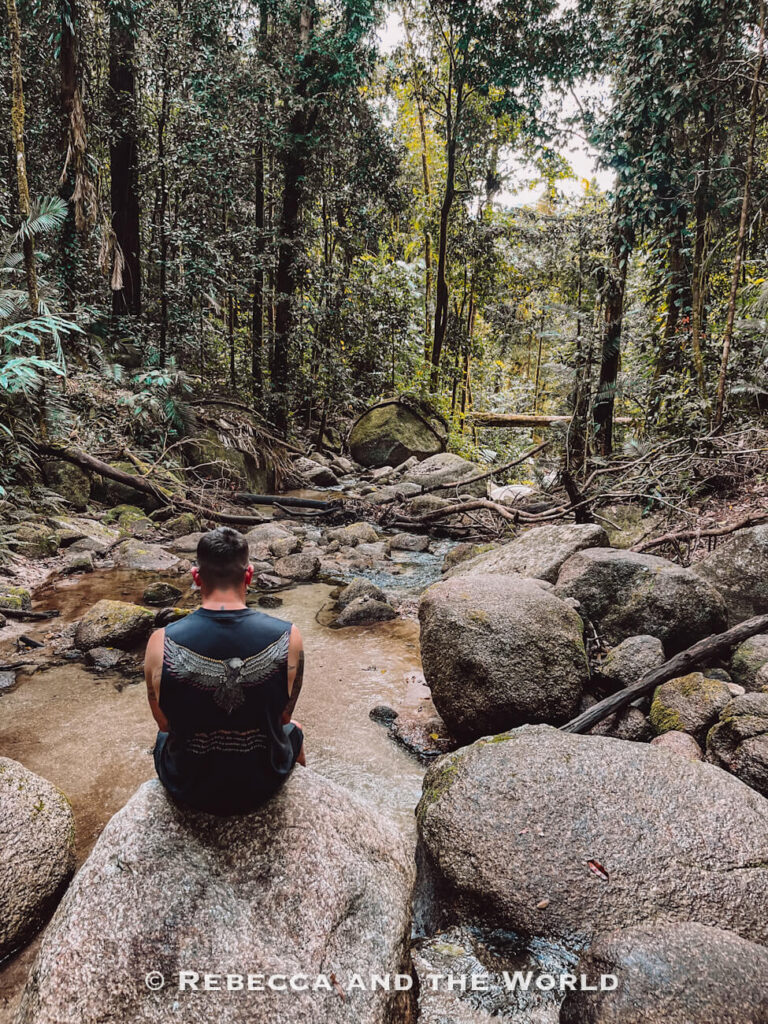
While you’re on this loop, take the short 120m offshoot to Wurrmbu Creek. It’s a peaceful little detour with boulders you can walk across, and a lovely spot to sit for a snack. You can also take a dip in the water here.
Lower River Track (640m return)
This track runs along the riverbank before joining back up with the Baral Marrjanga track. There are a few spots where you can scramble down and take in the Mossman River and its boulders up close, and this is where you’ll find the main swimming hole (more on that below).
It can get slippery in parts, especially after rain, so watch your footing.
This is a good one to save for your way back to the shuttle stop – just follow the stairs marked with the “Car park” sign just after the stairs down to the swimming hole.
Ngadiku Dreamtime Walk
All of these walks I’ve just mentioned are completely free – but I highly recommend booking the paid Ngadiku Dreamtime Walk, led by Kuku Yalanji guides.
You take a separate shuttle to a different part of the gorge that isn’t open to the general public. The tour starts with a Welcome to Country and a traditional smoking ceremony, where you walk through the smoke to cleanse yourself before entering the rainforest. From there, your guide leads you along a private track, stopping to explain how the Kuku Yalanji people have used the plants and trees here for thousands of years. It finishes with muffin-style damper with honey and billy tea from the Daintree Tea Company.
Our guide, Kairisha, shared so much interesting information about Kuku Yalanji beliefs and values, and how plants and trees in this area have traditionally been used for food, medicine, building shelter and catching food. It’s incredible what you can do with the natural world around you if you know what you’re doing!
We learned how people traditionally found partners to marry within the community (it’s a lot more structured than swiping right), heard about Kairisha’s own totem and what it means to her, and watched her make natural paint from ochre and water and paint footprints on her arm. She also showed us a plant that lathers up like soap when you rub the leaves together with water.
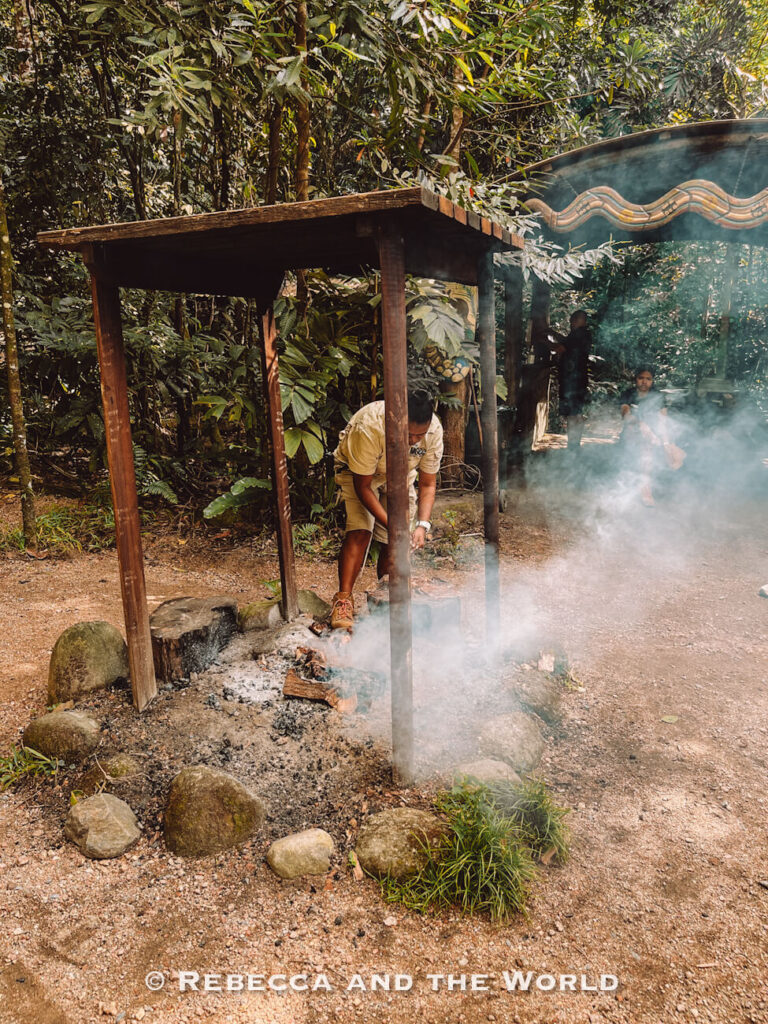
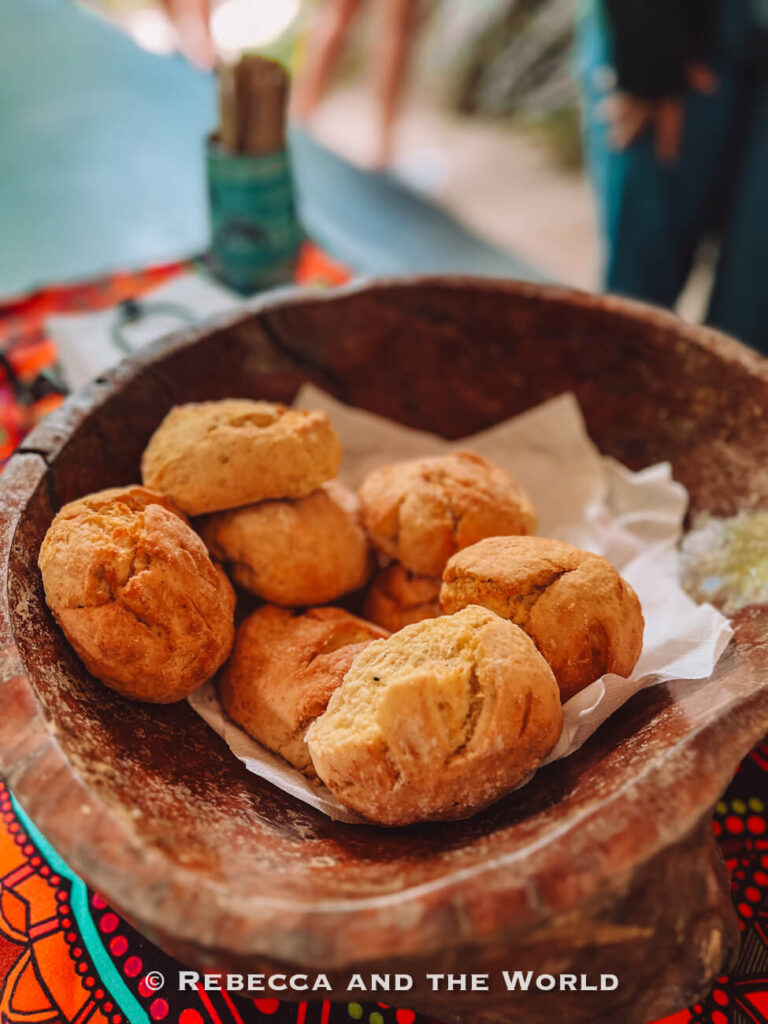
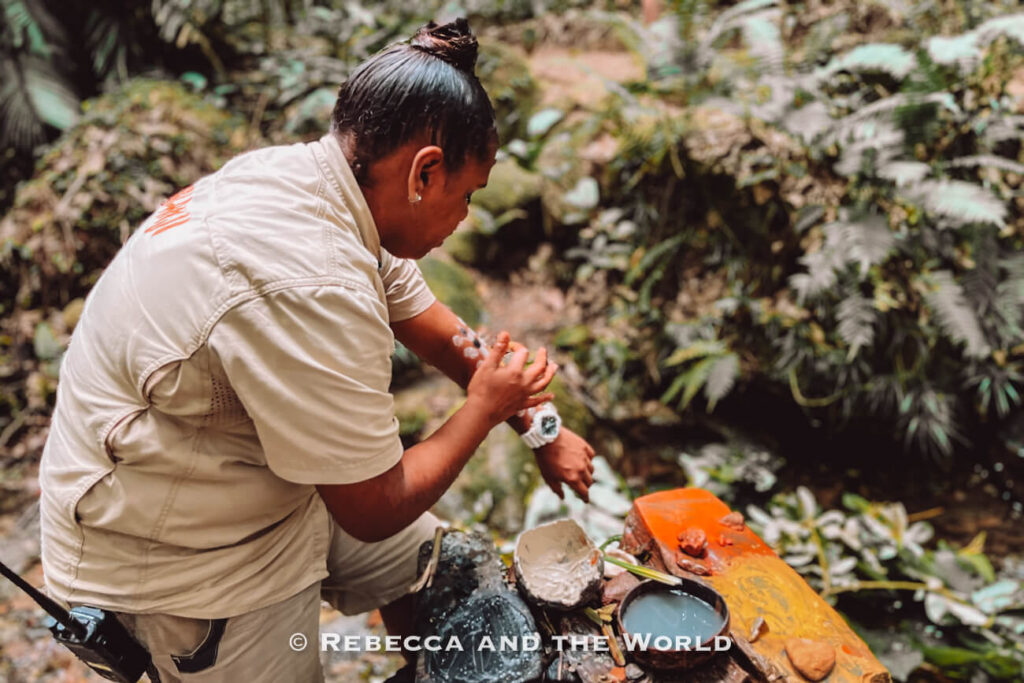
We did this tour before the self-guided walks, and we noticed so many things we would have missed completely if we hadn’t done this experience.
Book ahead! Our tour group was completely full, so I’d recommend booking at least a few days, if not a week, in advance, especially in the dry season when the tour buses are rolling through.
Details: Tours run daily at 10am, 11am, 12pm, 1pm and 2pm, and cost $105 for adults, $53 for children aged 5-15, with the shuttle included. Book online here.
Mossman Gorge swimming spots
The Mossman River and Wurrmbu Creek (accessed via that short trail off the Rainforest Circuit Track) are the main swimming spots in the gorge. The main swimming hole is on the river just below the Lower River Track, where the water pools between the boulders, and it’s a stunning spot to cool off after a walk – if you can handle the temperature!
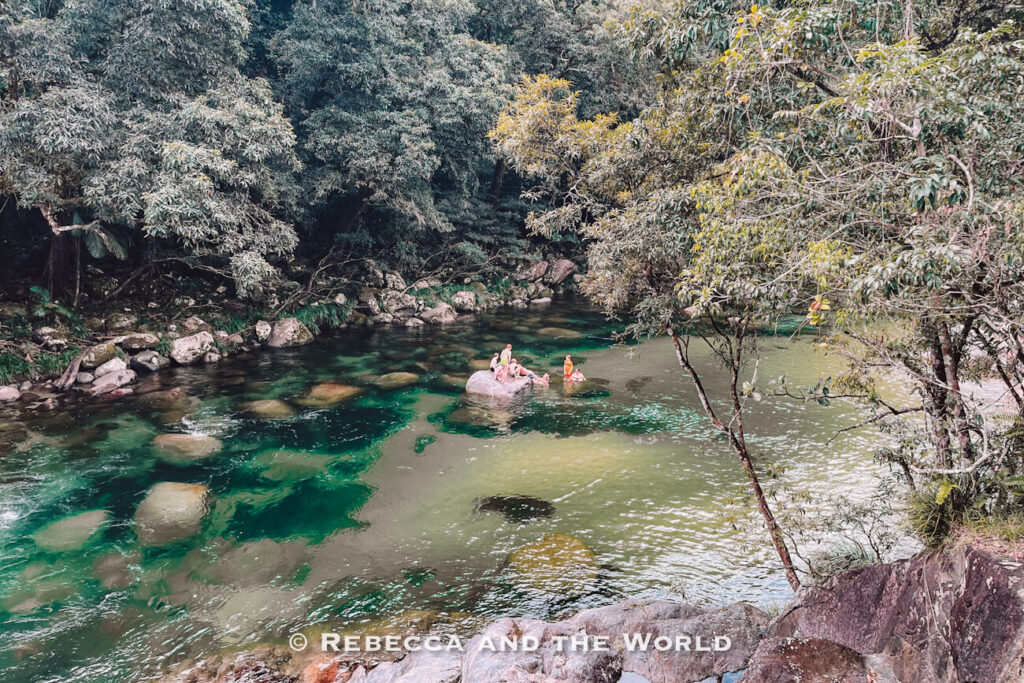
The water is cold. Take-your-breath-away cold, even in the middle of the day. It was far too cold for me, but plenty of people were happily floating around in it, and after a sweaty loop of the Rainforest Circuit Track I could see the appeal. I was chatting with the lifeguard and she said she only swims there in the height of summer.
There are also some spots along the Rainforest Circuit Track where you can take a dip, and it’s far less crowded here.
There are real hazards here, including strong currents and submerged rocks, and people do drown at Mossman Gorge. There are signs posted at the shuttle stop telling you the swimming conditions for the day. On the day we visited, the sign said “no swimming”, but there was still a lifeguard stationed at the Mossman River keeping an eye on things, and – of course – people swimming anyway.
If you’re planning to swim, water shoes are a great idea, as the rocks are slippery and the riverbed is uneven. And bring a towel, because there’s nowhere to dry off other than the rocks.
Mossman Gorge Centre facilities
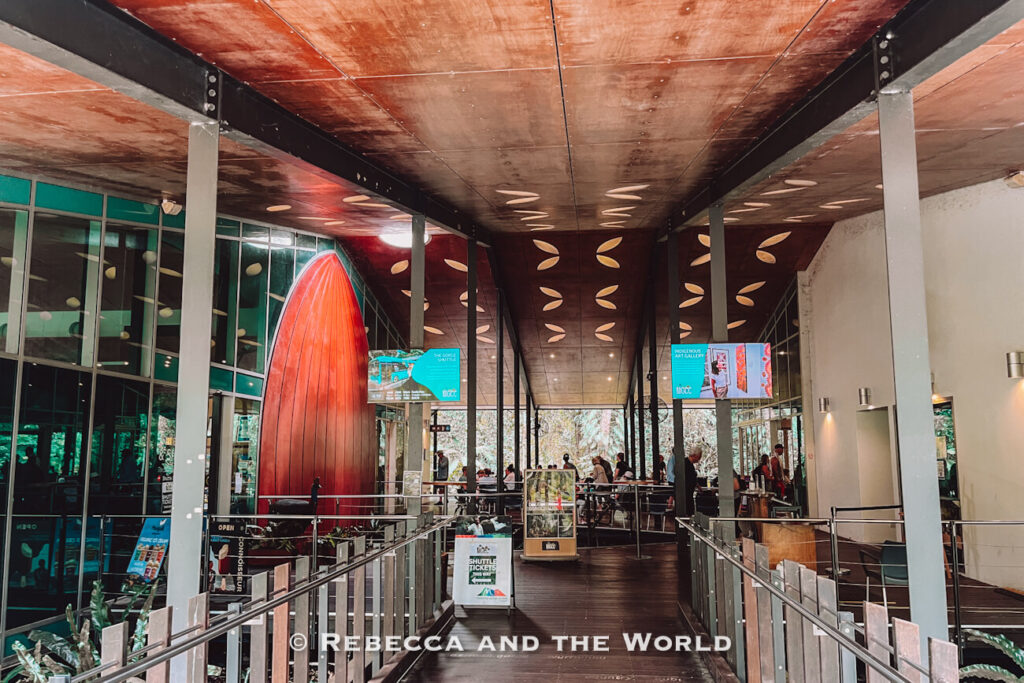
Back at the Mossman Gorge Centre, Mayi Café serves kangaroo, emu and crocodile burgers, as well as salads, sandwiches and barramundi tacos. It’s a good option for lunch before or after your walk. If you’d rather bring your own food, there are plenty of spots for a picnic.
The Indigenous Art Gallery features traditional and contemporary art and crafts from local Kuku Yalanji artists, and it’s worth a browse even if you’re not planning to buy anything. The attached gift shop stocks everything from postcards to jewellery, cards and clothing from Indigenous designers – a much better souvenir option than the usual airport fare.
Wildlife to look out for
Mossman Gorge sits within the Wet Tropics World Heritage Area, which is home to a third of Australia’s mammal species and more than 400 recorded bird species, so there’s a lot living in there – even if the rainforest keeps most of it hidden.
Cassowaries live in the gorge but are rarely seen, and tree kangaroos are even rarer – they spend most of their time high up in the canopy, so you’d have to be very lucky (and looking up at exactly the right moment) to spot one. We didn’t see either, but I still spent a lot of the walk peering hopefully into the trees!
What you’re more likely to see are Boyd’s forest dragons, which sit perfectly still on tree trunks at about eye level and are surprisingly easy to walk straight past. Keep an eye out for brush turkeys scratching around in the leaf litter, and big electric-blue Ulysses butterflies flitting through the gaps in the canopy. Down at the river, you’ll often spot jungle perch hovering in the clear pools between the boulders.
More than anything, though, you’ll hear the rainforest rather than see it. The birdlife is constant – whipbirds, catbirds and the occasional screech of a lorikeet in the black bean trees – so slow down every now and then and just listen.
Best time to visit Mossman Gorge
Mossman Gorge is open year-round. The dry season (May to October) is the most popular time to visit this area, with cooler temperatures, less humidity and clearer water. It’s peak season for the whole region, so the tour buses roll through in numbers from mid-morning onwards.
The wet season (November to April) is hot, humid and, well, wet. But it’s also when the rainforest is at its most lush, the creeks are running hard and the whole gorge feels more alive. Just be prepared for the river to be off-limits on the day if there’s been heavy rain, and pack a poncho (an umbrella is useless under the canopy).
Final thoughts: Things to do in Mossman Gorge
Mossman Gorge is one of those places that’s easy to underestimate from photos – it doesn’t look all that different from any other rainforest walk until you’re actually standing under those trees, looking at boulders that have sat in that river for hundreds of years. This is ancient land that’s amazing to walk through.
Whether you’ve got two hours or a full day, it’s absolutely worth the drive from Port Douglas or Cairns, and if you can fit in the Dreamtime Walk, do it.
Mossman Gorge FAQs
Do I need to book the shuttle bus in advance?
No, you can buy shuttle tickets on the day at the Mossman Gorge Centre. The Ngadiku Dreamtime Walk is the one you should book ahead for, since spots are limited and it does sell out.
How long does it take to do all the Mossman Gorge walks?
Allow around two to three hours if you want to do all four trails and lookouts (roughly 3.4km of walking), plus extra time if you’re planning to swim.
Is Mossman Gorge suitable for kids?
Yes, if your kids enjoy being in nature. They’ll love the walks and learning about the trees and wildlife, and taking a dip in the water. Kids under five are free on both the shuttle and the Dreamtime Walk.
Can you swim at Mossman Gorge?
Yes, but only when conditions allow. Check the signs at the shuttle stop on the day, never jump or dive in, and be prepared for very cold water!
Can I visit Mossman Gorge without a car?
Yes – day tours run from both Cairns and Port Douglas that include transport, the shuttle and sometimes the Dreamtime Walk as part of the package. If you’re driving yourself, you’ll still use the shuttle once you arrive at the Centre.
Is Mossman Gorge part of the Daintree Rainforest?
Yes, technically. Daintree National Park is split into separate sections rather than one continuous block, and Mossman Gorge is the southernmost section, sitting within the wider Wet Tropics World Heritage Area. If you want to see the more remote parts of the Daintree, like Cape Tribulation, you’ll need to keep driving north across the Daintree River – but Mossman Gorge gives you a real taste of the rainforest without that extra travel time.
What should I wear to Mossman Gorge?
Comfortable walking shoes with decent grip are a must, given the roots and uneven ground on the Rainforest Circuit Track. Bring a swimsuit under your clothes if you’re hoping to swim, along with a rash vest or light layer for sun protection, since the humidity here means you’ll want breathable fabric over anything heavy. Pack a towel, reef-safe sunscreen, insect repellent and plenty of water.
Is there anywhere to eat at Mossman Gorge?
Yes – Mayi Café and Restaurant at the Mossman Gorge Centre serves food built around local produce and Indigenous-inspired flavours. There are also plenty of places to stop for a picnic.
Did you find this article helpful? Consider buying me a coffee as a way to say thanks!
I hope this things to do in Mossman Gorge guide has inspired you to plan a trip to this stunning part of Australia. Got any questions? Let me know in the comments below.
Read next
Before you go, you might like these Australia travel articles:
- The Best Stops on a Cairns to Port Douglas Drive (COMING SOON)
- Things to Do in Port Douglas: What to See, Do and Eat in Australia’s Favourite Town
- Things to Do in (and Around) Cape Tribulation
- What to See and Do in the Daintree Rainforest (COMING SOON)
- The Ultimate Cairns to Cape Tribulation Road Trip Itinerary
AUSTRALIA TRIP ESSENTIALS
- Book your flight to Australia online with Skyscanner. I like this site because it shows me which dates are cheaper.
- One thing I always purchase is travel insurance! Travel Insurance Master allows you to compare across multiple policy providers, while SafetyWing is great for long-term travellers and digital nomads.
- Wise is my choice for sending and receiving money and spending money overseas (you can get a digital and physical card).
- Find a great hotel in Australia. Check prices on Booking.com and Expedia online.
- Check out the huge range of day tours throughout Australia on GetYourGuide or Viator.
- Saving money? Check out the range of free walking tours across Australia with GuruWalk (don’t forget to tip!).
- How to get around? I use DiscoverCars for car hire, or Motorhome Republic and Jucy for campervan/RV rental. For buses, trains and ferries, I use 12GO, Busbud and Omio.
- Grab an e-sim to stay connected while on the road.
- A copy of the Lonely Planet guide to Australia will be handy.
- Pack sunscreen (look for SPF50 or higher), a hat and sunglasses to protect your eyes and skin.
- Check out my Amazon shop for my fave travel items – everything from backpacks and suitcases to travel adapters and beauty products.
PIN IT FOR LATER: THINGS TO DO IN MOSSMAN GORGE
Save this Mossman Gorge guide to Pinterest so you can plan your trip later.