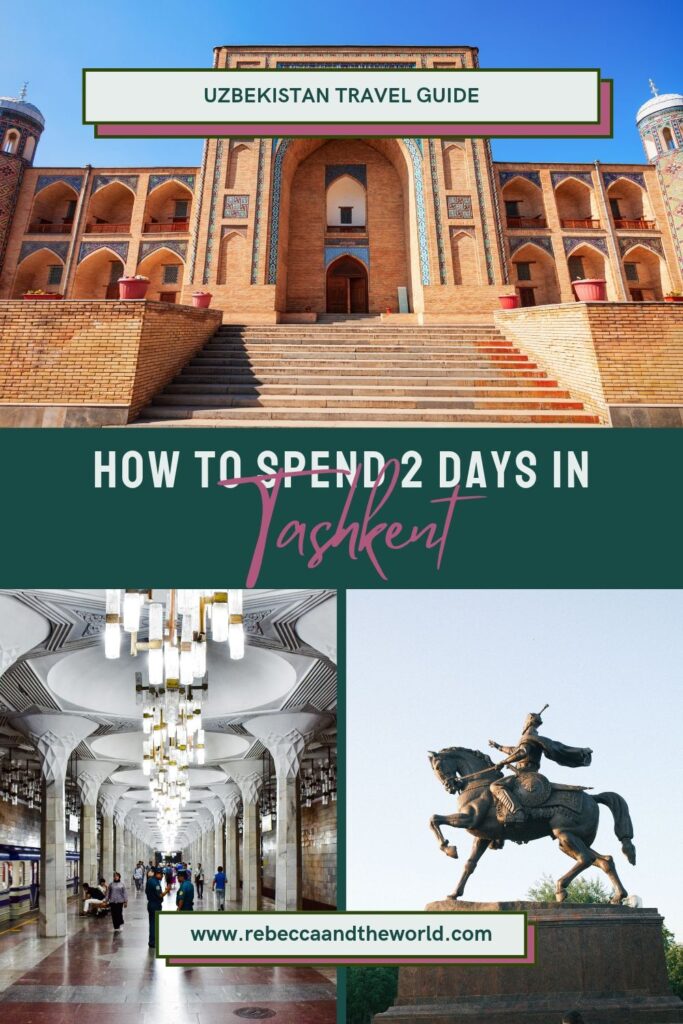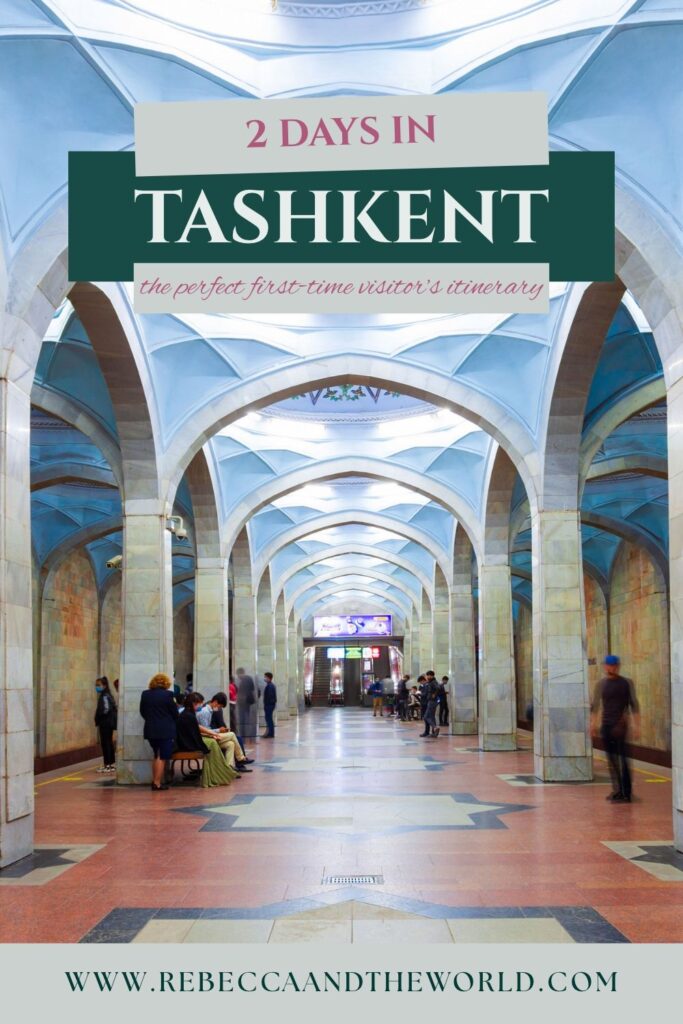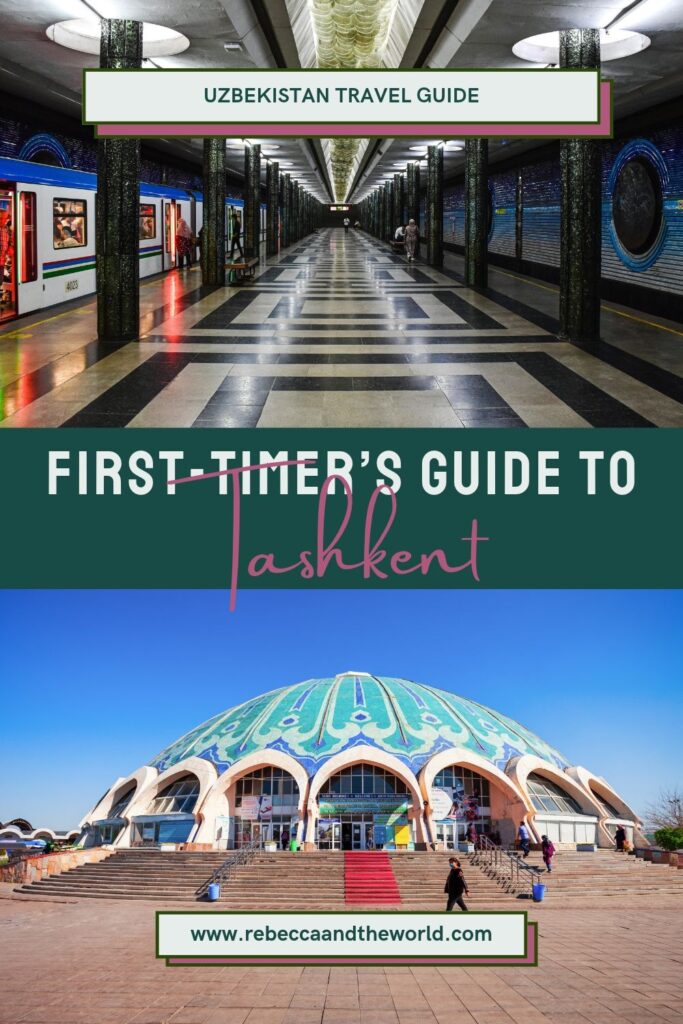

Planning a visit to Tashkent and not sure where to begin? Here’s my 2 days in Tashkent itinerary that hits the highlights of the city in a short amount of time.
Tashkent really surprised me. Like many other travellers, I arrived in Uzbekistan’s capital with just two days to explore – but I left wishing I’d had more time.
Sure, it’s another big city, but it’s a fascinating one: a capital rebuilt from scratch after a devastating earthquake, filled with Soviet modernist buildings, mosaic-covered metro stations that doubled as bomb shelters, and a fantastic food scene.
And the city’s history just got a well-deserved recognition: in 2026, UNESCO added Tashkent’s modernist architecture to the World Heritage List, recognising ten buildings and urban ensembles built between the 1960s and early 1990s as the region’s best examples of Soviet-era design.
I visited Tashkent as the first stop on a longer Uzbekistan itinerary that continued on to Samarkand, Bukhara and Khiva by train. Here’s how I recommend spending two days in Tashkent before you head further along the Silk Road.
This blog post may contain affiliate links, meaning if you book or buy something through one of these links, I may earn a small commission (at no extra cost to you).
Tashkent itinerary at a glance
Day 1
- Morning: Sightseeing and Craft n Culture Food and Metro Journey
- Midday: Tashkent TV Tower and the Memorial to the Victims of Repression
- Afternoon: State Museum of Applied Arts
- Evening: Dinner and Magic City at night
Day 2
- Morning: Islamic Civilisation Centre and Hazrati Imam Complex
- Midday: Minor Mosque and lunch at Minor Somsa
- Afternoon: Monuments along Sharaf Rashidov Avenue, State Museum of History of Uzbekistan
- Evening: Amir Timur statue, a drink at Hotel Uzbekistan’s rooftop bar, wander down Sayilgoh Street
Map of Tashkent itinerary locations
Getting around Tashkent
Tashkent is a big, spread-out city, but getting around is super easy. The metro is cheap, fast and an attraction in its own right – I’ve given it its own section in this article, because you should definitely plan to spend some time admiring the individual stations. Each ride costs around 2,000 som (about 12 cents), charged every time you tap on or off, and you can ride all lines all day for next to nothing. Trains run from 5am to midnight, and you can pay with a foreign credit card.
For anywhere the metro doesn’t cover, Yandex Go is the way to go. It’s the ride-hailing app of choice across Uzbekistan, and in Tashkent it’s remarkably affordable – you can cross the entire city for just a few dollars. I used it constantly during my 2 days in Tashkent.
One thing worth knowing before you land: arrivals at Tashkent airport can feel a little chaotic, with unofficial taxi touts approaching you before you’ve even found the exit, asking “do you want a taxi?” or “which hotel are you going to?”. A polite “I’m okay” and walking away worked fine for me. Skip the touts and book a Yandex instead.
→ READ NEXT: How to get around Uzbekistan (COMING SOON)
Day 1 in Tashkent
Morning: UNESCO sightseeing
Start the day with one of the best things to do in Tashkent: a four-hour food-and-metro tour with Craft n Culture that covers the famous Chorsu Bazaar and the best Tashkent metro stations.
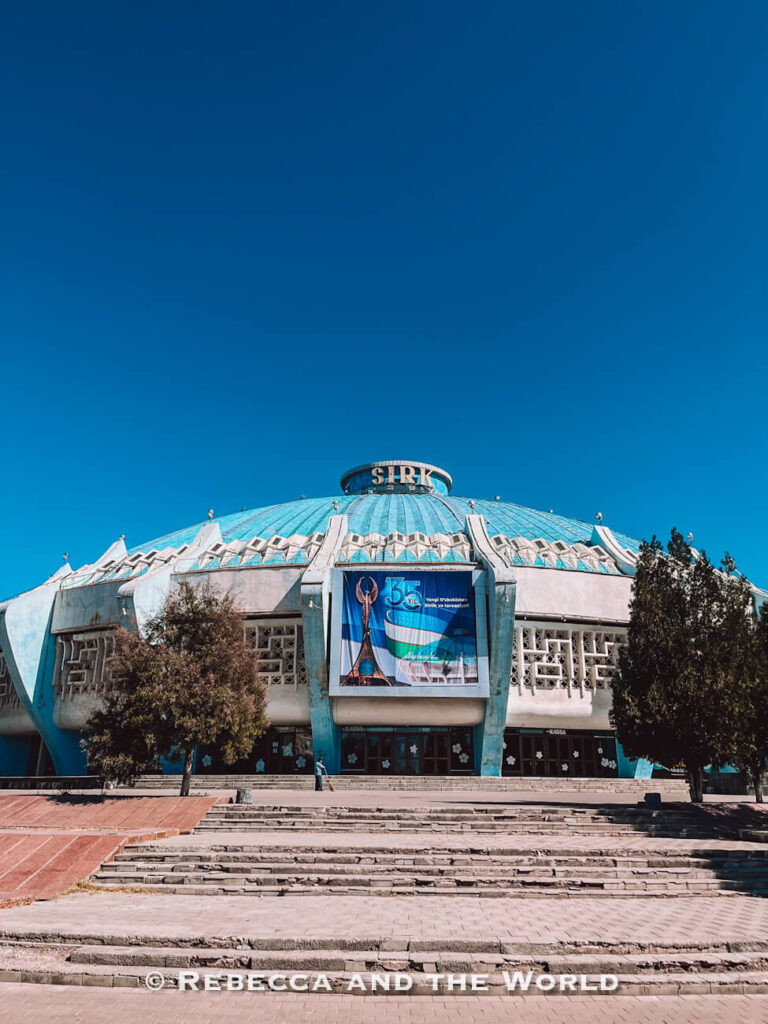
But first – some sightseeing. While Craft n Culture can arrange hotel pick up for you, I’d suggest making your own way to Chorsu Bazaar, if you can, so you can make a few stops on the way. The first stop should be to admire the Tashkent Circus from the outside. While I certainly don’t condone circuses, this is one of the most interesting buildings in Tashkent (and is one of the buildings recently added to the UNESCO list).
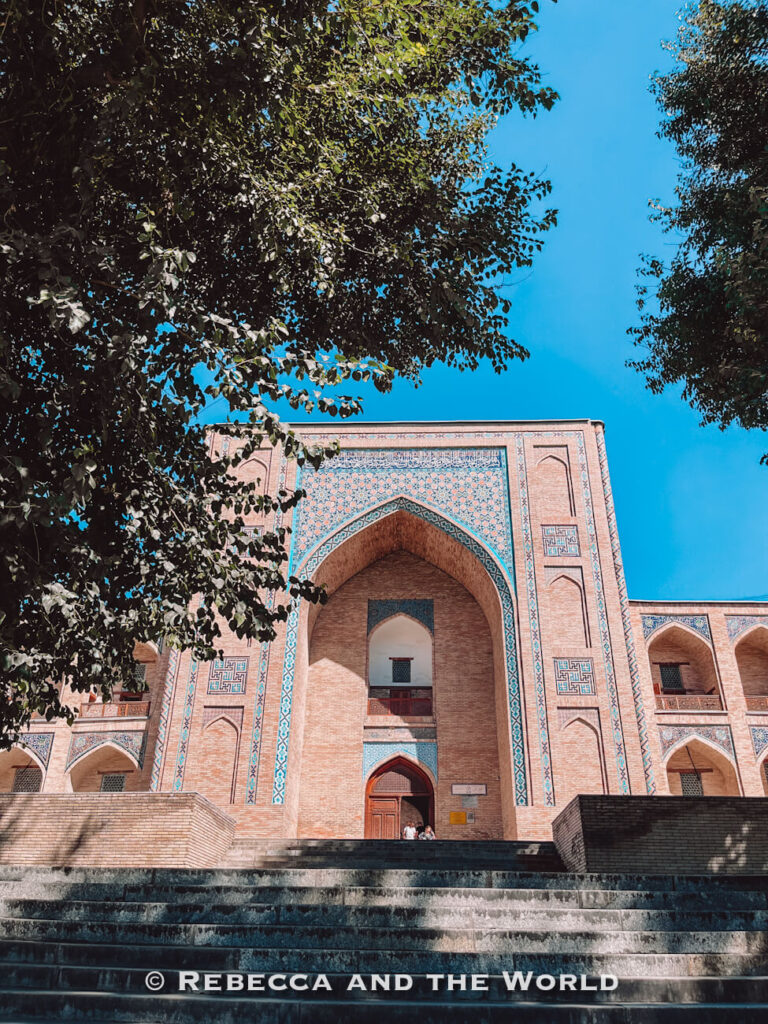
Then, head up Navoi Avenue and stop in at the Kokaldash Madrasah, a functioning 16th-century school with a lovely courtyard garden and upper floor balconies. Make sure you go upstairs to check out the calligraphy and woodworking shops – there are some well-priced souvenirs here, including carved secret boxes. The vendors will show you the wares, but I didn’t find them pushy at all.
Craft n Culture food and metro tour
Then head around the corner to Chorsu Bazaar to meet your Craft n Culture guide.
Lately, I’ve been loving doing a walking tour (usually involving food!) on my first day in a new city, then spending the rest of my time wandering independently. While you can certainly explore Chorsu Bazaar and the metro stations by yourself, I highly recommend adding Craft n Culture to your Tashkent itinerary. The tourism business is run by an Uzbek man named Yusuf and his Polish wife, Julia, and I learned more about Tashkent in those four hours than I would have in a week of solo wandering. That’s why I think tours are worth it.
🍉 BOOK CRAFT N CULTURE’S FOOD AND METRO TOUR HERE 🍉
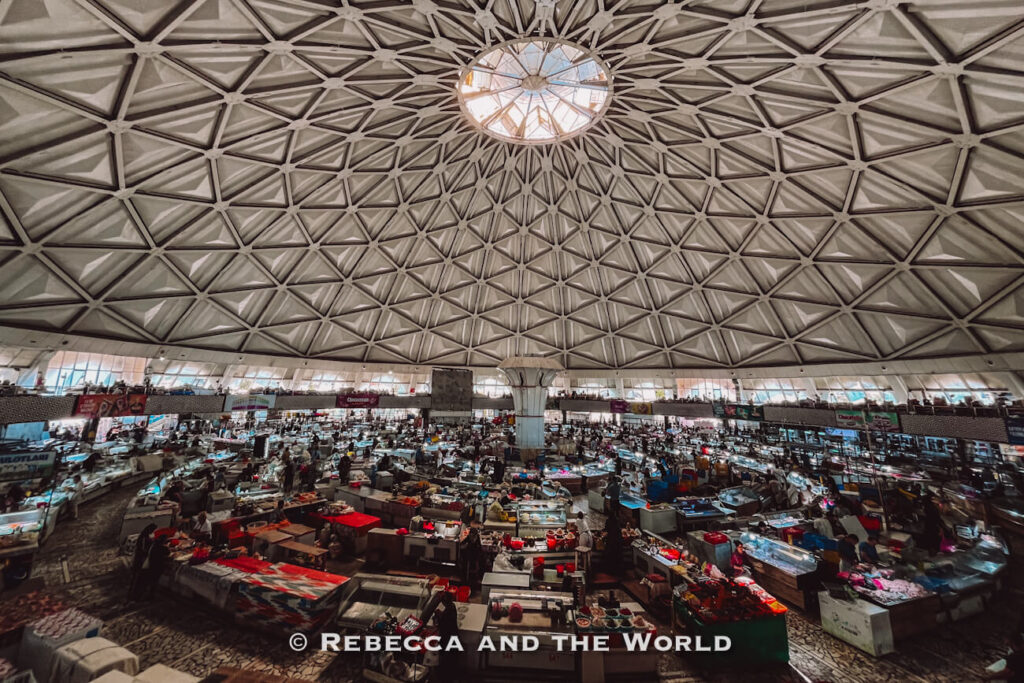
The Tashkent food tour starts at Chorsu Bazaar, the blue-domed market that’s become one of Tashkent’s landmarks (and a must for any Tashkent itinerary). Look up as you walk in – the mosaic covering the dome is easy to miss if you’re focused on ogling all the stalls. While the market is believed to be more than 2,000 years old, the current building was constructed after the 1966 earthquake.
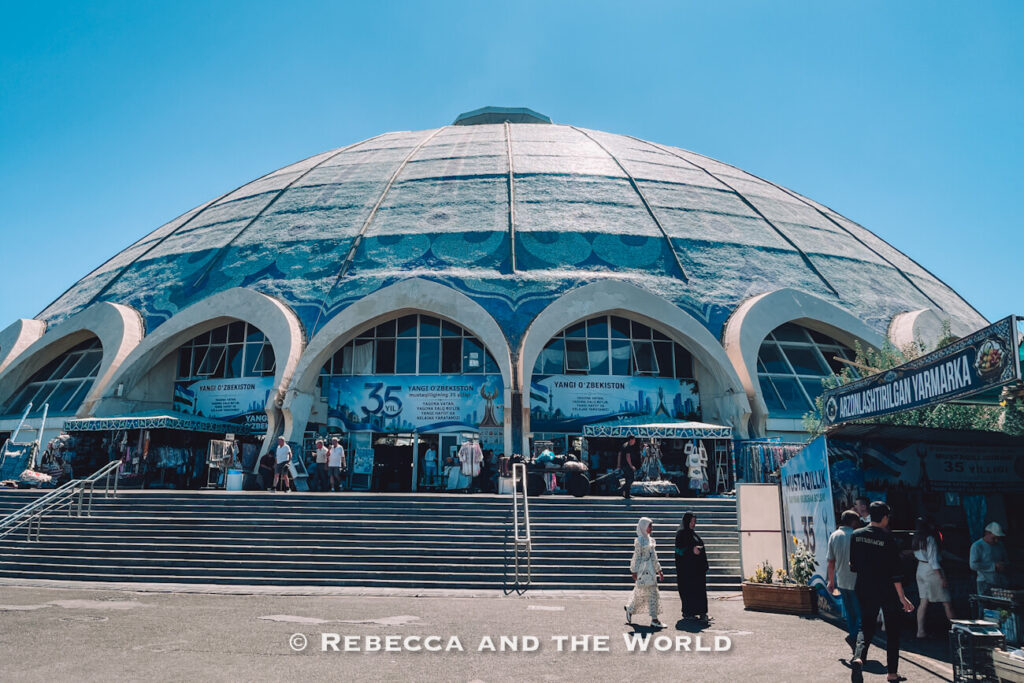
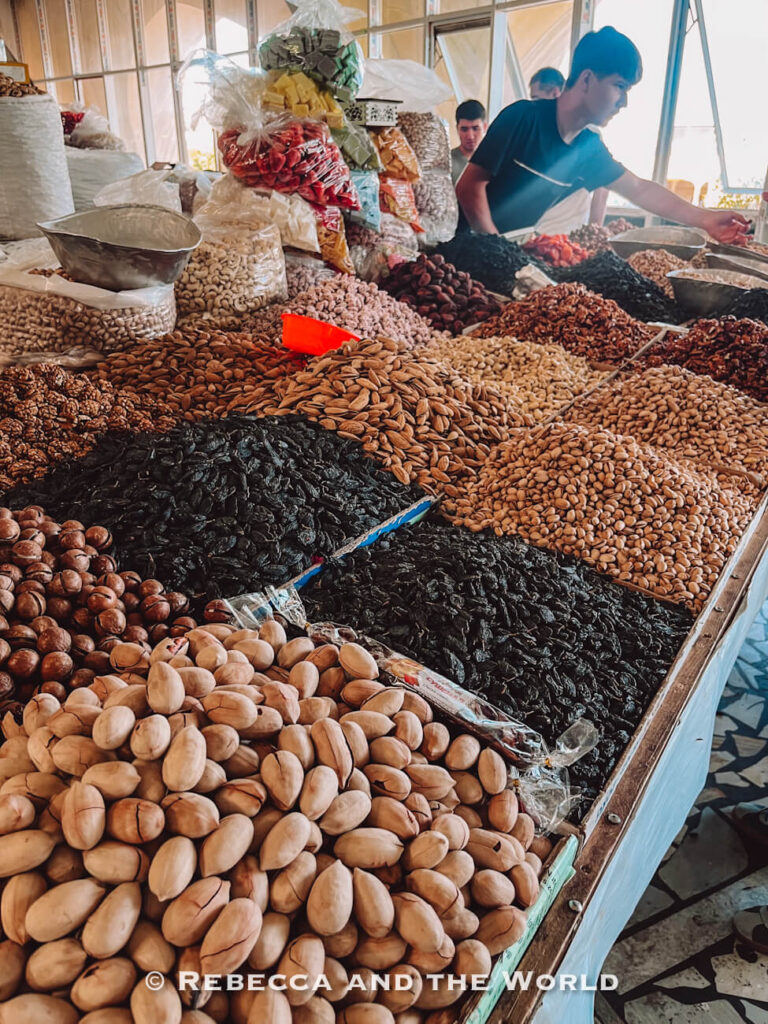
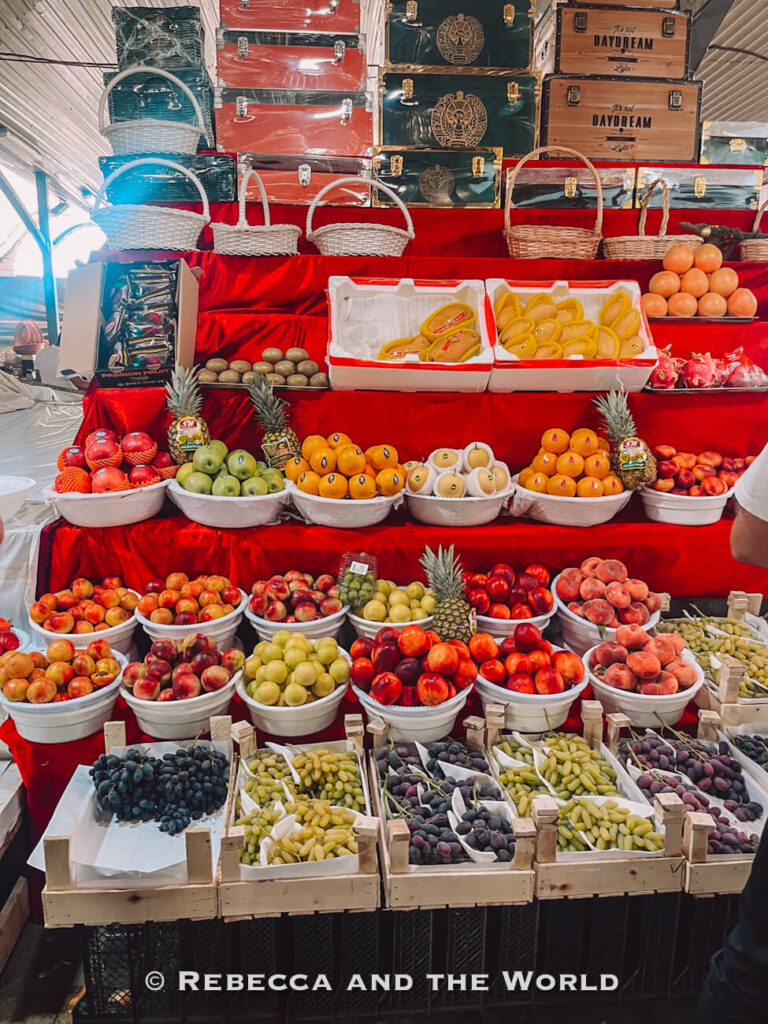
This is a real working market, not just a tourist attraction. The ground floor is meat, salads and dairy, and upstairs is nuts and dried fruit – the second-floor balcony is great for a view over the stalls.
Having a guide here pays for itself immediately, because you get to taste your way through the market rather than just look at the stalls. I tried macadamias, pecans, chickpeas, pickled salads, raisins, candied almonds, dry and salty local cheeses, plus apricot pits that are boiled, fried and salted (these are apparently good for the stomach, though to be fair Uzbeks think most things are good for the stomach!).
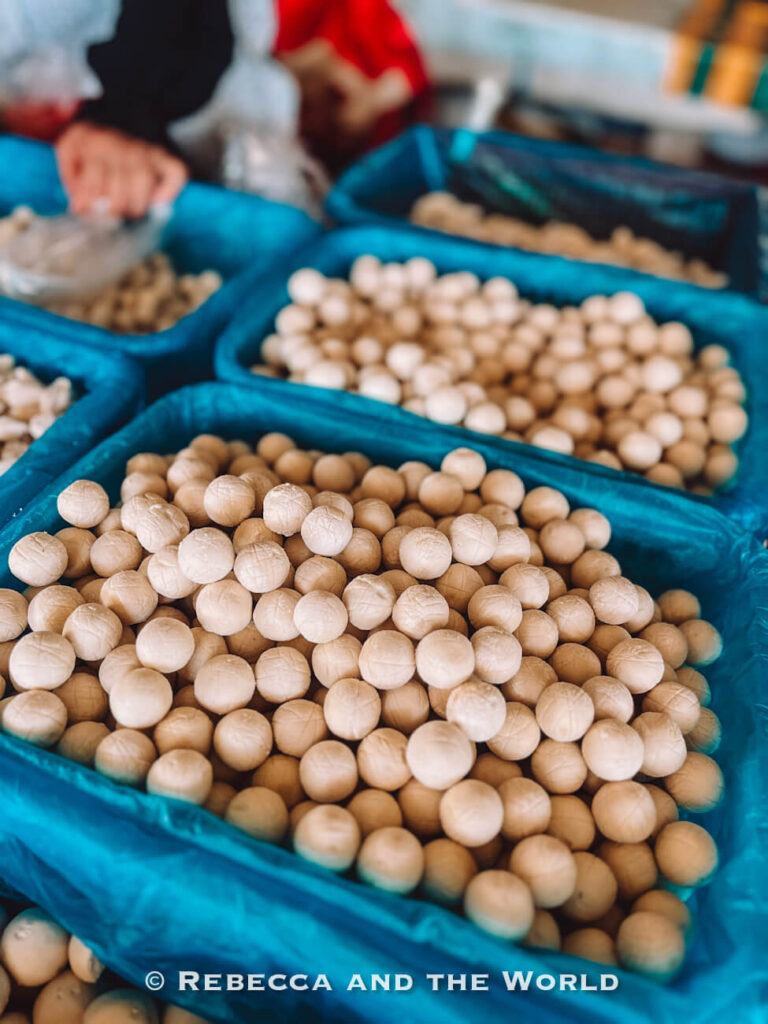
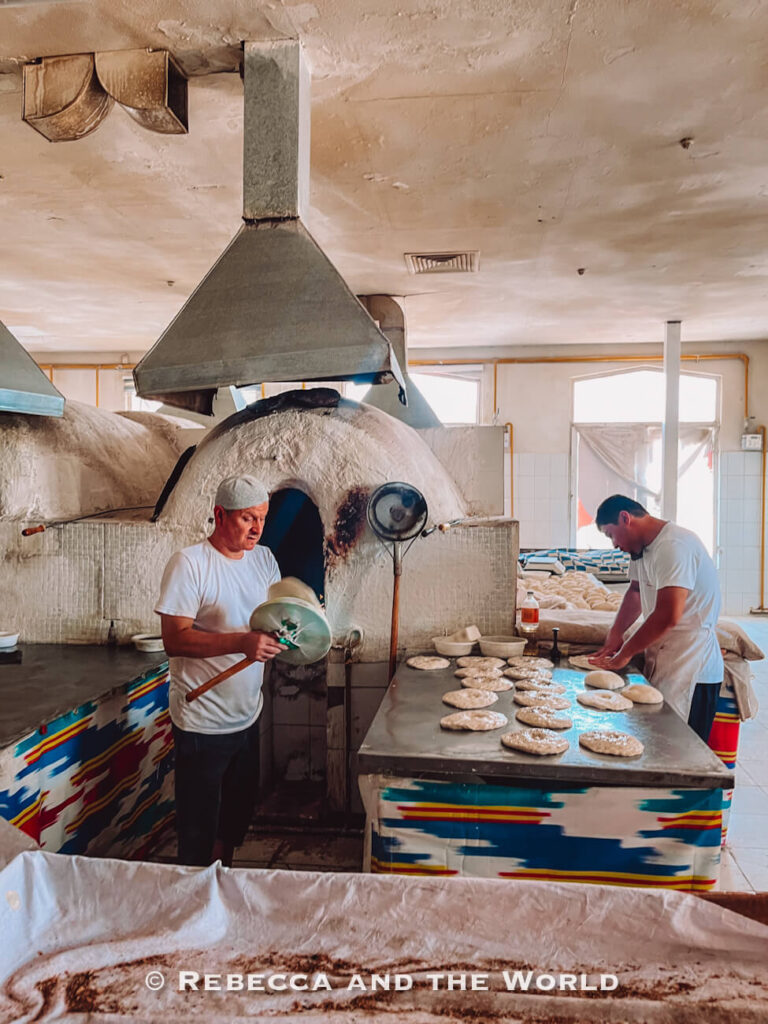
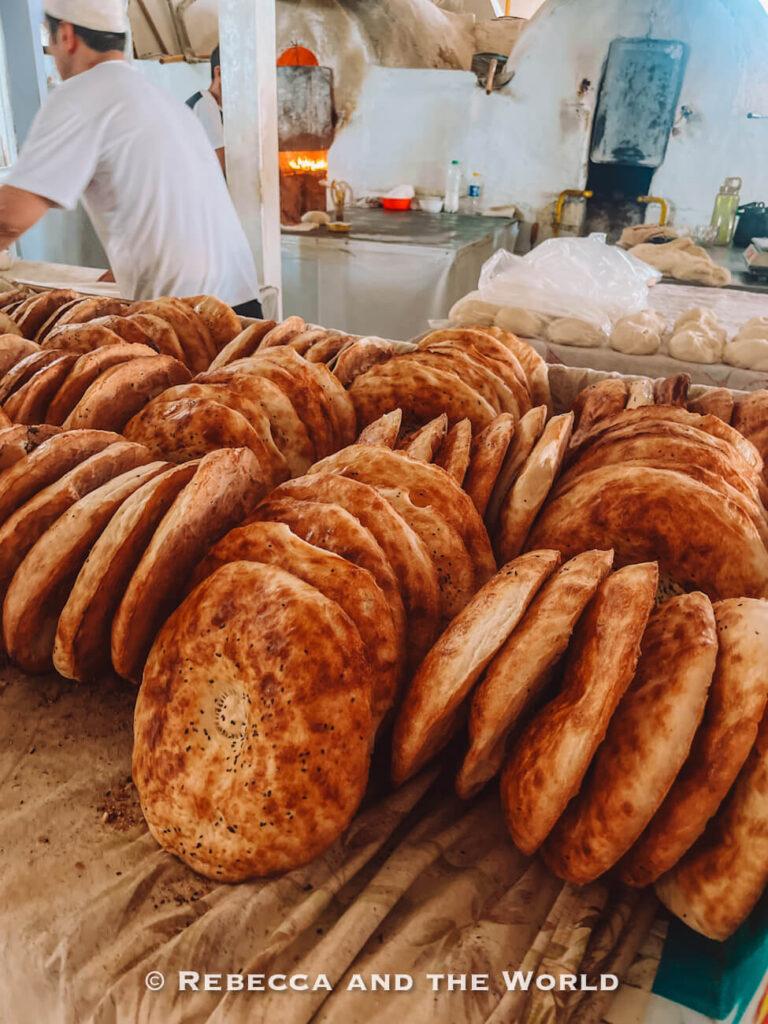
The tour also winds through the bakery. Until I did this tour I had absolutely no idea how important bread is in Uzbekistan – it’s a daily staple and families and businesses even have their own bread stamps, so everyone can tell whose bread is whose when it’s all baking together in a communal tandoor.
The final stop of the market tour is in the food court, where Yusuf and Julia’s local knowledge earns its keep – if vendors hear you speaking English, prices go up, so having a local guide order for you really does help.
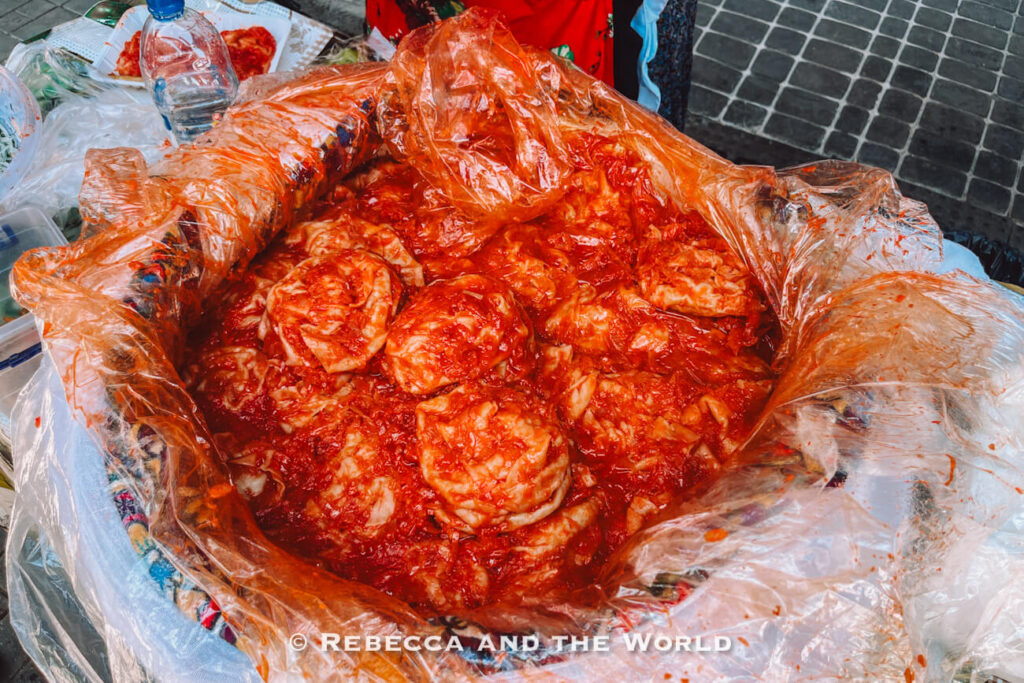
I tried hanim (or hanym, it’s spelled in many different ways), which Yusuf described as a kind of Uzbek lasagne but is really closer to one big dumpling: shredded potato wrapped in dough and covered in a tomato-based sauce. I ate it with my hand, which goes inside a plastic bag so you don’t end up covered in sauce. This was so delicious, I could have eaten a dozen of them – but I knew there was more food coming!
Remember to ask before you photograph individual vendors – although I found everyone was happy to do so.
→ READ NEXT: Still not sure if Craft n Culture’s food and metro tour should be on your Tashkent itinerary? Read my full review here! (COMING SOON)
The metro tour: Tashkent’s underground art gallery
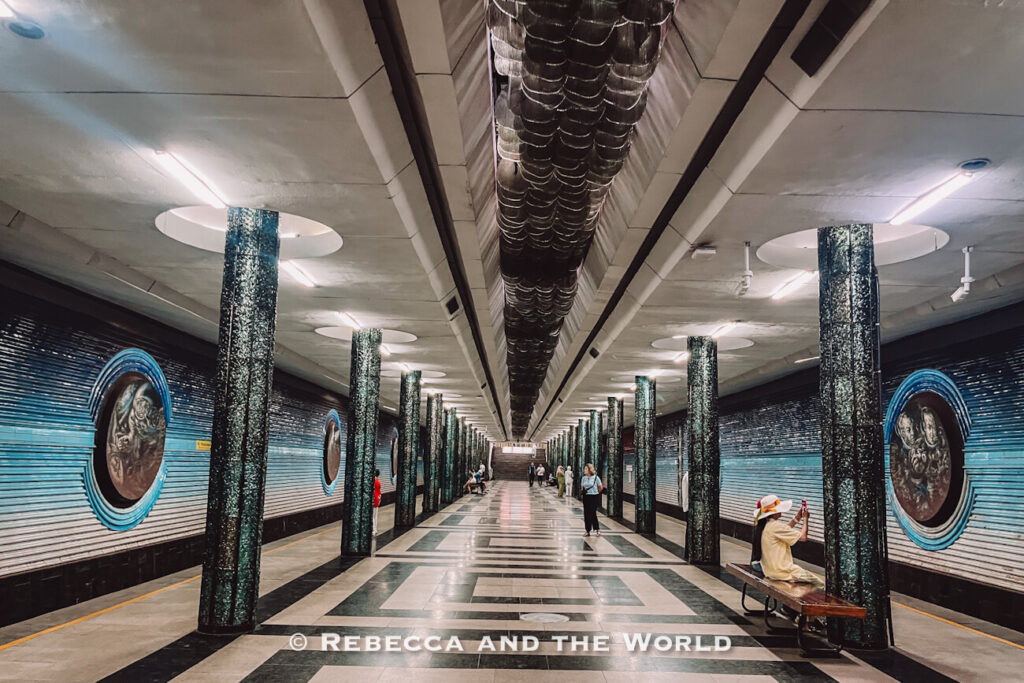
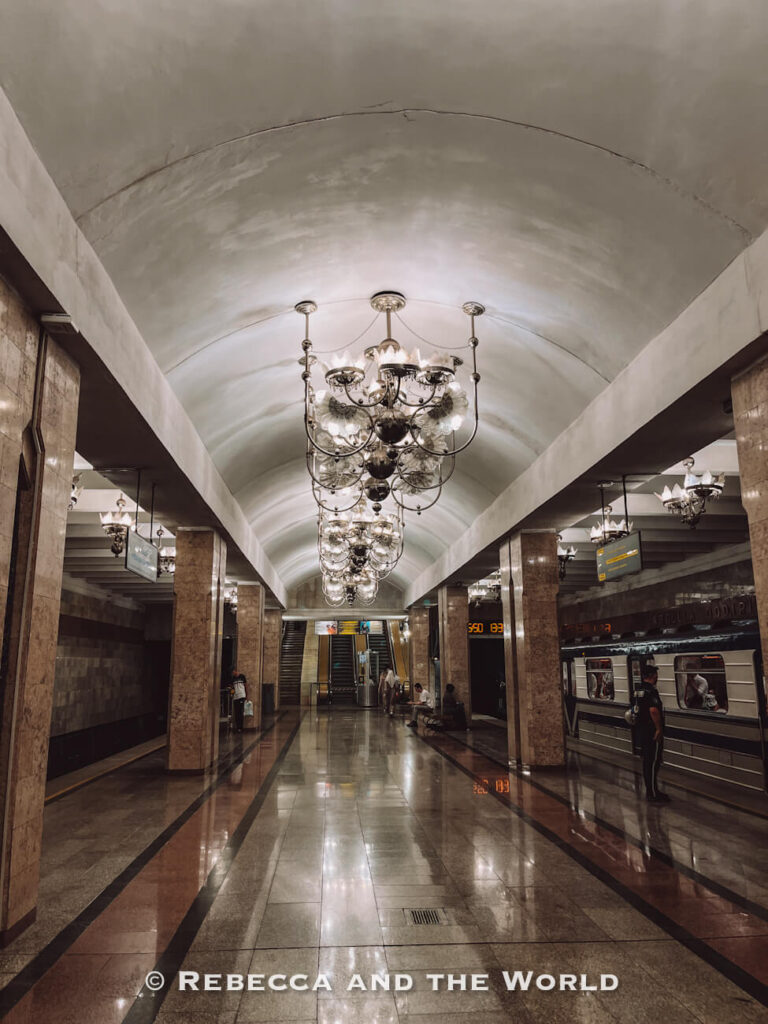
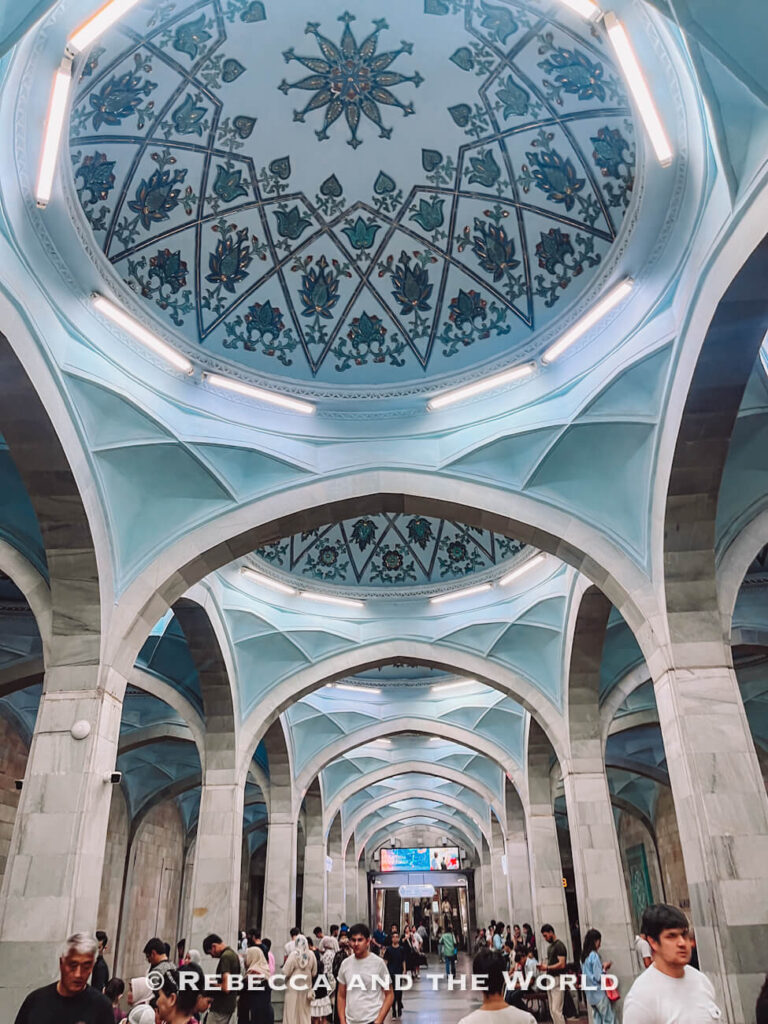
The second half of the tour is the metro – probably one of the best things to do in Tashkent. Tashkent’s metro opened in 1977 – the first underground railway in Central Asia – and its stations doubled as nuclear bomb shelters during the Cold War. There are four lines in total, two built during Soviet times and two built after independence, and photography inside the stations wasn’t even allowed until 2018 for security reasons. Luckily, you can snap away now – and you’ll want to take a lot of photos!
We started at Chorsu station and worked our way through some of the system’s best-known stops:
- Gafur Gulom (built 1991) – named for a poet known for translating Shakespeare into Uzbek, this station has a “Soviet seismic” modernist design, with big supporting columns, circular hidden ceiling lighting, turquoise granite columns and intricate ceramic murals.
- Alisher Navoi (built 1984) – named for the writer who translated literature from Farsi into Uzbek, this station has a ceiling of intricately decorated domes and murals inspired by his work.
- Paxtakor (built 1977) – meaning “cotton picker,” this station is decorated in vibrant blue and green cotton-flower mosaics that pay tribute to Uzbekistan’s (dark) cotton-picking history.
- O’zbekiston – chandeliers shaped like cotton flowers, and one of the prettiest stations on the line.
- Kosmonavtlar (built 1984) – the most famous station of them all. The walls are covered in white tiles that gradually fade to blue, meant to represent the view astronauts get of Earth from space. Paintings along the wall are of famous people like the first man and woman in space.
- Ming O’rik (built 2001) – meaning “a thousand apricots,” while this station is not as striking as the others, the square glass chandeliers are gorgeous.
- Abdulla Qodiriy – named for the writer known for fighting against the Russian Empire and reforming education.
- Bodomzor (built 2001) – meaning “almond field,” the ceiling is decorated in ceramic almond and almond-flower designs, and there are geometric patterns and nature-influenced lighting.
One thing you should know is that people on the metro, especially older women (!!), can be surprisingly pushy – expect to have people push their way onto the train before you’ve had a chance to get off, or roughly shouldered on your way out!
Plov: Uzbekistan’s national dish
The tour finishes with Uzbekistan’s national dish, plov. We tried three different types of plov at Besh Qozon, Tashkent’s famous plov centre (there are two in Tashkent, one next to Chorsu Bazaar and another in the north-east of the city – we went to the latter).
We ate: Tashkent plov (also called wedding plov), made with beef, sunflower seed oil and raisins and topped with a slice of horse meat; Fergana-style plov, made with sheep’s fat, usually lamb, and easily the deepest in flavour of the three (this was my favourite!); and a more Persian-style layered Samarkand plov, made with linseed oil, beef and yellow carrots.
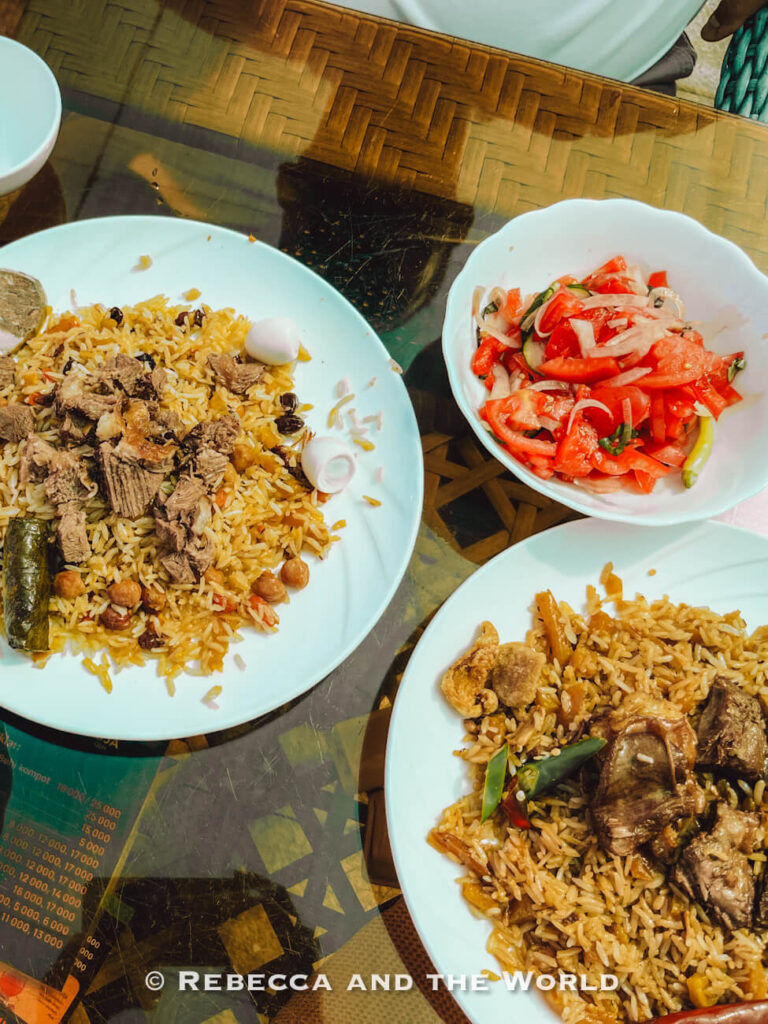
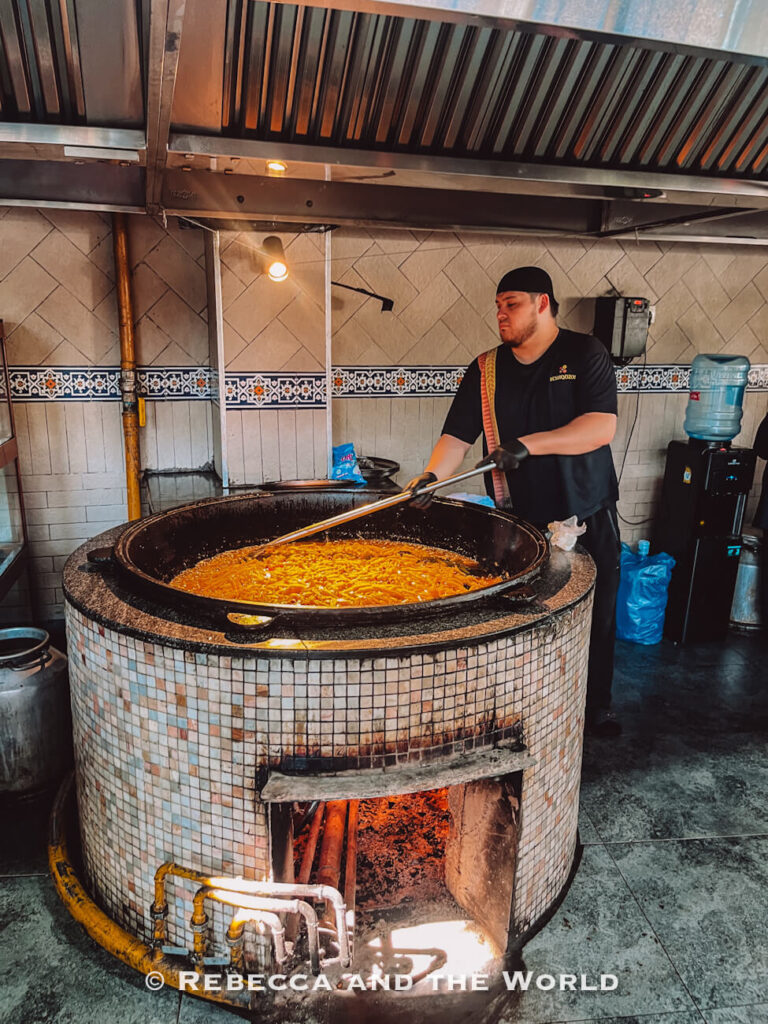
As I learned from Yusuf, if you want to eat plov like a local, the rice should be fluffy and the oil rich enough that it drips down your arm to your elbow. And it’s eaten with your hands or a spoon – NEVER with a fork!
It’s a fitting way to end four hours of eating and exploring – piles of plov cooking away in huge cauldrons, and a proper sit-down lunch after a morning spent snacking your way around the market.
🍉 BOOK CRAFT N CULTURE’S FOOD AND METRO TOUR HERE 🍉
Midday: Tashkent TV Tower and the Memorial to the Victims of Repression
After the tour wraps up, you’re right near Tashkent TV Tower, a Soviet-era landmark and one of the tallest structures in Central Asia. Yusuf told me that most former Soviet cities got a TV tower or a metro – but Tashkent got both. Snap some photos and move on to the park surrounding the Memorial to the Victims of Repression.
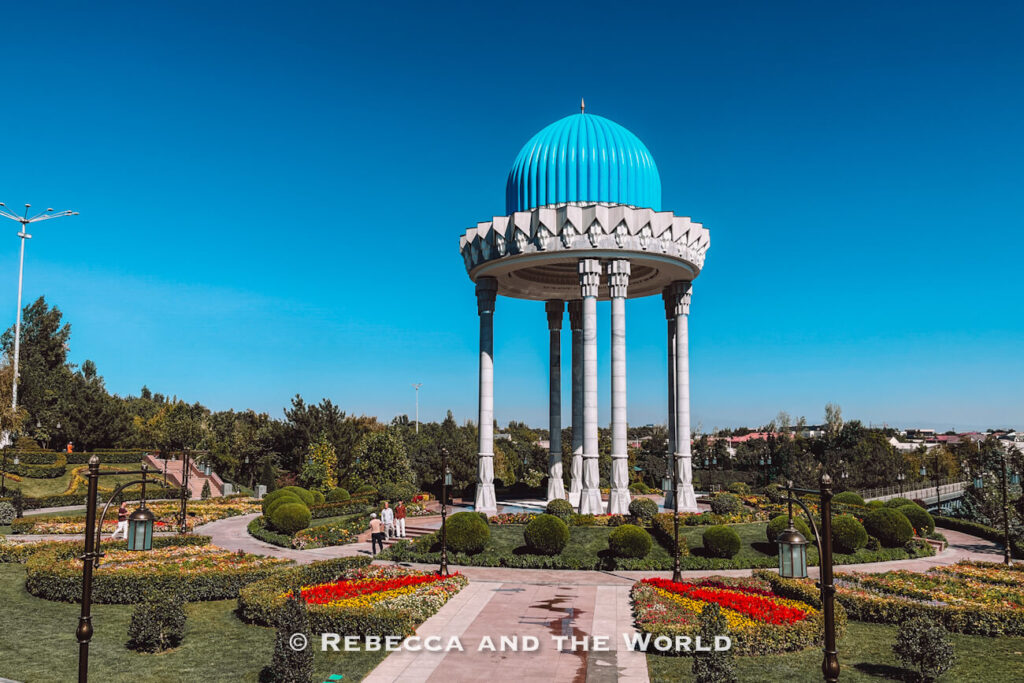
The museum here was established in 2002 to honour those killed during political repression stretching from the Russian colonial period in the 1860s through Stalin’s regime and the “Cotton Case” prosecutions of the late 1980s. Inside you’ll find photographs, documents and personal belongings of victims, scale models of concentration camps and prisons, and a preserved prison van used to transport people.
It’s a sobering stop after the lightness of the morning’s food tour, but an important one – almost everyone I met in Uzbekistan seemed to have had a family member sent to the Gulag or executed during this period, and this is one of the few places that reckons with it directly.
Afternoon: State Museum of Applied Arts
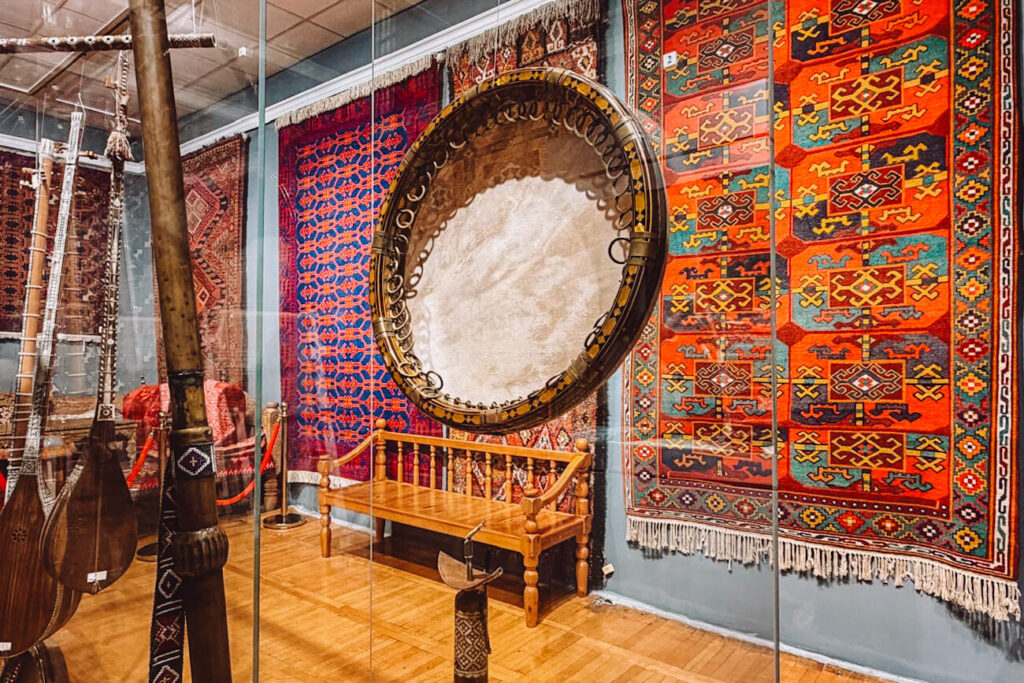
Spend your afternoon at the State Museum of Applied Arts, which is worth visiting for the building alone. It occupies the former palace of a Russian diplomat, built in the late 19th century, whose interiors were later redone in an elaborate Oriental style by local artisans after the diplomat fled the country in 1918.
It’s had several lives since – housing Austrian officers during the First World War, functioning as an orphanage after the Revolution – before becoming the Handicraft Museum in 1937, the forerunner of the museum you’ll walk through today.
Inside are more than 4,000 exhibits covering Uzbek decorative art: wood carving, ceramics, jewellery, gold weaving, embroidery and embossing. It’s a manageable size, so you won’t need more than an hour or two.
Evening: Dinner and Magic City
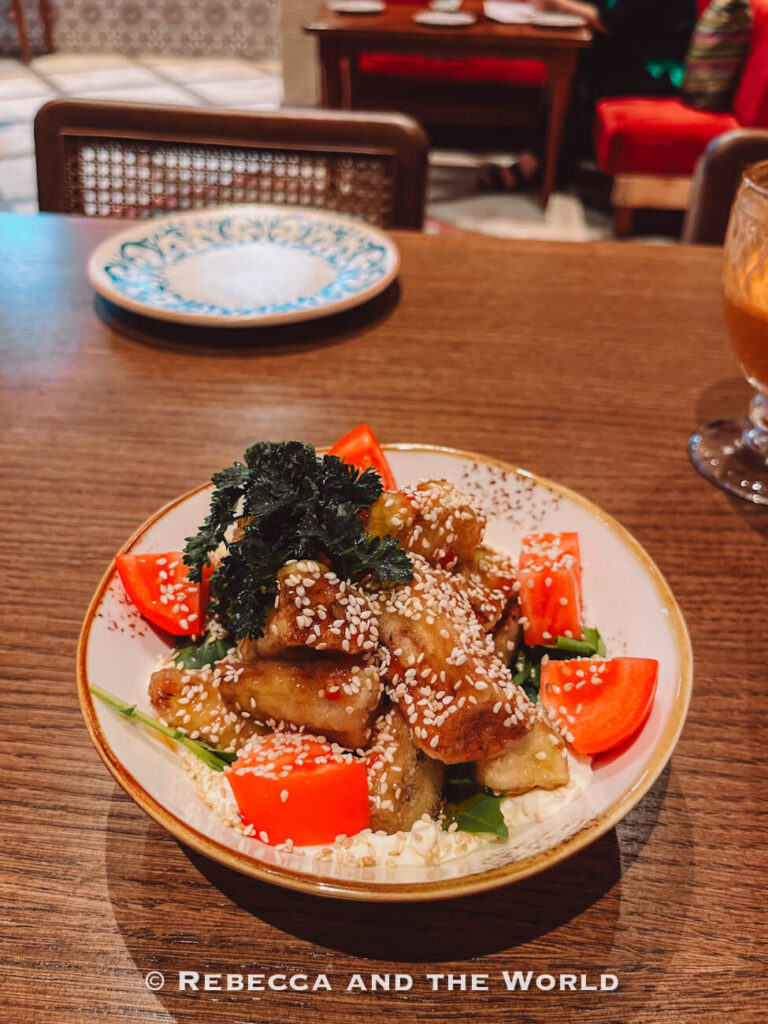
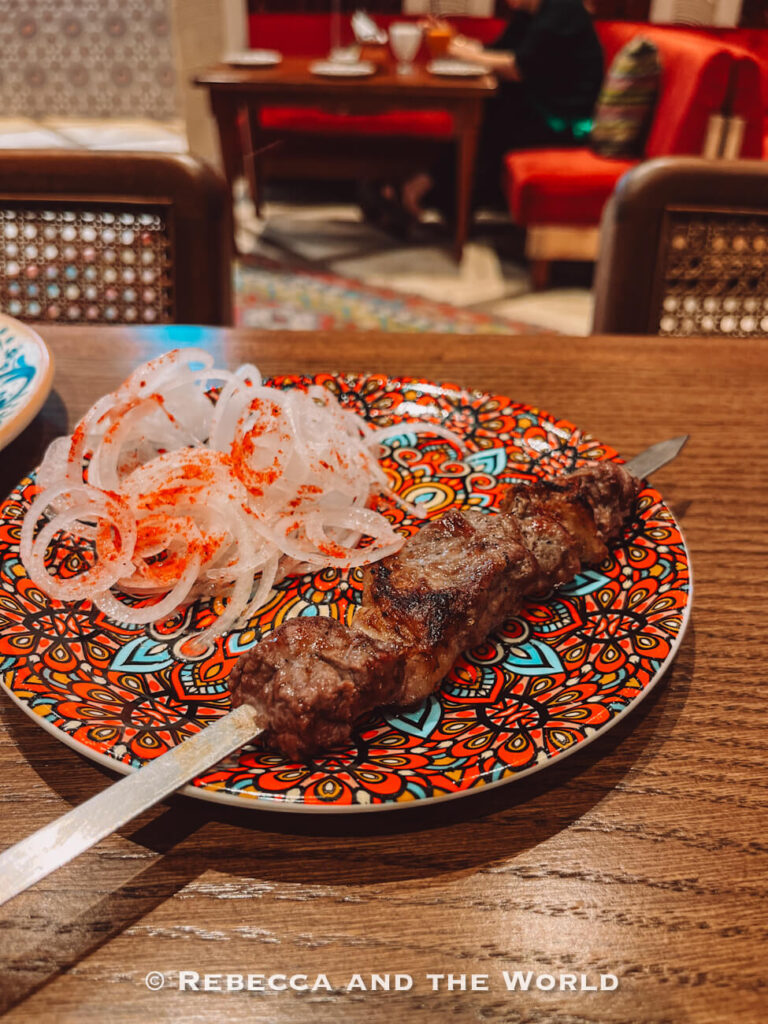
Hopefully you’re not still full from the day’s eating! For dinner, I loved the food at Boboy, an Uzbek eatery with a couple of outlets around the city. The menu is classic Uzbek dishes like samsa with a hot broth filling, fried lagman loaded with beef and vegetables, manta dumplings and lamb barbecue. My own dinner there included a more-ish tempura eggplant salad with sesame seeds, tomato and a labneh-style yoghurt base, plus a lamb kebab and a piece of bread so large it could have been a meal on its own.
Alternatively, Afsona, is another well-regarded spot in the city. This stylish, contemporary restaurant puts a spin on traditional Uzbek dishes and there’s an open kitchen so you can watch the staff at work. Order the pumpkin manti (dumplings), plov, samsa and hanim (the “Uzbek lasagne” dish I ate at the bazaar), and there are good vegetarian options, too.
→ READ NEXT: The best foods to try in Uzbekistan (COMING SOON)
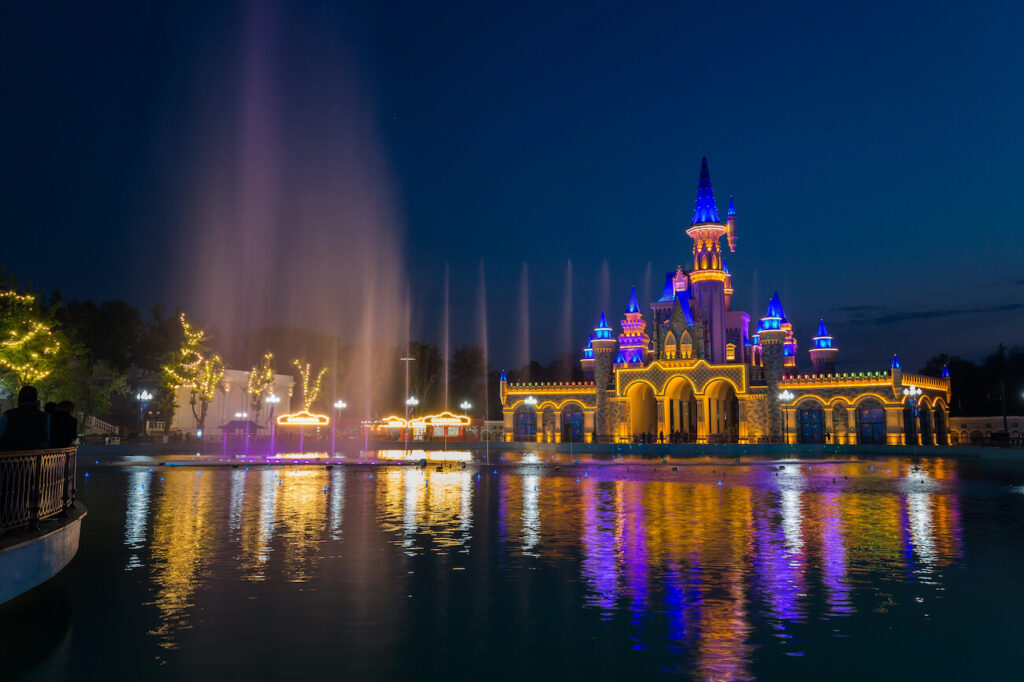
After eating, head to Magic City for cheesy fun. It’s a big, brightly lit amusement park that really comes alive after sunset, with an illuminated castle, a lake with light and fountain shows, rides, food stalls and cafes. Entry is free and you simply pay for the rides you want to go on. I didn’t go here on my trip, but it looks like a fun thing to do in Tashkent – it’s very much a family and local hangout. Friends of mine had a fun time there, riding all the rides and participating in a pancake eating competition!
Day 2 of the Tashkent itinerary
Morning: Islamic Civilisation Centre and Hazrati Imam Complex
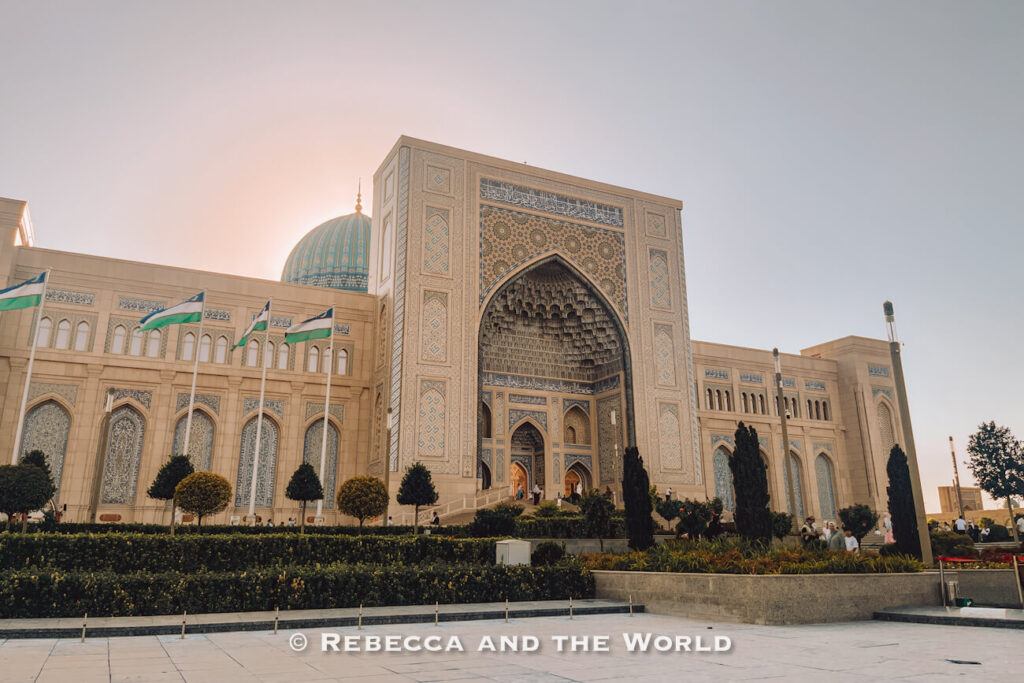
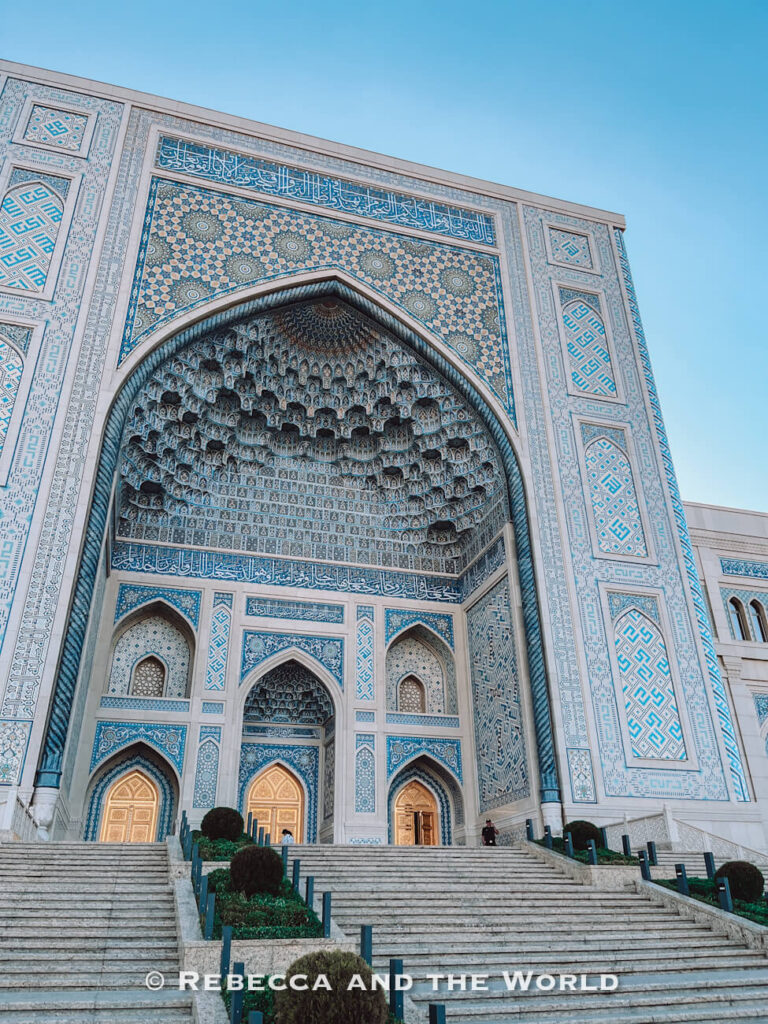
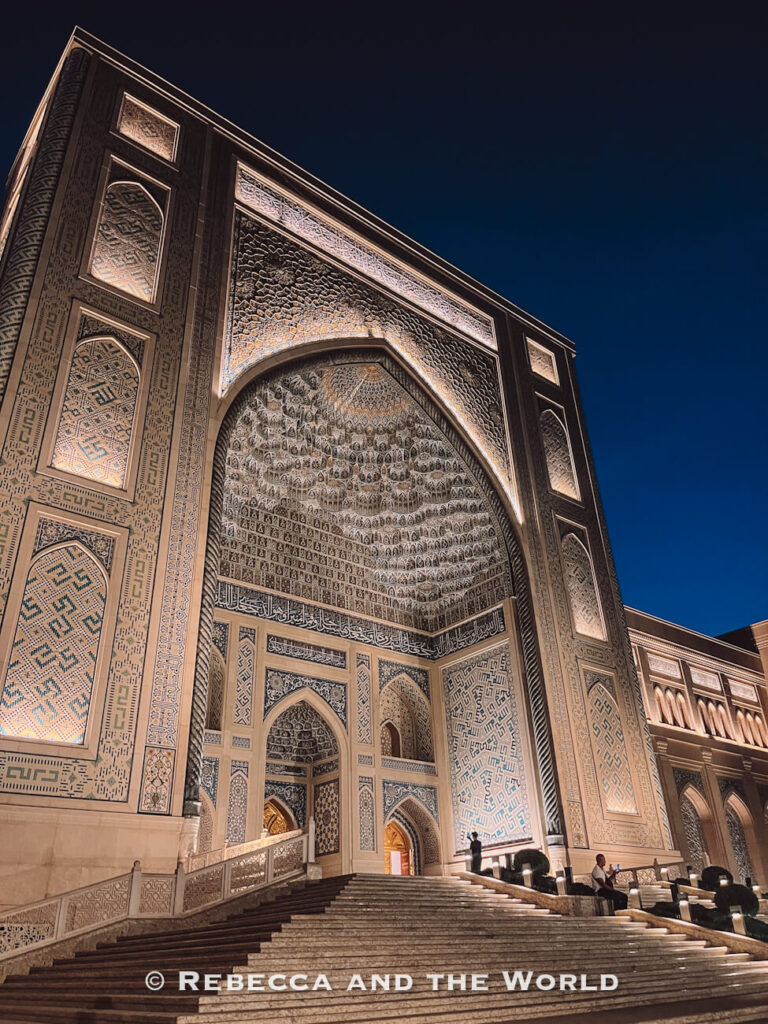
Start your second day at the Islamic Civilisation Centre, the largest complex in the world dedicated to Islamic research and one of the most interesting museums in Tashkent.
Buy your ticket then wait for the next English-language tour – they run throughout the day whenever a group is ready, so turning up on or near the hour or half hour should be enough to catch one. Expect the tour to run about two hours; if you need to leave early, just let your guide know. Strangely, you’re handed an earpiece, so the tour is a mix of recorded narration with live commentary from the guide, which I’ve never experienced before.
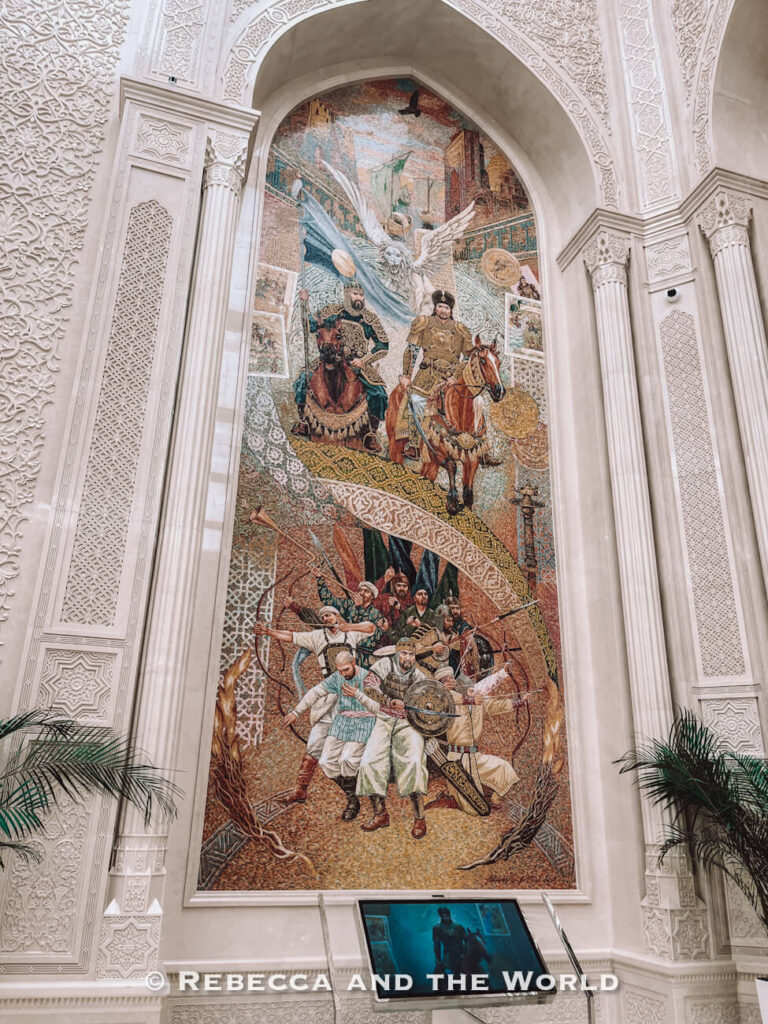
The tour starts in the Hall of Glory, an enormous space lined with 14 towering mosaic panels (each took six months to complete), each depicting a well-known historical figure. A touch screen beneath each one has more information and video.
From there, the exhibits move roughly chronologically, from pre-Islamic history and the Silk Road to the Timurid Renaissance. The museum leans heavily into high-tech presentation, with touch screens, music and AI versions of historical figures (including Ulugbek, the famous astronomer) that you can “ask questions” of. It’s good fun for kids, too.
The highlight, saved for the end, is the Hall of Quran (a stunningly decorated space), believed to hold the oldest Quran in the world alongside 114 other holy Qurans from different periods.
You need to cover up to enter the Hall of Quran, but there are robes and head coverings at the entrance if you forget. Either way, wear respectful clothing.
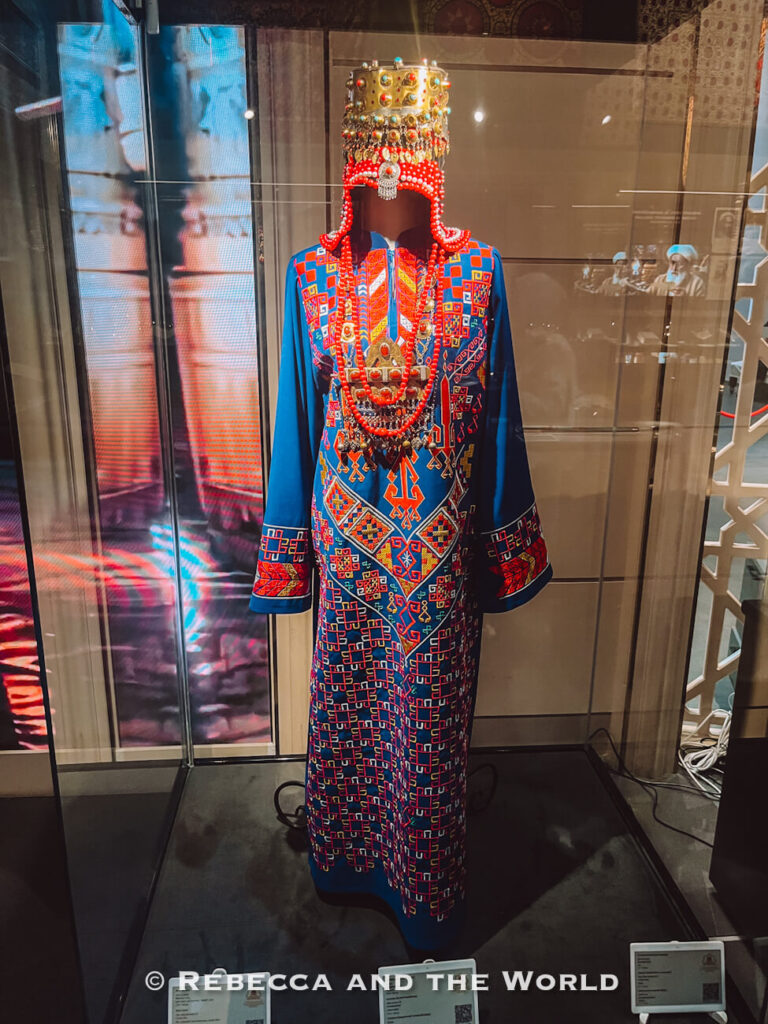
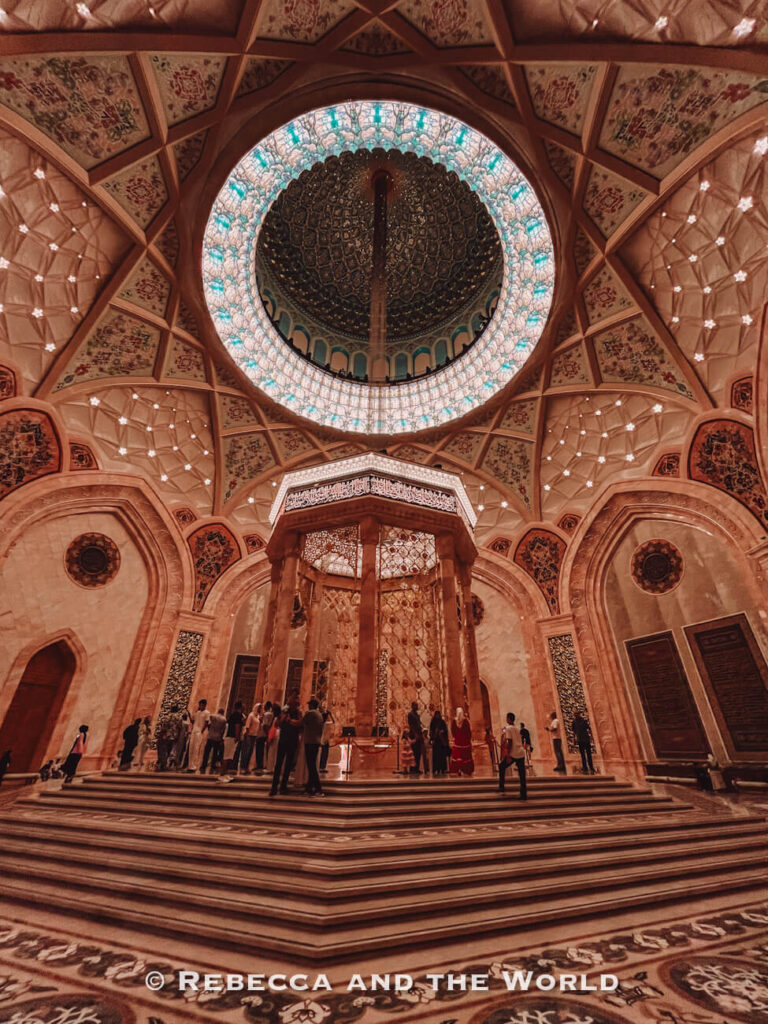
If you have time, extend the morning into the Hazrati Imam Complex next door in Khast Imam Square, the religious heart of Tashkent’s Old City that dates back to the 16th century. It was heavily restored in 2007, which takes a little of the atmosphere away, but it’s still an impressive complex of mosques, mausoleums and madrasahs covered in intricate geometric decoration.
Its biggest drawcard is the Uthman Quran, a roughly 1,300-year-old manuscript. It’s said to have belonged to Caliph Uthman, the third successor to the Prophet Muhammad. Women will need a headscarf to visit.
Midday: Minor Mosque and Minor Somsa
From here, make your way to the Minor Mosque, on the bank of the Ankhor River. It’s a relatively new addition to Tashkent’s skyline, opened in 2014, but it’s become one of the city’s must-see sights despite (or maybe because of?) being so modern. The whole structure is covered in white marble, which on a sunny day makes it glow, and it holds more than 2,500 worshippers inside a hall decorated with Quranic quotations and a gold marker pointing towards Mecca.
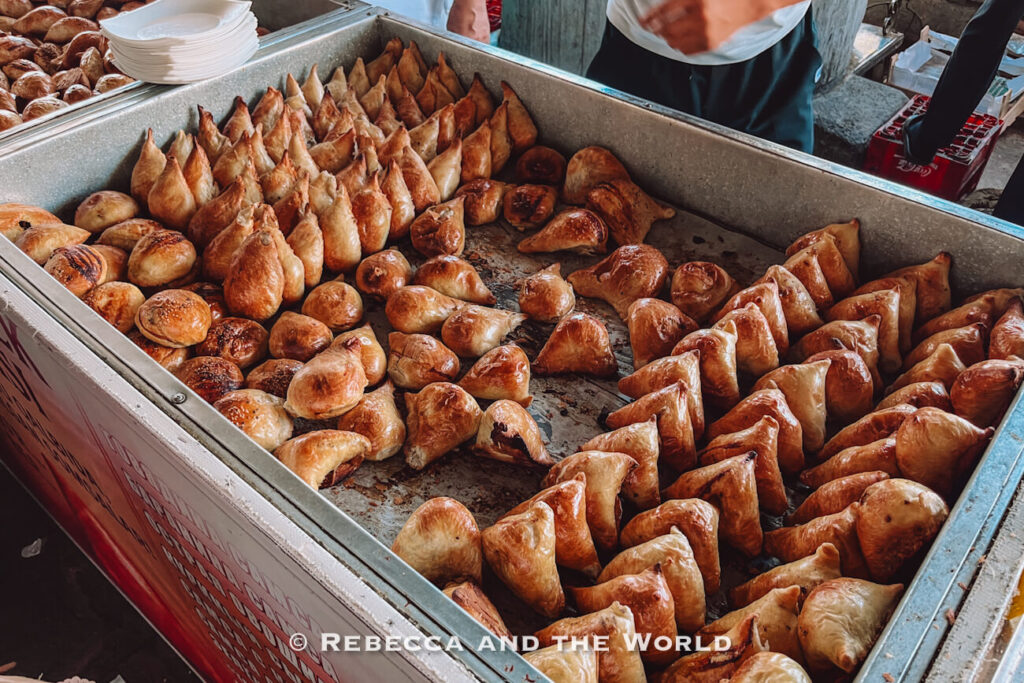
Right nearby is Minor Somsa, considered by plenty of locals to be the best samsa spot in the city. Its most famous dish is the beef samsa, baked in a traditional tandoor, with crispy, thin pastry wrapped around a generous amount of juicy meat. Make this your lunch spot.
Afternoon: Sharaf Rashidov Avenue, monuments and the history museum
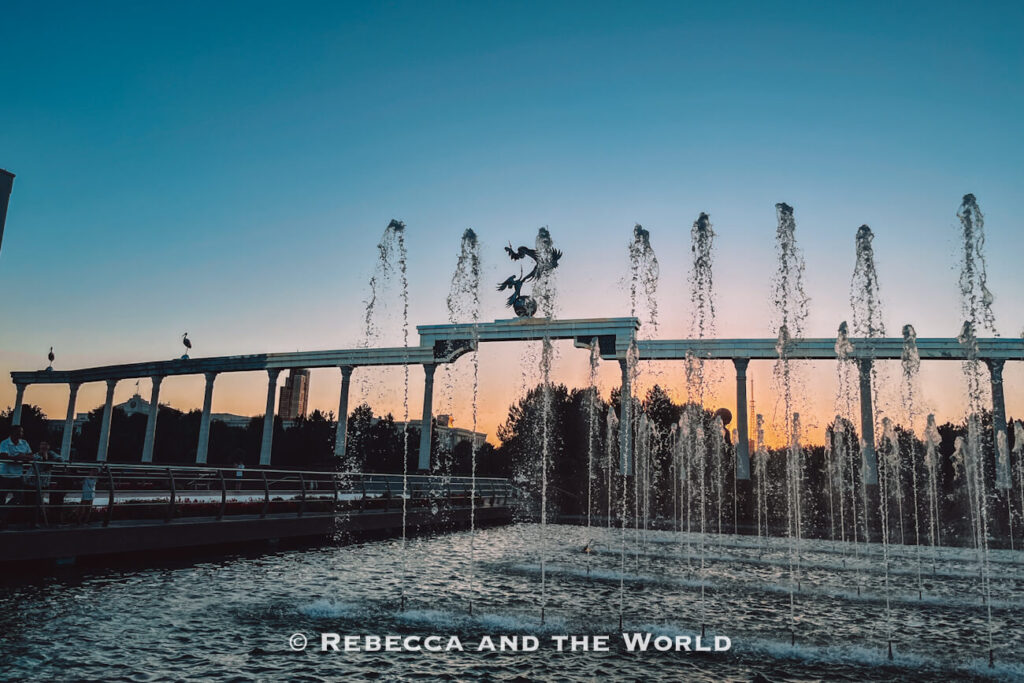
Spend the afternoon working your way along Sharaf Rashidov Avenue towards Mustaqillik Maydoni (Independence Square), Tashkent’s central square and one of its most monument-dense stretches.
The square was renamed in 1992 after Uzbekistan declared independence, replacing what had been Lenin Square (the Soviet leader’s monument was removed).
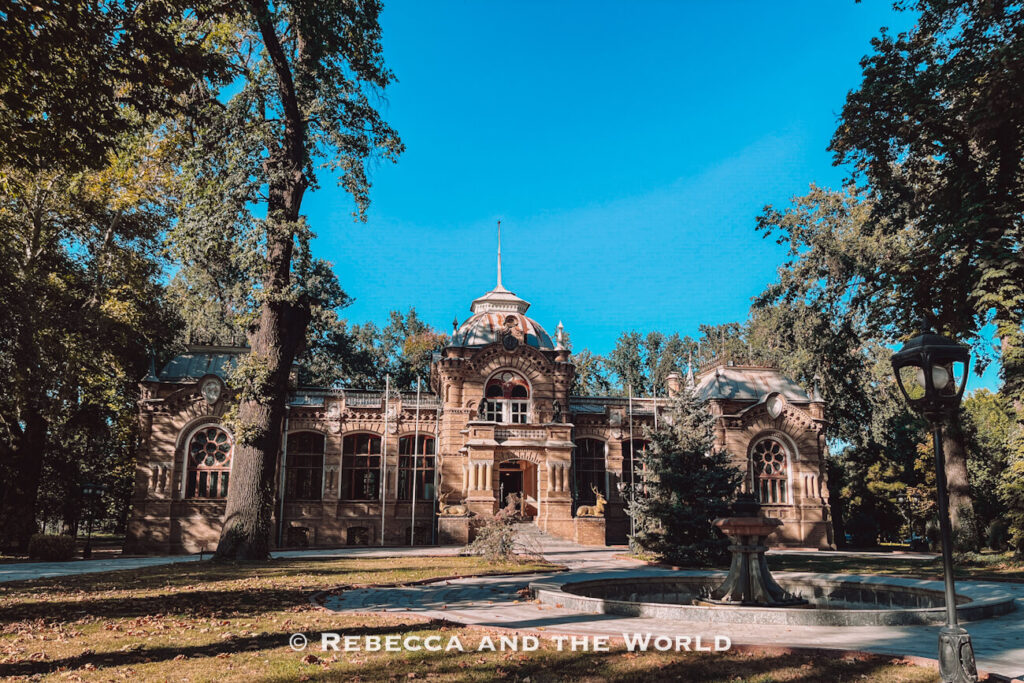
Cross the road to peek through the fence at the Palace of Grand Duke Nicholas Constantinovich (also called Romanov Palace). This 19th century building is unfortunately closed to visitors, but it’s still worth a look from outside.
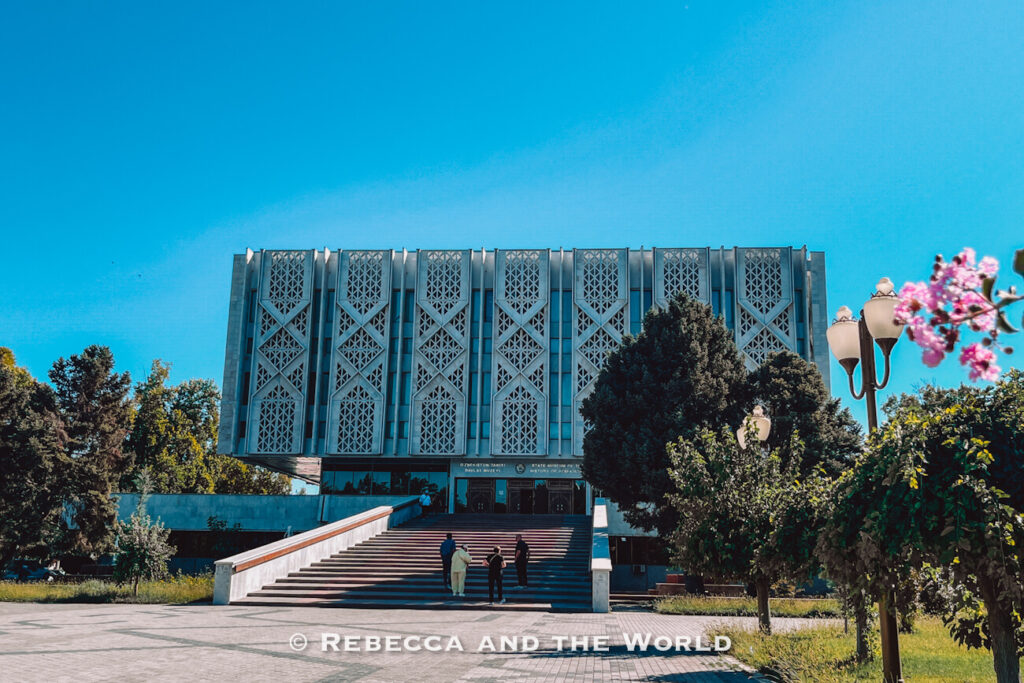
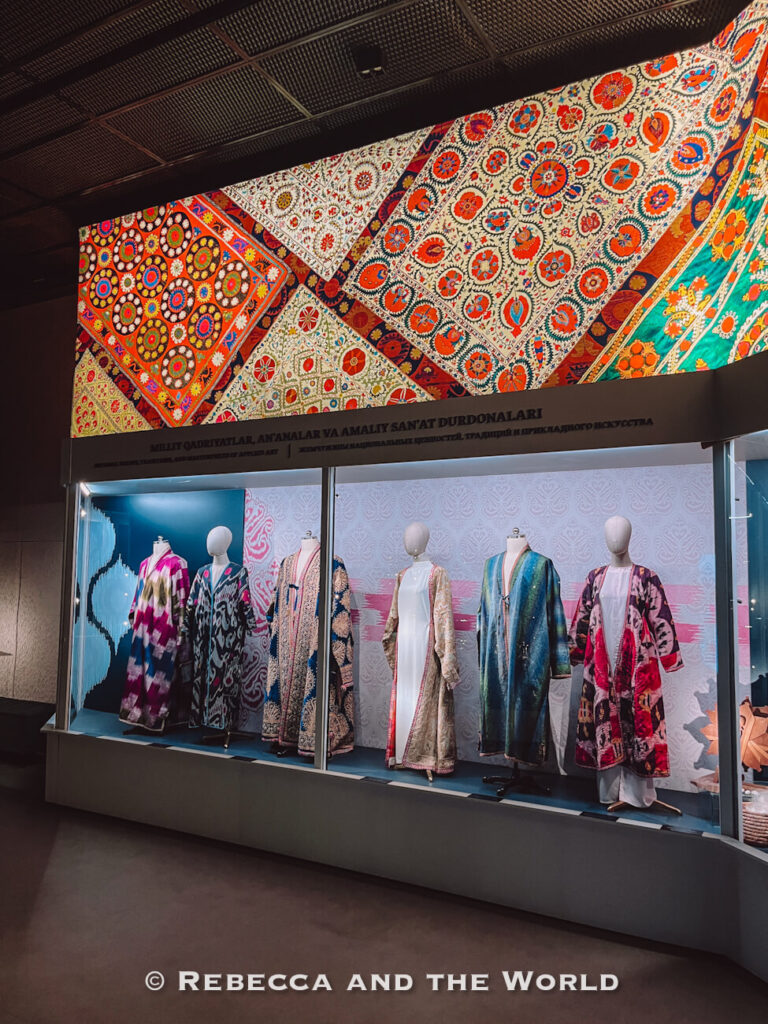
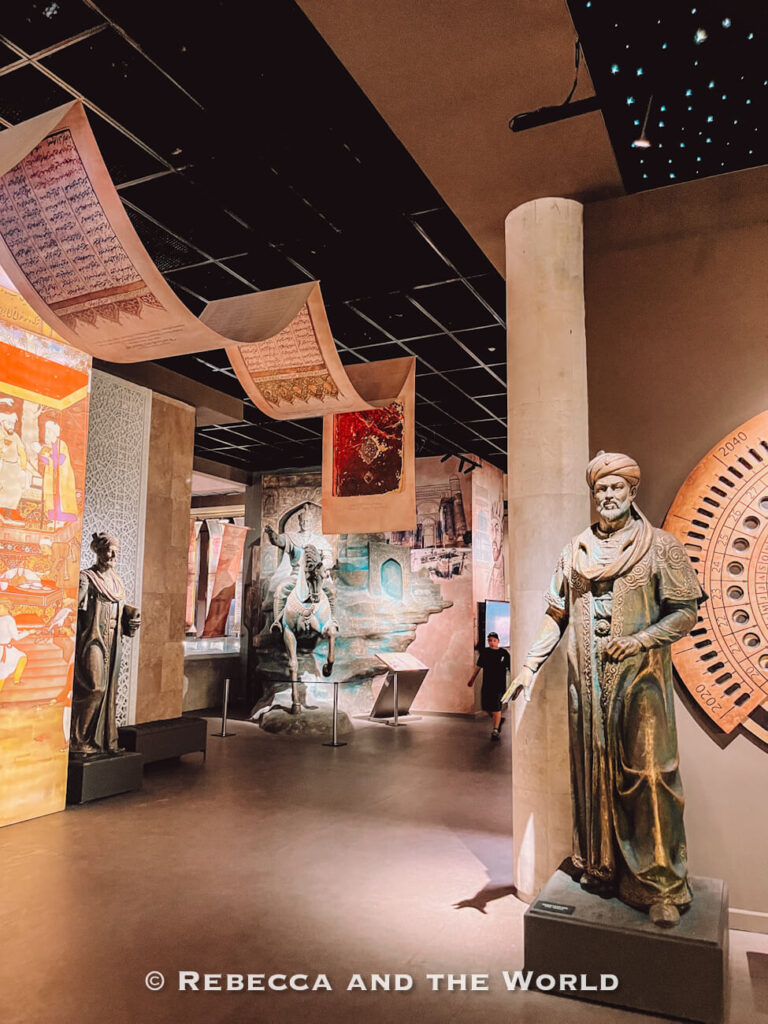
From here, it’s a short walk to the State Museum of the History of Uzbekistan. Spread across two floors, it covers everything from the Stone and Bronze Ages through the spread of Buddhism and Islam, the “first Eastern Renaissance” of the 8th to 12th centuries, and important historical Uzbek figures including the mathematicians al-Khwarizmi and Ahmad al-Farghani.
The museum only reopened in 2026 after renovation, and it’s one of the best things to do in Tashkent to learn about history and culture. There’s some overlap with what you’ll have already seen at the Islamic Civilisation Centre, but this museum has a broader scope, including an exhibit on the Russian Empire period that – according to my guides from the Craft n Culture tour – is surprisingly candid about the atrocities of the Soviet era rather than only the achievements, plus a small exhibition on the Aral Sea that squarely blames Soviet cotton policy for its collapse, and a large closing section on independence.
If you’re museumed out by this point in the day, though, don’t feel obliged to go in – the building itself is worth a look from outside, and I wouldn’t blame you for skipping another two hours indoors after the morning you’ve had!
Evening: Amir Timur, rooftop drinks and Sayilgoh Street
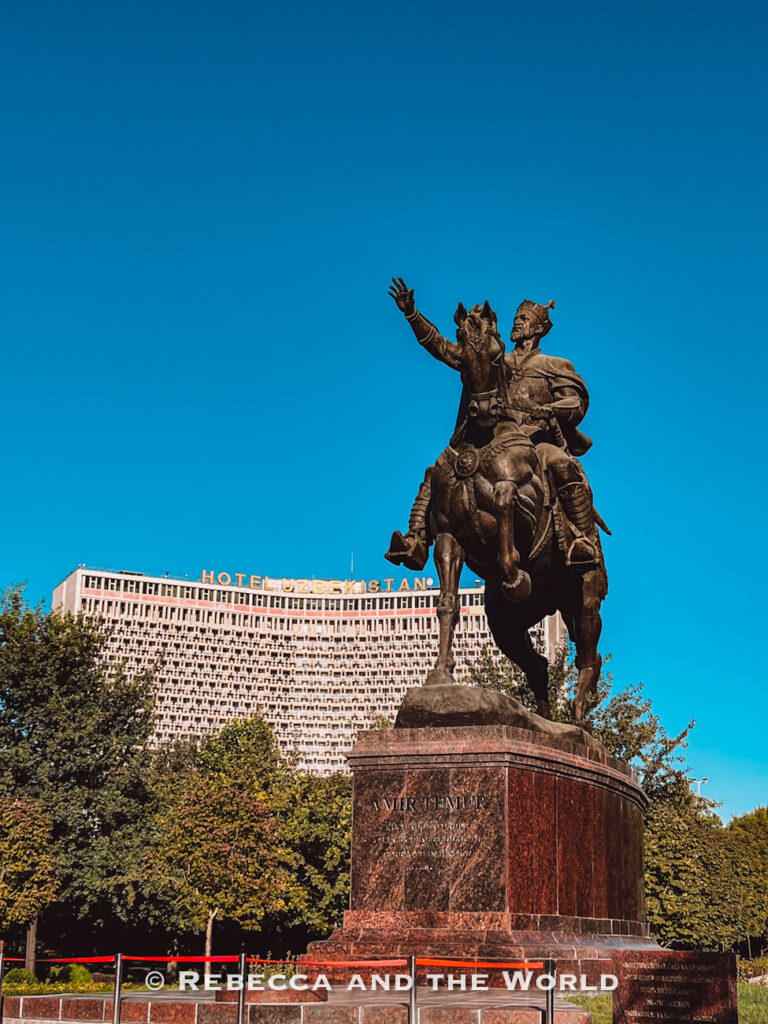
Walk to the Amir Timur Statue and Square, a popular spot for an evening stroll. There are always photographers here who’ll offer to take your photo for a fee – I overheard one quoting around 10,000 som.
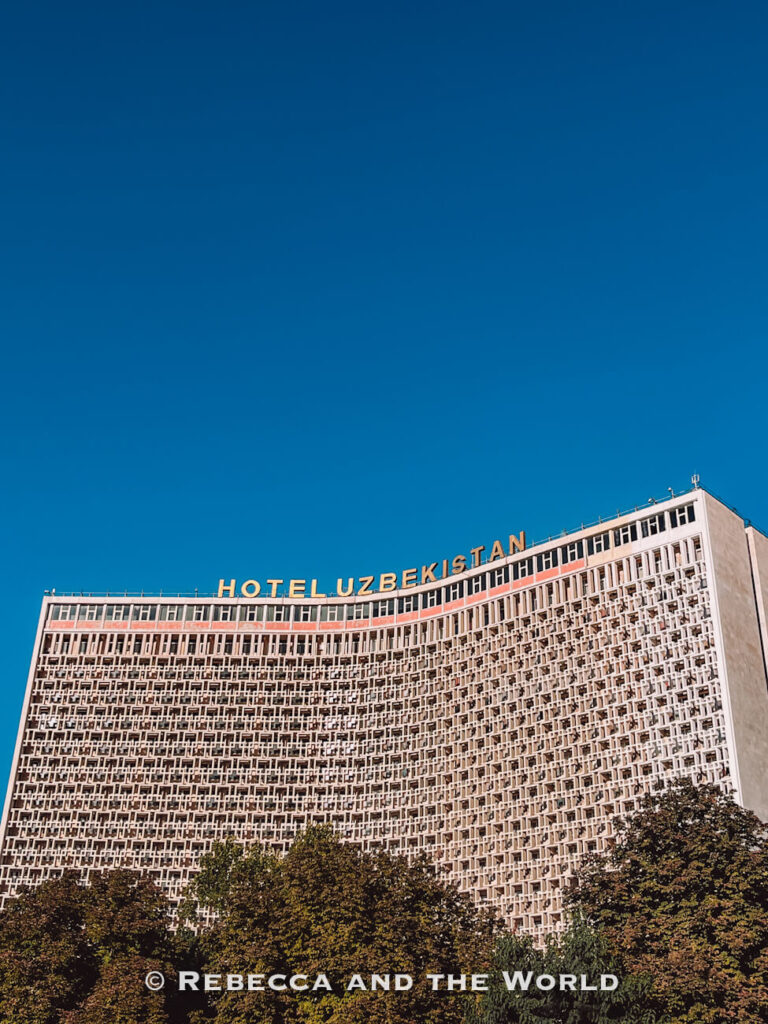
From there, head to Hotel Uzbekistan, an unmissable, almost brutalist Soviet-era building that’s worth stopping to photograph even if you’re not staying there. Head up to the rooftop bar for a drink as the sun goes down – it’s one of the better perches in the city for watching Tashkent shift from day to night.
Finish the evening with a wander down Sayilgoh Street, a pedestrian strip that comes alive after dark. You can rent electric cars or buggies for kids to drive around, street artists will offer to draw your portrait, and there are plenty of small fast-food-style spots if you want a casual bite, plus table tennis tables, families out strolling and fairy lights strung overhead.
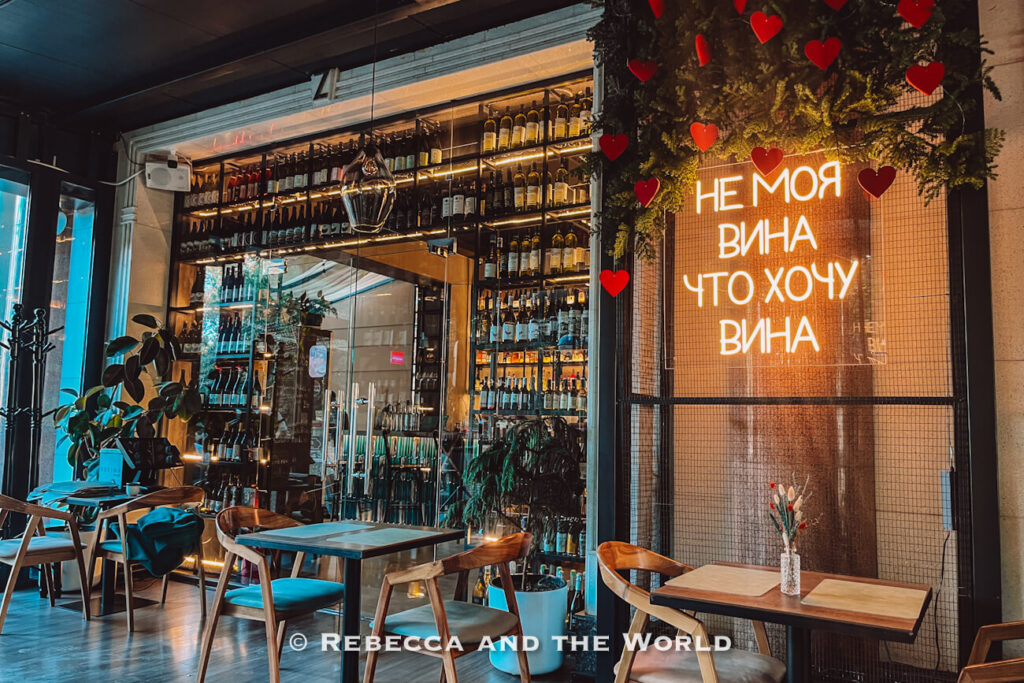
For something a little nicer to finish the trip, duck into Just Wine Bar & Store on or near the street for a glass of local wine – I had a local Riesling (delicious!) and a tomato and burrata salad. A delightful way to end two days in Tashkent!
→ READ NEXT: How much does it cost to visit Uzbekistan? (COMING SOON)
Where to stay in Tashkent
Tashkent is a sprawling city, and these three areas stand out to me as good neighbourhoods to base yourself in.
The Old Town
Near Chorsu Bazaar and the Hazrati Imam Complex, this area has a quieter, more traditional atmosphere and easy access to the sights that open this itinerary. It also tends to be cheaper for the quality of hotel you get.
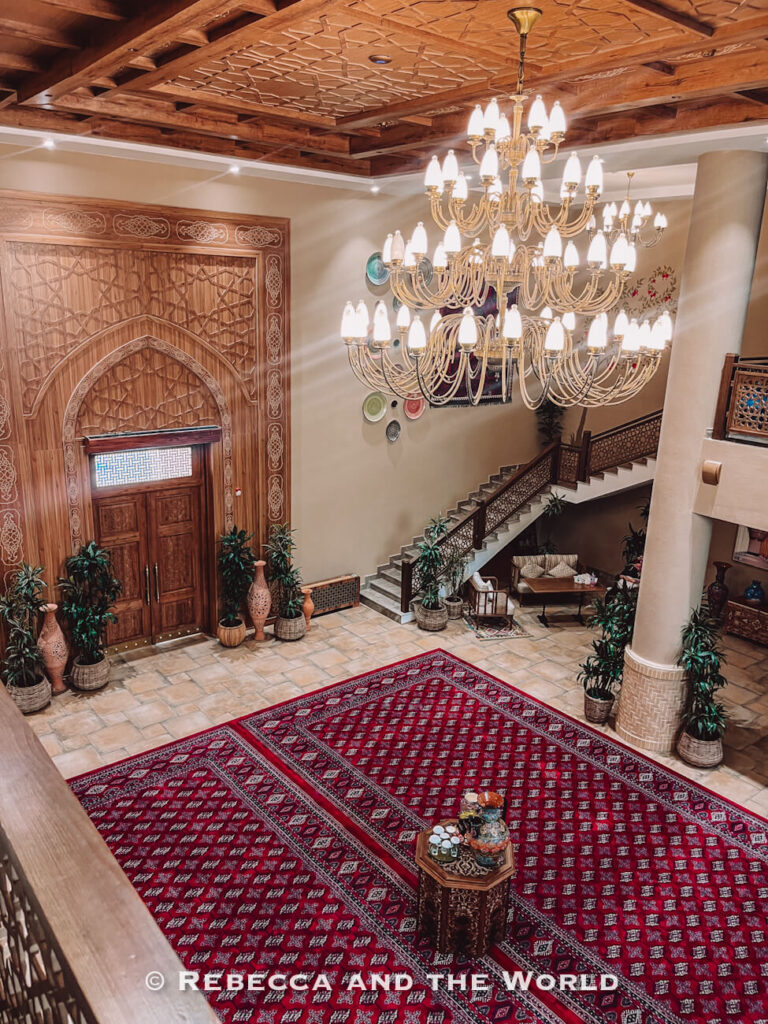
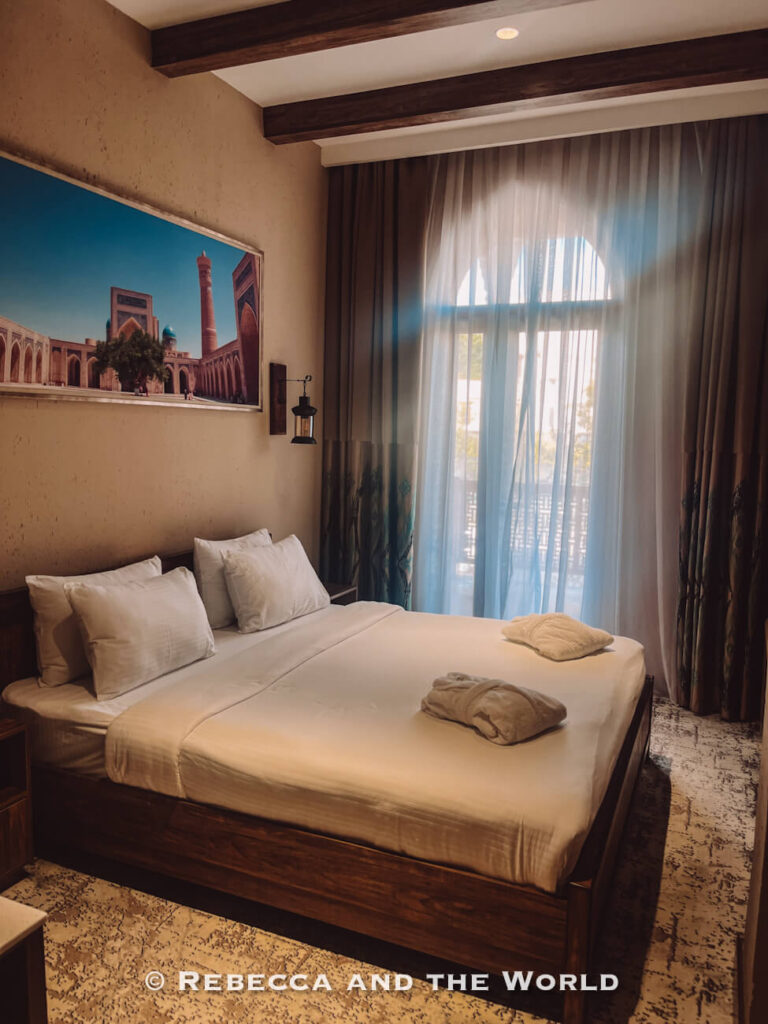
- Faravon Boutique Hotel – this is where I stayed. It’s a relatively new property within walking distance of Chorsu Bazaar, the Hazrati Imam Complex and the Islamic Civilisation Centre, with small, thoughtfully designed rooms (some with their own terraces), traditional Uzbek design touches throughout, and a fantastic buffet breakfast. I thought this was excellent value. | Check rates on Booking.com or Expedia
- Hotel Inspira-S Tashkent – a modern hotel with spacious rooms, a gym and pool. There’s an onsite restaurant that serves an excellent breakfast. | Check rates on Booking.com or Expedia
Amir Timur Square and Tashkent City
This area is central and has a relaxed feel despite being right in the middle of things, with plenty of cafes and restaurants within walking distance.
- Holiday Inn Tashkent City – I stayed here on my return trip to Tashkent and it’s a dependable choice. My room was huge and the restaurant’s buffet breakfast was outstanding. It’s inside the Tashkent City development, just a couple of minutes’ walk from Tashkent City Park, with an indoor heated pool, sauna and hammam. | Check rates on Booking.com or Expedia
- Hyatt Regency Tashkent – a step up if you want to spend a bit more, with spacious rooms, spa services and an excellent breakfast. | Check rates on Booking.com or Expedia
Mirabad District
If you’re after nightlife and value for money, the Mirabad District has trendy bars and restaurants along Taras Shevchenko Street and generally the best rates in the city for what you get. It’s also closer to the train station (for continuing on to the Silk Road cities by rail).
- Manor Hotel – a hotel on Taras Shevchenko Street itself, with an indoor pool, spa, sauna and a good breakfast, at a budget-friendly price point. | Check rates on Booking.com or Expedia
- Moderno Hotel & Spa – a step up from the budget options, near the trendy bars and restaurants. The hotel has an indoor pool, gym, sauna and a hugely popular buffet breakfast. It’s sometimes only available for a minimum two-night stay, so check this before booking. | Check rates on Booking.com or Expedia
→ READ NEXT: What to know before you visit Uzbekistan (COMING SOON)
Practical tips for visiting Tashkent
Best time to visit Tashkent
September and October are considered the best months, with warm days, clear skies and none of the brutal heat of summer. April and May are a close second, with comfortable temperatures and blooming parks.
I visited in August, which meant very hot days (expect mid-30s°C), but I didn’t find it stiflingly hot – and there are several indoor activities in this Tashkent itinerary that you can plan around.
What to wear in Tashkent
Pack light, breathable clothing for the heat, but bring something that covers your shoulders and knees for visits to mosques and religious sites (women will need a headscarf for places like Hazrati Imam Complex). Comfortable walking shoes are a must – you’ll cover a lot of ground on foot and via the metro.
→ READ NEXT: The ultimate Uzbekistan packing list (COMING SOON)
Is Tashkent safe?
Tashkent is about as safe as capital cities get. I visited as a solo female traveller and – other than the Craft n Culture tour – was by myself the entire time. I felt completely comfortable walking around on my own, including at night, and violent crime is close to unheard of. The main thing to watch for is pickpocketing in crowded spots like the metro and Chorsu Bazaar, so keep valuables secure and be a little more alert than usual in a crush of people.
→ READ NEXT: Is Uzbekistan safe to visit? (COMING SOON)
Learn some history ahead of time
I’ll admit that I knew very little about Central Asia before I took this trip, so two excellent books I read beforehand were Sovietistan and Unravelling the Silk Road. Both are written in an engaging narrative, travelogue style, and both were fascinating deep dives into the history of Uzbekistan (and other Central Asian countries).
Tashkent itinerary: Final thoughts
Two days in Tashkent is a great amount of time to see the highlights (although I could easily spend more time here!). This is a city with a fascinating history and great food, and it’s a lot more visually interesting than its reputation suggests. If you’re passing through on your way to the rest of Uzbekistan, don’t just treat it as a layover. Give it a full day two days (at least) to discover.
FAQs: Visiting Tashkent
Is two days in Tashkent enough time?
Yes, for most travellers. Two days is enough to cover the highlights I’ve outlined in this itinerary – Chorsu Bazaar, the metro stations, the major museums, Hazrati Imam Complex – without feeling rushed. If architecture and museums are a particular interest, you could easily stretch it to three days.
Is Tashkent worth visiting?
Yes, I was really surprised by Tashkent! It’s such an interesting mix of modern architecture, historical buildings and embedded culture. Two days is a great amount of time to visit, but you could easily spend more time here.
Do I need a visa to visit Uzbekistan?
Visa requirements vary by nationality and do change, so check the current rules for your passport well before you travel.
Is Tashkent safe for tourists?
Yes. It’s widely considered one of the safer capital cities in the region, with violent crime close to unheard of. The usual precautions around pickpocketing in crowded areas like markets and the metro still apply.
Is Tashkent walkable?
Central areas are walkable, but the city is spread out overall, so you’ll want to combine walking with the metro and Yandex Go for anything further afield.
Is tap water safe to drink in Tashkent?
I stuck to bottled water throughout my trip, which is the safer and more common approach for visitors.
Did you find this article helpful? Consider buying me a coffee as a way to say thanks!
Now you know how to spend two days in Tashkent, when are you planning a trip there? Let me know in the comments below!
Read next
Before you go, you might like these travel articles:
- Is the Craft n Culture Tashkent Food and Metro Tour Worth It? (COMING SOON)
- The Ultimate Uzbekistan Itinerary (COMING SOON)
- How to Spend 2 Days in Samarkand (COMING SOON)
- How to Spend 2 Days in Bukhara (COMING SOON)
- The Best Things to Do in Khiva (COMING SOON)
BOOKING A TRIP SOON? HERE ARE SOME HELPFUL LINKS
- Book your flight online with Skyscanner – it’s where I always start my flight research. (I then book directly with the airline.)
- One thing I always purchase is travel insurance. Travel Insurance Master allows you to compare across multiple policy providers, while SafetyWing is great for long-term travellers and digital nomads.
- Wise is my choice for sending and receiving money and spending money overseas (you can get a digital and physical card).
- Find a great hotel on Booking.com.
- How to get around? I use DiscoverCars for car hire, or Motorhome Republic and Jucy for campervan/RV rental. For buses, trains and ferries, I use 12GO, Busbud and Omio.
- Grab an e-sim to stay connected while on the road.
- Check out the huge range of day tours throughout major cities and countries on GetYourGuide, Klook or Viator. I’m always a fan of a good food tour!
- Saving money? Check out the huge range of free walking tours on GuruWalk (don’t forget to tip!).
- Stuff I always pack? A reusable water bottle, packing cubes and a handy electronics organiser. Check out my Amazon shop for all my fave travel items – everything from backpacks and suitcases to travel adapters and beauty products.
PIN IT FOR LATER: 2 DAYS IN TASHKENT ITINERARY
Save this 2 days in Tashkent itinerary to Pinterest so you can plan your trip later.